
Past Breaking Downs:
- What is the Michigan system?
- How Jared Cunningham defended John Jenkins
- The breakdowns in the Pitt defense
NEW YORK - I am a believer in advanced statistics. But I'm not a 'stat geek'.
There is a difference.
I don't think that numbers can tell you the whole story. Yes, using the stats generated by Ken Pomeroy or Synergy Systems can be extremely enlightening, their value is diminished incredibly when they aren't taken in context with what actually happens on the court. For example, using Kenpom's efficiency numbers, Drew Wiley from Boise State and Tyrus McGee from Iowa State are the two most effective players in the country, but you are a truly dedicated hoop head if you know who those two kids are.
Another example? Missouri's Ricardo Ratliffe. He's the most efficient high-major post player in the country, sitting above the likes of Jared Sullinger, Thomas Robinson and Anthony Davis. But I don't think he would be one of the top 15 big men selected if we were to do a draft. What makes him so efficient is that he shoots a ridiculous 77.3% from the field (he's made 30 of his last 32 attempts), but if you watch Missouri play, the majority of Ratliffe's buckets are coming off of assists from his dynamic back court of Michael Dixon and Phil Pressey.
When the ball is given to any capable 6'9" big man in front of the rim, he's not going to miss many of those shots.
That brings us to Ratliffe's Missouri teammate, sharp-shooting two-guard Marcus Denmon, who is fourth in the Player of the Year race according to the guys at CBS and dubbed a first-team all-american by Luke Winn. Denmon's numbers alone are impressive -- he's averaging 21.3 ppg and 5.6 rpg while shooting 50% from three (seven attempts per game), 54.3% from the field overall and 89.3% from the line.
He's also the third-most efficient player in the country with an offensive rating of 147.3, according to Kenpom. That efficiency number becomes all the more impressive when you consider the fact that his performance against Villanova -- 28 points, 10-16 shooting from the field, 6-9 from three -- actually dropped him from being considered a "major contributor" to just a "significant contributor" to Missouri's offense. Think about that. (A major contributor has a usage rate between 24-28%, while a significant contributor is the range 20-24%.)
The most efficient major contributor with Denmon's drop is now Jarrod Jones of Ball State, whose offensive rating is 134.4.
All told, those numbers made me ask why. What is Denmon doing that makes him such a potent offensive weapon? Why is he a guy that both stat heads and more traditional hoop junkies think so highly of?
Denmon is, first and foremost, a catch-and-shoot player. According to Synergy, 50.6% of his shots -- 59 of 106 -- have been of the catch-and-shoot variety, with 79.7% (or 47) of those coming from beyond the arc. Denmon is scoring 1.468 PPP on catch-and-shoot jumpers, and that number rises to 1.548 PPP in a spot-up situation. (34.4% of his possessions-used come as a spot-up shooter. The difference between spotting and catching-and-shooting is that you can take a catch-and-shoot jumper on the move.)
Where Denmon is the most dangerous is in transition simply because he is so good at running from defense to offense. As soon as Missouri gains possession -- sometimes even earlier, if Denmon is able to anticipate who is going to get the rebound -- he's of and running. He understands how to stay wide and create space between himself and the transition defender.
Here's a perfect example. As soon as Phil Pressey grabs the rebound you can see Denmon, at the bottom right of this picture, taking off (click the picture to enlarge):
Pressey pushes the ball and recognizes that Villanova's defenders are all packed into the paint, so he kicks the ball to Denmon, who drills the three:
Mike Anderson may no longer be at Missouri, but that doesn't mean that the Tigers are afraid to get out and run in transition. In fact, they are running more and doing it better than they did last season: in 2010-2011, 17.7% of Missouri's possessions came in transition, when they scored 1.175 PPP. This season, 20.4% of their possessions have been in transition with an average of 1.18 PPP.
In fact, Missouri is so good on the run that they are able to fast break off of made baskets. In this example, you'll see Marcus Denmon challenge to Dominic Cheek three:
And then take off running. You'll notice he is the only Tiger not shown as the ball is inbounded:
He is once again able to spread the floor and find an opening, knocking down another three:
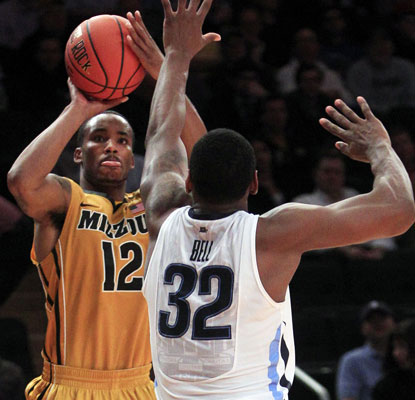
Against Villanova, Marcus Denmon hit 10 field goals. Nine of them came via assist from either Phil Pressey or Michael Dixon. Four of those were threes on the wing in transition, but the other five field goals came in the half court.
While Missouri is getting out in transition more often this season, they actually are averaging fewer possessions per game, 70.2 versus 72 a year ago. The reason for that is their execution in the half court; Frank Haith has a pair of point guards that understand how to pull the ball out and run their offensive sets. Last year, Missouri scored just 0.893 PPP in the half court. This season, that number is up to 1.072 PPP. A lot of what Missouri does in the half court involves ball-screens with their playmakers, but they do run some sets specifically designed to get Marcus Denmon a look at the rim.
In this first example, Missouri goes 1-4 high (both of the big men are on the elbows and the wings are foul-line extended):
And runs Denmon off of a double-screen across the two bigs, looking to isolate him on the opposite wing:
In this instance, Villanova defended it well, but Denmon was able to find some space when Pressey drives at his defender and kicks the ball out to him for an open look:
In this second example, Missouri uses the same set, but Matt Pressey is the guy that runs over the top of the double-screen: 
Denmon circles through underneath, using a double-screen at the top of the key:
He doesn't have a shot on the catch, using one dribble to free himself for a pull-up 17-footer:
The biggest reason that Denmon has been so efficient this season because he never turns the ball over. Well, never isn't exactly correct. In eight games, he has exactly four turnovers, good for a turnover rate of 4.1%. That's ridiculous.
But the other reason that Denmon is so efficient is that his point guards get him the ball in a position where all he has to do is shoot the ball. If there was a way to determine a point-per-dribble stat, he would probably have the highest rating for any scoring guard. That's also part of the reason his turnover rate is so low -- he doesn't need to create from the time he catches the ball until the time he shoots the ball.
There is no doubt that Denmon is one of the best in the country at what he does, but what he is is a finisher. The same way that Ratliffe is thriving because he is big and gets put into positions where all he has to do is score a layup of dunk the ball, Denmon is playing so well because his point guards are putting him in a position where all he has to do is shoot the ball.
And boy, when he gets in a rhythm, he may be the best shooter in the country.
But he helps his teammates get opportunities as well. You cannot leave Denmon to help on a driver. His man has to stay hugged up on him, otherwise Pressey or Dixon will find him, and odds are good Missouri is going to be getting three points on that possession instead of a possible two. In this example, you see Pressey come off of a ball-screen (which, admittedly, Mouphtaou Yarou defends terribly) and drive down the middle of the lane:
But Denmon's man -- and the guy guarding Kim English, who is shooting over 54.9% from three as well -- can't help, so when Yarou tries to block the shot, it creates an opening for Pressey -- who Ratliffe said has "eyes not only on the back of his head, but the side of his head too" on Tuesday night -- to throw a gorgeous pass for a dunk:
Continue reading...
Friday, December 9, 2011
Breaking Down: The Efficient Assassin, or how Marcus Denmon does his damage |

Friday, February 18, 2011
90% of basketball is the flow: An inside look at the best hairdos in college hoops |
No sport allows the viewing public to focus on the face and head of players as much as basketball does.
Think about it: Hockey, football, baseball and lacrosse all require helmets. Even water polo and wrestling requires some sort of head-gear. Soccer is played on a field that's damn-near a quarter-mile long. Nobody watches tennis or bowling. But in basketball, viewers can see every part of a players face.
Why do I bring this up?
Well, only because the college basketball landscape features some of the most interesting hairdos in the entire sports world.
Is this list completely unnecessary? Absolutely. Is it a waste of time? Probably. But does it make you a better, more knowledgeable college basketball fan? Hell-yes it does.
If you are interested to see who made last year's list. Here ya go: Part 1, Part 2.
Mike Bruesewitz - Wisconsin
I know what you're thinking: "When the hell did Wisconsin offer Carrot Top a scholarship?" Mike "Ravishing Red" Breueswitz is setting the Midwest ablaze with his heart, hustle and hair. There's the "Bruesewitz hair-cam" and even red wigs for sale at the Badgers team store.
Bruesewitz hasn't always donned the flaming mop-top. Up until this season he has sported a more conservative crew-cut, but was inspired by his older brother to let his hair down. 
The Bruiser's head of hair is about as unique, and red, as any head of hair in the country.
Dwight Buycks - Marquette
I love Dwight Buycks. I'll admit it, and I have no shame in doing so. Just look at this dude, and try to tell me you don't at least admire his swagger.
What I like the most about Buyck's hairdo, which I have coined "the buyck tread", is that he mixes it up. After all, versatility is key in any sport. You have to keep people on their toes, and that's exactly what Buycks is doing.
Rotnei Clarke - Arkansas
I'll forgive him for the egregious misspelling of his first name for now, because my man Rotnei is repping the "brohawk" to the max. Clarke is arguably one of the best pure-shooters in the country. But he also seems to follows the golden rule of all sports "You have to look good in order to play good".
I'm not exactly sure how the "brohawk" stays intact during games, but I'll save that for another post. Maybe we should ask Gary Parrish, he probably knows the answer:
Honorable Mention: Cade Davis, Oklahoma
Andre Coimbra - Central Michigan
How in-the-world do you play with something like this?
I just don't understand how somebody can play a close-quarters-game like basketball with such spacious hair. If I had to play against him, I'd get rather frustrated. Plus you have to wonder whether all that hair gets in the way of his brain processing information. I mean, why would somebody from Rio de Janeiro want to spend four years in Central Michigan?
Jae Crowder - Marquette
He's got locks similar to Morehead State's Kenny Faried. There is something ferocious about Crowder's look. Maybe it's his size, after all, he's just 6'6, but his upper body is stacked, and when he gets fired up, he looks like some sort of wild animal.
I would not want to fight for a rebound against hair like this.
Honorable Mention: Kenny Faried, Morehead State, Nick Mason, Arkansas
Marcus Denmon - Missouri
This is the cornrow'd version of "lettuce". Demon's cornrows are well manicured and well maintained. His hairdo is similar to what teammate Michael Dixon rocked last season. There is no denying that Denmon has been on fire this season, and there's no denying that his hairdo is pretty fresh.
Honorable Mention: Marvell Waithe, Arkansas, Aaron Brown, Temple
Tyrone Garland - Virginia Tech
You may be surprised to know that Garland is the 3rd leading scorer in Philadelphia Public School history, only one spot behind Wilt Chamberlain. But that's about all that garland and "The Big Dipper" have in common. The freshman guard may have the most unique set of hair follicles in the ACC. What really makes his hairdo interesting is the headband. We've seen many players with dreads as long as Garland's but that headband keeps it under control. 
What I also love about Garland is that he's versatile. He's gone with dreads, straight cornrows, designed cornrows and even a Katt-Williams-esque flat-iron approach.
Honorable Mention: Steve Tchiengang, Vanderbilt
Aloysius Henry - UNC-Greensboro
Henry is in a hair-class of his own. I mean, what exactly is that? Is it a mini-fro? Is a gheri-curl? Are they tiny dreads?
Whatever it is, I am certain that it is pretty cool. The six-ten native of the Windward Islands definitely has that Caribbean-style of flow going on. I really can't emphasize how much I like this 'do.
Scotty Hopson - Tennessee
Nobody rocks the high-top fade harder then Hopson. He's been repping the "Fresh Prince" all-season-long and it doesn't look like it's going anywhere. 
I've always been a big fan of this hairdo, and I love to see somebody represent it this thoroughly. I only wish he would continue to grow it out until Kid'n'Play have to sue for stealing their likeness.
Honorable Mention: Norris Cole, Cleveland State, Anthony Jones, Baylor, Ryan Evans, Wisconsin
Jordair Jett - Saint Louis
Awesome name? Yup. Awesome head of hair? Yup yup.
But seriously, I think this might be too much hair for one head. It looks like he doesn't even know what to do with all those dreads. It's like a messy ball of extension-cords. Your mom will tell you to unravel them and put them away, but you just can't get them untangled. So what do you do? You bunch them up as tightly as possible and wedge them into a cupboard hoping they will stay put. At least for the sake of opposing players, Jett seems to have his follicles under control.
Skylar McBee - Tennessee
The loveable Volunteer walk-on captured the hearts of hoops fans everywhere last season with his game-clinching 3-pointer against top-ranked Kansas. But now McBee captures the hearts of pre-teen girls everywhere with his homage to Justin Beiber.
I call it "the McBeeiber".
Honorable Mention: John Shurna, Northwestern
Jesse Perry - Arizona
And the winner for "Biggest head of hair in College Basketball" goes to..... Seriously, look at that. It's some amalgamation of dreadlocks and cornrows. Whatever it is, it's way too much. Imagine going for a rebound against him? It looks like that thing could drop you like a bad habit. Its one thing to have to box out a guy with long dreads that might whip you in the eye or neck, but it's another thing to get knocked out by somebody's dreadlocks. 
Imagine how strong his neck muscles must be for having to hold up that much weight all the time?
Cory Remekun - St. Louis
That is no ordinary afro.
It's a mullet-inspired pseudo-hi-top=fade-meets-afro-slash-frohawk. Sure it looks like kind of normal from afar but at the proper angle, you can tell this hairdo is one of a kind. It's almost like a rhombus-shaped afro. I'm not sure if that's what Remekun was going for, but that's what he got, and it's pretty cool. (A big H/T to @MattSebek for the twitpic)
Stephen Roundtree - Oral Roberts
If I could grow hair like this, I totally would. Its kind-of like the gheri-curl of our generation, and I love it. 
It also kind-of looks like one of those goofy snowboarding hats you see people wearing because they think it's hip and cool but everybody else knows that it's totally lame.
Donald Sims - Appalachian State
In Sims' four years at Appalachian State he has amassed a plethora of awards, achievements, records, and career-bests. But as for his hair, I'm not really sure what to say.
The only "best-of" or "all-hair" team Sims' qualifies for is the "All-over-the-place" squad. Sims' hair is even more confusing in person. It's not exactly an afro, but it's not exactly a gheri-curl or curly-locks either. So in conclusion, I'm not sure what exactly is going on upstairs with Sims, but at least it deserves recognition.
Sai'Quon Stone - Southern Mississippi
Here we have another Double-gold-winning head of hair (All-Name-Teamer/All-Hair-Teamer). Stone subscribes to the Stanley Robinson School of hair-care: If you got it, flaunt it.
Sai'Quon will rock cornrows one game, dreads the next, a different type of cornrows after that, followed-up by a combination of dreads and cornrows. Like I stated earlier, versatility is key. You gotta keep the people alls wanting more, and I think Sai'Quon knows this. I mean, why else would he subject head scalp to such bizarre designs?
Jeron Trotman - Centenary
Centenary has not one a single game this season and will probably finish the season without one. I can't imagine they have too many fans at their home games. But if you want to sell a bad product, you have to spruce it up a bit, and that's exactly what Trotman has done with his head.
I mean, this is probably the only time this year you've seen a picture of a Centenary player, so Trotman's work is already paying off.
Honorable Mention: Moussa Camara, Binghamton
Mike Wilder - UC-Irvine
Last, but certainly not least, is last season's winner of the "Donald Trump Award for Most Outstanding Head of Hair", Mike Wilder. I'm rarely at a loss for words, but it's easy to forget what I'm talking about when I gaze at his super-mega-afro-crag. 
If UC-Irvine hasn't started selling "Mike Wilder afro wigs" at home games, somebody in the marketing department needs to be fired.
So there you have it. An in-depth look at some of the best hairdos in college hoops this season. But my work isn't done. I know there are dome-pieces out there I haven't seen yet. If you have noticed a bizarre hairdo, or if something catches your eye during a game, hit up @BIAHtheTrizzle or email us at contactBIAH@gmail.com
Continue reading...
Tuesday, February 15, 2011
Hoops Housekeeping: Missouri's shooter, Florida's boardsman may miss time |
Yesterday, we did a bit of Hoops Housekeeping, catching you up on some injuries and lineup changes. Here are three more newsworthy injuries to keep in mind this week.
Chandler Parsons: Parsons was the SEC's leading rebounder heading into Saturday's game against Tennessee, but he was hobbled early in the first half thanks to a knee he took to the thigh from Alex Tyus. They are calling it a deep thigh bruise (essentially a really, really bad charlie horse), but don't let the name fool you, the injury is fairly severe. Parsons is still on crutches and the bruise has started to bleed.
"I would say he's out right now," Donovan said on the SEC teleconference, "for how long I don't know. But I don't envision him practicing until at least possibly Thursday or Friday, maybe. And how well he responds over the next three or four days will determine whether or not he can play on Sunday."
The good news is that Florida won't play until Sunday, and that's against LSU.
Marcus Denmon: Missouri's leading scorer is questionable for tonight's game against Texas Tech. He took an elbow to the eye from Laurence Bowers in the second half of Missouri's win over Oklahoma on Saturday and did not return. He needed two stitches to close the wound.
"Marcus yesterday participated in shooting, no contact," Missouri head coach Mike Anderson told reporters. "So he'll come in this morning, and we'll check him, but it seemed like his eye was swollen a little bit, but not as much as we anticipated, so we'll know more today. We'll know more on his status later on today."
Delvon Roe: The oft-injured Michigan State big man took a nasty spill late against Penn State has he tried to finish a layup that got Draymond Green his triple double. His right knee got trapped under neath him as he fell, but there apparently is no ligament damage.
"That is real positive news for us," said Michigan State coach Tom Izzo. "[He is] "not going to be playing at the level he was playing at no matter what he does."
"I don't know if he can play 20 minutes or none. I have no clue. I don't hide injuries like other people do. I'm not trying to trick them."
Continue reading...
Thursday, December 9, 2010
Marcus Denmon provides heroics in the wake of his cousin's death |
This post can also be found at Beyond the Arc.
I'm far from veteran in the sportswriting business, but in my limited time covering college basketball, I've learned that the key to being a good writer is being able to find the story within the game. Quite often, there are nights where that storyline is not always easy to find.
And then there are times when an article will write itself.
Like Missouri's 85-82 win over Vanderbilt Wednesday night.
On Friday, Marion Denmon was shot when the car he was riding in got caught in the crossfire of two cars in a "rolling gun battle". Denmon was hit and taken to the hospital, where he died Tuesday afternoon.
Marion Denmon is the cousin of Marcus Denmon, the Missouri Tiger's leading scorer. They were close, growing up in the same house in Kansas City. After the shooting, Denmon made the trip back to Kansas City to be with his family, but he returned to Columbia for the Tiger's media day on Monday. He didn't tell anyone what had happened, not until he took to facebook after his cousin had passed.
Fast forward to Wednesday night. 
Missouri is playing Vanderbilt on ESPNU, and Denmon is in the lineup. But, understandably, he is not himself in the first half. Coming into the game, Denmon had been playing the best basketball of his life. He was averaging 16.4 ppg (and 23.0 ppg in his last two games) and shooting 56.4% from three. After 20 minutes, however, Denmon had just two points on 1-6 shooting from the field.
The second half didn't start out much better. He missed a three. He missed a 15 footer after tracking down a loose ball. Throw in a foul here and a turnover there, and Denmon and the Tigers found themselves down 54-48 after a Jeff Taylor dunk with 13 minutes left in the game.
That's when Denmon took over. First, it was a jumper in transition to cut the lead to four. Then he found Justin Safford open for a three that cut the lead to one. After he made 1-2 free throws, Vandy scored, but Denmon answered right back with a three to keep the deficit at one. Two possessions later, Denmon drove to the rim for a layup that gave the Tigers the lead at 59-58.
Three minutes later, after Vandy had retaken the lead, Denmon again drove and scored, this time drawing a foul as well, to put Mizzou back ahead 67-66, but this game would eventually go to overtime.
With 1:42 to go in the overtime, Lance Goulbourne slipped a screen and gave Vandy a 79-77 lead, but Denmon answered at the other end with a contested 25 footer to retake the lead. After the two teams traded buckets, the score was 82 all and Vandy had the ball with a chance to hold for the final shot.
But Brad Tinsley made a lazy pass, Denmon read it, jumped the passing lane, and streaked the other way for a layup and the foul.
After he hit the free throw, Vandy came the other way and Tinsley missed a 35 foot prayer at the buzzer.
All told, Denmon scored 19 of his 21 points after halftime. He sparked the run that got Mizzou back into the game Vandy opened up their biggest lead. He scored six of the last eight Tiger points, including the game winning steal and bucket.
"In the first half he played with a heavy heart. He lost a family member," coach Mike Anderson said after the game. "But, in the second half he played more like Marcus."
Heavy heart and all.
I'm not a religious person. I don't believe in a higher power. And I hope that no one implies that this performance by Denmon was a result of anything other than a young man showing just what he is capable of in spite of horrific circumstances.
Tonight's win goes beyond a mark in the W column. It goes beyond the basketball.
This win won't bring his cousin back. I'm sure Denmon would trade every win, every basket, of his career to bring his cousin back.
But even if it was for a short two and a half hours, Denmon was able to get his mind, and his family's mind, off the tragedy at hand.
RIP Marion Denmon. I know your cousin did you proud tonight.
Continue reading...


 Posts
Posts


