
Its always good for a laugh when the NBA officially announces the list of early entrants into the NBA Draft. This year was no different.
Among the head scratchers were four players currently (or recently) suspended from their schools (Keion Bell, Desmond Holloway, Willie Reed, and Antoine Watson), two Junior College players (Tiondre Johnson and Roscoe Davis), two members of D-III teams (Dan Kelm, Thomas Tibbs, Jr), and a player at an NAIA school (Jacob Blankenship).
Some familiar names popped up as well. TyShawn Edmundson, a 6'4" from Austin Peay and formerly of St. John's, put his name into the mix after averaging 17.1 ppg this past season. Chaminade's seven foot center Mamadou Diarra, who transferred to the Maui Invitational's host school from USC, declared as well. He made some noise when he had 16 points, 11 boards, and five blocks against Michigan State this year. And Ryan Kelley finally resurfaced two years after leaving Colorado after one season riding the pine.
Also, as you might expect, there were a number of juniors from low-majors around the country that declared to get a feel for what they need to work on to make it at the next level. Yale's 6'10" center Greg Mangano declared after averaging 16.6 ppg, 10.0 rpg, and shooting 36.6% from three. Darrion Pellum put his name in the mix after averaging 17.5 ppg for Hampton while JP Primm of UNC-Asheville declared following his 14.5 ppg, 4.0 apg, and 2.1 spg season. Charlie Westbrook of South Dakota and Brandon Wood of Valpo had already made their intentions known.
Most surprising? Keishawn Mayes of Campbell. He averaged 3.5 ppg in just 10.0 mpg for the Camels last season.
Beyond that, there weren't too many surprises on the official list. Most of the names had already leaked out. But here are four players that you will want to keep an eye on over the next two weeks:

Continue reading...
Thursday, April 28, 2011
A look at some of the surprising names on the early entry list |

Tuesday, April 26, 2011
Who made the wrong early entry decision?: Hollis Thompson should withdraw from the draft |
Hollis Thompson's decision to enter the 2011 NBA Draft was a bit of a surprise to all involved.
And its only partly because the 6'7" sophomore averaged just 8.6 ppg and 4.4 rpg this past season.
Thompson is a talented player. He's a small forward with NBA length and athleticism. He is a very good shooter from the perimeter and has shown flashes of being able to put the ball on the floor and get to the rim. The problem? Thompson has never had the opportunity to showcase his ability on the offensive end of the floor.
This past season, Thompson spent the first half of the year starting at the four with Chris Wright, Austin Freeman, and Jason Clark logging the majority of the perimeter minutes. Midway through the year, Nate Lubick slid into the starting lineup and Thompson became Georgetown head coach John Thompson III's hired gun off the bench.
There were reports that Thompson was unhappy with that role, which is why he declared for the draft and considered transferring out of Georgetown.
That makes absolutely no sense.
You see, Freeman and Wright both graduate this spring, as does starting center Julian Vaughn. With Vee Sanford transferring out of the program, that means that Thompson, along with Clark, will be the featured scorer in JT III's offensive next season, likely taking over Freeman's role as resident long-range assassin. And with Nate Lubick, Henry Sims, and Jerelle Benimon returning up front -- and a loaded group of freshmen bigs, headlined by top-30 recruit Otto Porter -- back court minutes will readily available.
Thompson showed flashes of being an all-Big East caliber player last year. He had 18 points and nine boards in a win over NC State. He went for 16 points and seven boards against St. John's. And he average 16.0 ppg on 17-26 shooting in the Hoyas final three games, including a 26 point, seven rebound outburst in Georgetown's loss to VCU in the first round of the tournament.
Thompson has a chance to show the country -- and the NBA GM's -- just how good he can be next season.
He should withdraw from the NBA Draft.
Who else made the wrong early entry decision?
There are conflicting reports about what Gibbs is planning to do, likely the result of Gibbs and his family having conflicting emotions about the decision. Its obvious that Gibbs wants to -- or is, at the least, trying to convince agents and GM's that he wants to -- become a pro. But the bottom line is that he just isn't an NBA player right now. He's a 6'1" shooter that is a step slow and can't jump all that high. But he is a great college player, and having the chance to prove he can create off the dribble should help his standing as a draft prospect.
Lee seems like he was just done being a college student. That is the only explanation for a player that has a chance of going undrafted to remain in the draft. Lee showed some flashes of being a productive scorer this season and he is a terrific defender, but he averaged just 2.0 apg this season and shot 29.5% from beyond the arc. The physical talent is there, but another season in Westwood -- playing for a team that would likely have been the cream of the Pac-10 crop with him -- to develop his all-around offensive game would have helped his stock.
Richmond may not have had much of a choice in this situation. Assuming he did, he probably could have used another season of seasoning. Its certainly not an issue of potential. He's an athletic, 6'8" combo forward that can do a lot of different things on a basketball court. He's got the makings of being a terrific all-around player one day. This issue is that some of his off-the-court problems make it seem like he may not ever live up to that potential. He missed a few practices and a game in the middle of the season and was suspended at the end of the season by Bruce Weber. He needs another season to develop as an adult and a professional, not necessarily as a basketball player.
I don't generally like to criticize a player for staying in school. Taylor is going to earn his degree and get a chance to play with guys like Fetsus Ezeli and John Jenkins for another season on a top ten team. That said, Taylor would have been somewhere in the late lottery or mid-first round of this draft. In a loaded 2012 draft, he'll likely go late in the first round. He may drop even more if he doesn't show improvement in his perimeter skill set.
Continue reading...
Who made the right early entry decision?: Renardo Sidney will be back for another season |
Renardo Sidney is the stereotypical one-and-done prospect.
His family moved from Mississippi to LA when he was 15 years old so they could capitalize off of the hype Sidney produced with impressive performance after impressive performance. He was a product of the summer, making his name on the AAU circuit and ABCD camp and infamously telling the Washington Post high school ball is "not that important". His father was employed by Reebok while coaching Sidney's Reebok sponsored AAU team. He was turned down by both UCLA and USC before enrolling at Mississippi State. After sitting out for a year due to illegal benefits that he received while in high school, Sidney tweeted "NYC #2011 Believe Dat" last summer despite still having to sit out nine more games.
It only made sense that Sidney would bolt for the NBA at the first opportunity.
Which why its a mild surprise that Sunday's early entry deadline came and went and Sidney's name was not entered, living up to the promise he made on facebook back in March.
Sidney needs another year in school. Right now, the only thing worse than his reputation as a basketball player is his reputation as a person and a teammate. Sidney was twice suspended for fighting with a teammate (one of those times came in the stands during an ESPN telecast) and was largely ineffective for much of the season due to the fact that he was completely out of shape and lacked the desire to a) change that fact and b) give consistent effort when he did have energy.
While most of the focus on a basketball player's time in college is on his development as a player, its also true that these players develop and mature as people. That is why Sidney needs another year in school. He needs to learn how to be a man. How to be a professional.
Derrick Caracter agrees.
The first step in that process? Making the choice to come back for another year at Mississippi State.
Who else made the right early entry decision? (Looking past the Kemba Walkers and Derrick Williams' of the world)
Knight is likely going to be a top ten pick in this draft after averaging over 17 points and four assists per game and proving that he had the ability to perform in the clutch in the tournament. But if Knight had returned to school, he likely would have been forced to, at the least, split the point guard duties; most believe that Marquis Teague would have started over him.
Lamb was a breakout performer in March. The 6'5" guard with the wingspan of a pterodactyl developed the aggression and the confidence to be a serious scoring threat for the Huskies in the Big East and NCAA Tournaments. But the lack of consistency during the season and a frail frame put doubt into some NBA GM's minds. With Kemba Walker going pro, Lamb will have a chance to prove his mettle as the Huskie's offensive focal point.
Leonard might be the best physical specimen in this draft class. He's 6'7" with big hands, long arms, and terrific athleticism and explosiveness. He's relentless on the offensive glass and is a very good defender, both on the perimeter and in the paint. But Leonard's offensive repertoire has a ways to go. He can develop that in the NBA with a guaranteed contract as a lottery pick locked up. Coming back, especially considering the drop off in talent for the Aztecs next season, Leonard risked exposing his faults.
Robinson is a terrific prospect based on his size (6'9"), strength, and athleticism. The only thing missing in that equation is consistent production. He was impressive in the short time that he was on the floor, but on the season Robinson only managed to average 7.6 ppg and 6.4 rpg. Coming back for another season with both of The Morrii off in the NBA, Robinson will have a chance to prove what he can do as the go-to option in the post.
Continue reading...
Monday, April 25, 2011
Testing the waters: What teams have the most on the line? |
The deadline to enter into the NBA Draft came and went at midnight on Sunday night, meaning that as of now, the 50 names on our Early Entry List is just about final. (The NBA's official list probably won't surface until Tuesday or Wednesday, but most of the big names have made their intentions known.)
The deadline to withdraw from the draft is on May 8th. Who has the most hanging in the balance over these next two weeks?
No. 1 Texas: Tristan Thompson and Cory Joseph
Jordan Hamilton is gone. The sophomore will sign with an agent, thus ending any possibility of returning to school. Freshmen Joseph and Thompson also have their name in the NBA Draft pool, although their futures are on two very different paths. Most reports have Thompson remaining in the NBA Draft, which, as we talked about at length on Saturday, puts Texas in a huge hole. The only front court returnee that saw any action this season would be Alexis Wangmene (who averaged all of 9.6 mpg) and Rick Barnes is not bringing in any front court players that can contribute immediately.
Joseph, on the other hand, seems more likely to return to school. Thompson is going to be a lottery pick this season. Joseph will be lucky if he gets drafted at all. But with Myck Kabongo coming in this year, does Joseph want to spend another season sharing the point guard duties? With Joseph and Thompson back, the Longhorns will be a favorite -- along with Baylor and Kansas -- to win a wide open Big 12. Without those two, Texas has all the makings of an NIT team.
No. 2 Kentucky: Terrence Jones, Brandon Knight, and DeAndre Liggins
As of right now, Knight appears to be the only one of these three that has made up their mind. He's a virtual lock to be a top ten pick, and with Marquis Teague coming into Kentucky next season, Knight would be forced to play off the ball next season. Jones is also likely gone. He has a chance to be picked in the back end of the lottery, and with the amount of front court talent Kentucky has coming in next season, odds seems long that Jones will stay. Liggins is a bit of an x-factor. His decision to stay in the draft may end up being the result of how well he tests out. Can he sneak into the first round as a defensive-minded three point marksman?
Kentucky is going to be either the preseason No. 1 or No. 2 team in the country next season, regardless of what decision these three players make. Without them, Kentucky will be young but talented, with isn't all that different from what the Wildcats have been the past two seasons. But if all three do return, Kentucky goes from being a very good team to one of the most impressive collections of talent of the past quarter-century. They would go from a Final Four contender to a national title favorite.
No. 3 Butler: Shelvin Mack
When Butler made their first national title game back in 2010, the Bulldogs were led by a three-man attack of Gordon Hayward, Matt Howard, and Mack. Hayward went pro after the 2010 season, and Matt Howard will graduate this spring. That leaves Mack, who is currently a borderline first-round pick, as the only one with a chance to be a Bulldog next season.
Butler has some talent coming back next season, as well. Khyle Marshall looks primed to be the next Butler star and is the kind of athlete you rarely see in the Horizon League. Andrew Smith is a solid interior presence. Floor leader Ronald Nored returns, as do Chase Stigall, Chrishawn Hopkins, and Garrett Butcher. Without Mack, this team will once again be at the top of the Horizon. But with Mack's scoring, leadership, and ability to knock down shots in the clutch, Butler has a chance to once again be a top 15-20 team.
No. 4 Pitt: Ashton Gibbs
Gibbs is an interesting case. There have been multiple reports that Gibbs has made up his mind to stay in the draft, but in recent days he seems to have backed off of those statements a bit. It would probably behoove Gibbs to return to school; he'd be lucky to get drafted this season.
He also has a chance to have a special season for the Panthers. Gibbs would be a preseason all-american and the focal point for the Panthers. Pitt can replace the production from Gary McGhee and Gilbert Brown this season, but losing Brad Wanamaker is going to hurt. Wanamaker was the Panther's best playmaker, which would put even more pressure on Gibbs should he return. The 6'1" shooting guard became Jamie Dixon's go-to-guy at the end of a clock, as Gibbs is one of the best in the country at creating a look for himself coming off of a screen. Without Gibbs, the Panthers will have some major question marks on the offensive end of the floor.
No. 5 Michigan: Darius Morris
Morris was one of the catalysts to Michigan's surprise resurgence this season. Averaging 15.0 ppg and 6.7 apg, he sparked a late-season surge that saw John Beilein's club win eight of their last 11 regular season games, getting an at-large bid into the NCAA Tournament and nearly knocking off Duke to advance to the Sweet 16. Morris, for what it is worth, is likely a second round pick.
The rest of the Wolverines are young, talented, and fit well into the system than Beilein likes to run. But Morris is the engine. He's the guy that creates the open looks on the perimeter for sharpshooters like Zak Novak and Stu Douglass. He's the guy that gets Jordan Morgan open looks around the rim. He's the guy that defenses have to focus on, opening up driving lanes for Tim Hardaway, Jr. With Morris, Michigan will be a top 15 team in the preseason. Without him, they may not crack the top 25.
No. 6 Xavier: Tu Holloway
There is no question that Holloway was one of the most valuable players in the country this past season. He averaged 19.7 ppg, 5.0 rpg, 5.4 pg, and 1.4 spg while hitting countless late free throws and clutch shots down the stretch of games. With Dante Jackson and Jamel McLean graduating this season, losing Holloway would mean a team that rarely went more than six or seven deep would be losing three of their top five scorers. There's an argument to be made that, should Holloway return, he'll be the best point guard in the country.
No. 7 Tennessee: Scotty Hopson and Tobias Harris
The Volunteers are in a state of turnover. Bruce Pearl is out, Cuonzo Martin is in. They have the NCAA breathing down their neck. And if Hopson and Harris remain in the draft, then eight of the ten players in the Tennessee rotation that averaged double figure minutes will be gone. Hopson and Harris both have the talent to be first round picks in the NBA Draft. If they return, Martin will have a solid foundation -- along with Jordan McRae, Skylar McBee, Trae Golden, and Jeronne Maymon -- to build on.
No. 8 Missouri: Kim English and Laurence Bowers
Like Tennessee, Missouri will be heading into next season with a new head coach, as Frank Haith replaces Mike Anderson. With Justin Safford the only senior member of Missouri to graduate, the Tigers will be returning quite a bit of talent -- Marcus Denmon, Phil Pressey, Ricardo Ratliffe -- regardless of whether English and Bowers opt to remain in the draft. If they do come back, Missouri will be a contender for the Big 12 title.
Others:
The Eagles are losing eight seniors to graduation this offseason. If Jackson returns, he's talented enough to make BC a contender for an at-large spot in the tournament. If he doesn't return, BC's leading returning scorer will be a walk-on.
With Austin Freeman, Chris Wright, and Julian Vaughn all graduation, Thompson is being counted on to carry the Hoyas -- along with Jason Clark -- next season. Thompson has the potential to be an all-Big East player.
The Yellow Jackets have a roster returning with some talent on it. With new head coach Brian Gregory, it will be interesting to see if Shumpert is willing to return for another season.
The Terps lose quite a bit to graduation, but Terrell Stoglin and Pe'Shon Howard both showed some potential this season. Williams will be one of the best big men in the country if he does return.
Shurna's couldn't stay healthy this past season, which may have cost Northwestern a shot at a tournament berth. Juice Thompson graduates, but with everyone else coming back, Northwestern has a chance to be solid next season with Shurna.
With Tim Abromaitis, Scott Martin, and Eric Atkins all coming back, Notre Dame may be able to withstand the loss of Ben Hansbrough next season. But that will hinge on Scott's decision, as his inside-outside ability was a large part in what made the Irish so dangerous offensively.
Thompson seems like he is going to remain in the draft, which, combined with DeAngelo Casto's decision to turn professional, will push the Cougars back to the bottom of the Pac-10.
The Mountaineers will already be losing a number of key players to graduation. If Jones opts to stay in the draft, WVU may end up being an NIT team in 2012.
Continue reading...
Wednesday, April 13, 2011
The NCAA eliminating the testing the waters process would be terrible for the players |
We've talked at length, numerous times, about the stupidity of moving the deadline for collegiate players to withdraw their names from the NBA Draft to May 8th.
Well, the NCAA is on the verge of making an even worse move:
The Division I Legislative Council adopted a proposal on Wednesday that would “require student-athletes interested in testing the waters of the NBA draft to remove their name from consideration before the first day of the spring National Letter of Intent signing period." (Ed. Note: Today was the first day of the NLI signing period.)The change, which will take effect next year, isn't final until April 28th, after the Division 1 Board of Directors' meeting. But if this is what they ultimately decide on, its just about the worst possible scenario for the actual student-athletes themselves.
This would completely eliminate the process of testing the NBA Draft waters. For those unfamiliar, before last season, players were allowed one opportunity to declare early for the NBA Draft with a chance to pull their names out prior to a mid-June deadline. It allowed them to gauge their standing on draft boards, giving the players a chance to see if it was worthwhile for them to give up their remaining eligibility. They were able to workout for NBA teams and get feedback from front office types about where they stood to get picked. If you were a first round lock, you stayed in the draft. If you got feedback that it was in your best interest to return to school, you pulled out.
Last year, that deadline was moved up to May 8th, which handcuffed the players. The teams that were drafting weren't prepared to start evaluating prospects, and based on the rules for retaining eligibility (players can't miss class and they can't start working out for teams until after the deadline to declare has passed) it created a microscopic window for these kids to make potentially life-altering decisions.
And now that window will be closed.
This is nothing more than an effort to protect the coaches.
Having a player test the waters is difficult for coaches to handle. With a limited number of scholarships available to give out, coaches were left in limbo. Should they hope that the player testing the water returns, or should they recruit a player to fill the vacated scholarship in that player decides to leave?
Roster stability -- or, as Mike DeCourcy puts it, an opportunity for coaches to "play golf or go fishing in May without having to call NBA general managers and coaches on behalf of players trying to determine the best course for their futures" -- is valuable to coaches.
But allowing these kids the opportunity to make the best, most informed decision for their future should trump that.
College basketball (and football) players are already getting the short end of the stick. They are forced by the NBA to compete for at least one season -- with the new collective bargaining agreement, it may end up being two seasons -- at the collegiate level, where their talents generate revenue for the school and the NCAA instead of building up their back account. Personally, I believe that there should be some form of monetary compensation for players at this level of the sport, but that is far from a universal opinion.
What should be universal, however, is the opinion that forcing these athletes to make an uninformed and rushed decision about entering the NBA Draft less than two weeks after the national title game is completely unfair.
If this rule was in effect in 2008, North Carolina would not have had Ty Lawson, Danny Green, or Wayne Ellington return, meaning that the Tar Heels would not have won the national title in 2009.* It would have forced a guy like Scottie Reynolds, who played in the 2009 Final Four as a junior, to make a rushed decision on his draft status. This year, kids like Ashton Gibbs and Kim English would have had to make their decision on their basketball future by today.
*(The most ironic part of this mess? It is the coaches in the ACC that pushed the hardest to reduce, and eliminate, the process of testing the waters.)
"All this stuff: For the good of college basketball? This should be about these kids," Kentucky head coach John Calipari told DeCourcy. "They've done their good for college basketball. This should be about, 'How can we help these kids make a good decision?'"
And that's exactly right.
The draft process should be about coaches helping their players make the best decision for their future.
It should not be about the coaches making their job easier.
Continue reading...
Kemba will forgo his final year of eligibility; graduates in three years while reading one book |
As we all expected, Kemba Walker announced his decision to enter the NBA Draft on Tuesday afternoon.
Its the correct decision. There is nothing that he can do that will ever make his draft stock any higher. A 5'11" scoring guard, Kemba will be selected in the top ten of this year's draft despite most outlets projecting his best case scenario as a high-energy, instant-offense threat off the bench. That's what happens when you dominate the month of March in college hoops.
Throw in the fact that Kemba is coming off of a national championship and will be graduating this spring, and there really isn't anything left for him to do at the college level. According to the Hartford Courant, he'll be finishing up his degree by interning for whatever NBA team drafts him: Walker, a sociology major, is just shy of graduating. He'll finish course work over the next few weeks and will have some online courses and internship (probably conducted with the NBA team that drafts him) in order to officially graduate. He will walk in the commencement next month.
The fact that Walker is graduating in three years is a bit of a shock in and of itself. He wasn't exactly a model student prior to this year, but he made a decision over the summer to dedicate himself to his studies in order to leave UConn with a degree in three years.
Oh, and he also read his first book:Even before that Walker had begun trying to complete himself in ways that underscore the danger of painting any college basketball program—even one that will go on probation immediately after winning the national title—in broad, cynical strokes. Last spring Walker approached UConn academic counselor Felicia Crump and asked her to help him figure out how to earn his degree in sociology so that he could enter the draft this year and still graduate. Together they built a schedule that required Walker to take courses last summer in Storrs and then a full load in both the fall and the spring. "We're talking about a young man who was just an average high school student, at best, and who had always been more concerned with basketball," says Crump. "I told him, 'If you can do this, you'll leave behind a legacy that's more important than anything you do on the basketball court.'"
Walker took schoolwork with him throughout the Big East and NCAA tournaments, completing short required papers while postponing tests until after the season. He met with his campus tutor on Skype. And in his travel pack is a copy of New York Times columnist William C. Rhoden's Forty Million Dollar Slaves: The Rise, Fall, and Redemption of the Black Athlete, a book that Crump encouraged Walker to read as part of an independent study class on racism in sports. Before the Final Four, Crump suggested that Rhoden's book would be the first that Walker had ever made it through cover-to-cover. After the win over Kentucky, Walker confirmed this. "That's true," he said. "You can write that. It is the first book I've ever read."
Continue reading...
Monday, April 11, 2011
Perry Jones decides to return to Baylor |
With names like John Henson, Tyler Zeller, Tristan Thompson, and Jared Sullinger already pulling their names out of the NBA Draft, its hard to believe that we would get a bigger surprise staying school.
Cue Perry Jones III.
Not only is the Baylor freshman a virtual lock to be taken in the top five, but he also will be suspended for the first five games of the 2011-2012 season and will have to repay about $700 in impermissible benefits stemming from a trip to see a football game that was paid for by an AAU coach that also helped out Jones' mother with her rent.
"This is the decision I think is right," Jones told reporters on Monday. "The whole college experience with my teammates. That was a big part of this decision. Having fun with them. Just enjoying everything, just enjoying life with them. I do not want to cut that short and just leave out of nowhere. I want to have another good time like I did this year."
This decision will immediately vault Baylor back into the conversation for the top ten in the preseason. With Jones joining a front court that will also include Quincy Acy, Anthony Jones, and Quincy Miller, the Bears are loaded with length and athleticism. Throw is Deuce Bello in the back court, and their may not be a more athletic team in the country next season.
Baylor's issue this year, however, wasn't their front court. It was that they lacked a point guard. It will be interesting to see how AJ Walton develops, and whether or not Stargell Love and JuCo signee Pierre Jackson can fill the void. Also keep in mind that Gary Franklin, the former top 100 guard that transferred out of Cal during the middle of the season, will become eligible in December.
The bigger issue, however, is how many players actually are returning to college hoops. Most believe that the NBA will, in fact, be locked out starting on July 1st, which means that they players with their name currently in the draft pool will have to survive on endorsements and loans from their agents. How many more players will the lockout scare off?
Will this affect the decision of kids like Harrison Barnes, Terrence Jones, and Brandon Knight? Will borderline first rounders like Klay Thompson, CJ Leslie, and Khris Middleton decide to declare because they have a better chance of being taken in the first round? Will a kid like Kawhi Leonard or Jordan Hamilton leave because of the higher likelihood of being taken in the lottery?
By coming back to school, these kids will have a chance to actually play and improve their game by returning to school should the lockout last a significant portion of the season. But by taking a gamble and declaring, some players have a chance of significantly improving the money that they are guaranteed should the lockout end earlier than expected. The fact that next year's draft will be absolutely loaded will also be a serious consideration for the players that aren't guaranteed to be taken in the first round.
It also sets up an interesting situation for college basketball next year. There could end up being a number of very, very good teams at the top.
This process will be fun to follow, but it will be a fluid situation until we have passed the May 8th deadline and know for certain what next year's rosters will look like.
Continue reading...
Tuesday, March 29, 2011
The NCAA's deadline for early entry withdrawal needs to get pushed back |
Today, Ashton Gibbs, Malcolm Lee, and Jordan Williams all announced that they would be entering the NBA Draft.
But none of them signed with agents, meaning that they will be able to pull their name out of the draft field and return to school. For Gibbs and Lee, that would mean coming back for their senior seasons. For Williams, he would be returning for his sophomore year.
All three of these kids are making the correct move.
With the NCAA's rule that allows a player to "test the waters" of the NBA Draft -- declare once and withdraw by a specific deadline to retain their eligibility -- I don't think it is a stretch to say that every single junior in the country that has a glimmer of hope of being drafted should put their name in the mix.
Worst case scenario? The player doesn't get a single nibble from an NBA GM, they get no advice on what part of their game to improve, and they head back to school in exactly the same situation as they were when they declared.
For Lee and Williams, the correct decision may end up being to stay in the draft. Both of them have a shot at getting picked in the first round. If they can get a guarantee from a team in the first round, then they should probably remain in the draft, unless like college enough that they'll risk the guaranteed millions. If Gibbs is smart, he'll be withdrawing his name by the May 8th deadline. Right now, he is not an NBA player. He's only 6'1", he's not a point guard, and he's not all that quick or explosive.
The goal of this process, the whole reason that players have the ability to "test the waters", is so that these players can get the feed back they need to make an informed decision on their basketball future. Its so players like Ashton Gibbs will know whether or not leaving school early will result in them needing a passport to play professionally.
But that isn't the way it works anymore.
Not with the NBA Draft's withdrawal deadline moved up to May 8th. Players now get all of two weeks to schedule workouts with teams and gather enough information to make what may end up being the most important choices of their lives, one that could be life-altering in a positive or negative way.
It wasn't always this way. The rule used to be that the players had until mid-June to pull their name back out. But thanks to the complaints of coaches and a push from the ACC, the deadline was moved up. Their beef wasn't exactly wrong, either. You see, the late signing period in college basketball ends on May 20th, which means that just about every recruit in the country will know where they are going to college by May 20th.
With the later withdrawal deadline, it put the coaches in a bad spot. Is he staying in the draft or coming back to school? Do they recruit to fill that player's spot? What happens if they fill that scholarship spot but the player makes a surprising decision to return to school?
Its a tough position for a coach to be in.
But moving the deadline up is not necessarily the answer. It puts the kids who have their future on the line in an even tougher spot.
Players are always going to make bad decisions regarding their draft standing. There are always going to be players that leave school with almost no shot of getting drafted and players that return to school and pass on being selected in the lottery. There are a lot of knuckleheads out there that are either delusional about their abilities or spend too much time listening to the wrong people.
The point isn't necessarily to try and keep players from making the wrong decisions.
The point is that whatever decision is made, it will at least be an informed one. How they decide to use and interpret that information is irrelevant. The ability to obtain that information is what matters.
Will these players really be able to schedule enough workouts and interviews in less that two weeks time with teams that are not yet worrying about the draft? Will they be able to do it without missing class time, without the help of an agent, and without the ability to have their travel reimbursed?
Not likely.
And again, the people that pay the price are kids who are supposed to be making the decision.
Continue reading...
Wednesday, May 5, 2010
Three college stars will be keeping their names in the NBA Draft pool |
News leaked yesterday that three players will be keeping their names in the NBA Draft pool. One made the right decision, one was easy to predict, and one leaves us college folks scratching our heads.
Avery Bradley, Texas, G: Bradley probably made the right decision here, as reports have him signing with agent Dan Fegan. A consensus top five recruit coming out of Findlay Prep in Nevada, Bradley didn't exactly have the type of freshman season that would make people think he was a potential one-and-done kind of player. He averaged 11.6 ppg, but was inconsistent offensively and, at just 6'2", its unclear if he will ever be able to play point guard.
 Avery Bradley's best attribute is his defensive ability.
(photo credit: Flickr)
But there is no questioning his talent. There are few that get after it on the defensive end like Bradley does, as he has quick feet and is a strong and athletic kid. Offensively is where the issue lies. Like the rest of his Texas teammates, he was inconsistent to a fault this past season. He went for 20 five times, but there were also games where he was a complete non-factor on the offensive end. But for a freshman on a team with as big of a question mark at the point as Texas had this past season, isn't that to be expected?
Right now, Bradley still has some potential that he can capitalize on, but if he came back for his sophomore season and had the same problems, his stock might drop. He looks like he will be a late first rounder, possibly sneaking into the back end of the lottery, which isn't bad for an undersized two guard that isn't a big time scorer. He likely won't ever be a star at the next level, but if he can land in the right situation -- i.e. playing alongside a big playmaker (Brandon Roy, Tyreke Evans, Dwayne Wade) that can defend the two, he should have a solid career in the pros.
Devin Ebanks, West Virginia, F: We've already touched on the problems with Ebanks as a pro prospect. He has some intriguing tools, but right now there is more talk about his weaknesses than hype about his strengths.
Ebanks is long and fairly athletic. He can rebound the ball, is developing as a scorer, and has the tools to make him a decent defender. But it seems as if Ebanks has a long way to go towards understanding how to play basketball. Everyone in the NBA has tools. Length and athleticism will only get you so far. To be honest, I'd be surprised if a team used a first round pick on Ebanks, which is saying a lot considering that he was a potential lottery pick coming into the season.
Ebanks could have benefited from another season of learning the game, but sometimes a player just wants to go pro.
Samardo Samuels, Louisville, F: This is the decision that leaves me scratching my head. Simply put, Samuels is not a great pro prospect. His skill set is that of a center. He is a strong post player with a nice back-to-the-basket that understands how to use his body to hold a seal and create angles in the paint.
The problem is that he just doesn't have the size to be an NBA center, as Samuels is listed at just 6'8". Players his size have had success in recent drafts -- Paul Millsap ad DeJuan Blair immediately come to mind -- but Samuels doesn't have near the athleticism of Millsap and is not a rebounding machine or nearly as strong and aggressive as Blair (Blair also has the wingspan of a pterodactyl).
Samuels could have come back and been a favorite to win Big East player of the year. But even with a season of averaging 20 and 10, I doubt his draft stock would improve all that much. I wouldn't be surprised if he went undrafted this year.
Continue reading...
Thursday, April 29, 2010
The new early entry deadline sucks |
At midnight on Sunday night, the NBA Draft's early entry deadline came and went. Earlier today, the full list of 80 college players that had officially declared for the NBA Draft was released.
There were few surprises on that list, and only one (Tracy Smith of NC State, but he said via facebook that he would be returning to school) was a player with any real significance.
But that doesn't mean today didn't have any significance.
As you should be well aware, the deadline for underclassmen that haven't hired an agent to pull their names out of the draft is May 8th, which is all of nine days away; next Saturday.
What you may not know is that underclassmen are not allowed to begin scheduling workouts with NBA teams until after the official list is released, which happened today. They are also not allowed to workout with an NBA team if it conflicts with a class schedule, which basically rules out all weekdays.
What that means is that unless an underclassmen can schedule a workout with an NBA team for this weekend -- without the facilitation of an agent, mind you -- that player basically has next Friday and Saturday to workout for the 30 NBA teams.
Keep in mind, most of the teams picking at the end of the first round -- where the players still deciding on whether or not to remain in the draft are hoping to be picked -- are in the middle of the playoffs right now. The draft is the furthest thing from their mind.
The whole reason that the process of testing the waters was first implemented was to allow underclassmen an opportunity to gauge where their draft positions stands, get feedback from NBA GM's, and make a decision of whether or not they will be drafted high enough to warrant giving up their collegiate eligibility.
Sometimes players make the right decision, and sometimes they make the wrong decision, whether it is pulling their name out when they are a lottery pick (Willie Warren) or keeping their name in when most teams believe they will go undrafted (Jamont Gordan).
The point is that whatever decision is made, it will at least be an informed one. How they decide to use and interpret that information is irrelevant. The ability to obtain that information is what matters.
Is a player really going to be able to get a good feel for his standing based on one or two workouts?
Is he really going to be able to make an informed decision that can so dramatically impact his future and his earning potential in a period of less than a week-and-a-half?
I understand the argument in favor of this rule change. NBA teams have a chance to watch these kids all season long. There are hours and hours of game tape available that allows scouts to breakdown what each and every prospect can do on a basketball court. NBA scouts are at seemingly every single college basketball game involving a potential NBA prospect.
There is much more that goes into picking a player than just breaking down game film. Maybe in a workout, a team finds out that Big Man X has a better face-up game than he was able to display during the season. Maybe Point Guard Y shows that he has a better understanding of how to run a pick-and-roll than he showcased during the season, a play that is much more prevalent in the NBA than at the college level.
NBA teams get a chance to interview these kids. They get a chance to see what kind of work ethic they have. They get a chance to see if they have improved on any of their weaknesses since the season has ended. So much more goes into the process of determining who to pick in the draft than simply studying the x's-and-o's of what a player can do on the court.
"Houston does a combination of physical, athletic & psychological testing that far exceeds what most other NBA teams do," Draft Express tweeted over the weekend. "You can see the results they've had in the Draft the past few years-- Aaron Brooks, Carl Landry, Budinger, etc. Their work clearly pays off."
The kids are the ones being hurt here. Their futures are the ones that are being toyed with.
And it is all so that college coaches can rest easy at night, knowing who they will have and who they won't have on their roster. Remember, this rule was changed last season at the behest of the ACC's coaches, who were tired of waiting until the middle of June -- last year's deadline was June 15th, 10 days before the draft -- to know who was staying and who was leaving.
I don't exactly understand the problem. Its not like these coaches are going to be able to recruit replacements. As we mentioned yesterday, only five players on Rivals top 100 are still undecided on where they want to attend school. More than half of the 80 players that declared for the draft have yet to sign with an agent.
You needn't have taken calculus to realize those numbers don't add up.
The draft process was working. North Carolina won the 2009 national title because three guys pulled out of the 2008 draft. Scottie Reynolds, Patrick Patterson, and 24 other players pulled their names out of last year's draft.
Look through the list of players currently with their names in the draft.
Think about how different the college basketball landscape will be next season when -- not if, when -- kids on that list make the wrong decision to stay in the draft because they couldn't gather enough information.
Continue reading...
Tuesday, April 27, 2010
2010 NBA Draft Early Entrants: Who helps themselves the most by returning to school |
The NBA Draft's Early Entry deadline came and went on Sunday. Today, we will provide you with a bit of fodder over how some of this year's decisions could sway the 2010-11 college basketball season. For a complete list of this year's crop of early entrants, click here.
I am not opposed to early entry into the NBA Draft. In fact, I often support the decision of many of these kids to enter the professional ranks. When the opportunity to become a first round pick presents itself, there is no reason for me to protest against a kid pursuing his dream and making a (substantial) living. If you are blessed enough to be an NBA-worthy talent, there is no reason not to cash-in on your ability.
The issue I have is with the kids that stay in the draft when it would suit them best to go back to school for a year. I understand that this season is unique, with a potential NBA lockout looming, but there are still players who may be able to move up draft boards -- and possibly earn themselves a guaranteed contract -- by returning to school.
While it is a less-than-ideal format this year (and believe me, that is putting it lightly, but that is another post for another day), the ability to test the waters is great for these kind of players. In a perfect world, they can work out for NBA scouts, see where they stand in terms of the NBA Draft, and either continue on with their efforts to lock up a guaranteed contract or return to school and work on the specific aspects of their game that need improvement to up their stock as a draft pick.
Which players should pull their name out of the draft? Note that we are only considering guys that we deem potential first rounders one day. There are a lot of players with their names in the draft that clearly need to head back to school, or simply tested the waters because they are a junior.
Chris Wright, Dayton, junior: Wright has always been a sensational athlete. You don't get the nickname "Top Flight" easily. Wright is 6'8", strong, athletic, and built in the mold of the power wing/combo forward that has become a trend in today's NBA. As a junior, Wright finally started to show some flashes of a developed perimeter game, which he will need in order to become an NBA player. Every player in the NBA is an elite athlete. To warrant a first round pick, you need to bring something else to the table. Chris Wright, if he's smart, will return to Dayton and get up a lot of jumpers this summer.
(photo credit: Dayton Daily News)
But Wright isn't quite there yet. He jump shot, ball-handling skills, and instincts on the perimeter still need some work. If he can put in the work this summer, and develop himself like, say, Quincy Pondexter did this year, he should be able to work his way into next year's first round. This season, it is very likely that he will fall into the second round.
JaJuan Johnson and E'Twaun Moore, Purdue, juniors: Moore is the obvious one here. While he is a very good player at the college level, he lacks the ideal size and athleticism of an NBA two guard, and he isn't a point guard. Simply put, I'm not sure if the NBA is in Moore's future.
Johnson, on the other hand, has the potential to be a first round pick if he comes back. 6'10" and athletic with a soft touch on the perimeter will catch a lot of eyes. But Johnson's issue is his strength. He's just a slender guy, weighing right around 215 lb with a frame that doesn't exactly look like it can add a lot of size.
Johnson isn't a first rounder this year. If he decides to stay in the draft, he will be in that mix of guys looking to steal one of the last 10 picks of the draft. Given his limitations and the quality of talent in the 20-45 range, odds are good that he slips into the second round. But if he spends a summer in the weight room and showcases a better low post game next season for what should be a very good Purdue team, he would likely be a first round pick in 2011. Johnson has gone from the JV for his high school team as a junior to a potential NBA pick in four years. He clearly works hard and is willing to put in the effort to make himself better. The NBA can wait another year.
Keith Benson, Oakland, junior: Benson, like Johnson, is a borderline first round pick this year. Like Johnson, he is tall, long, and athletic with a soft touch on the perimeter. And like Johnson, Benson lacks the strength that is required to be a post player in the NBA. The talent is there for Keith Benson.
(photo credit: The Oakland Press)
Benson averaged 17 ppg this past season, but too much of that came from the perimeter. While he does have a foundation that should lead people to believe he can improve -- he has excellent footwork, for example -- he needs to get stronger and tougher. In a lot of cases, he is forced to be a perimeter shooter and a face-up big man not for a lack of post moves, but because he lacks the strength and the toughness to hold position on the block and finish those post moves. The strength and toughness issue shows through on the defensive end as well. Benson has first round potential, but he is much more likely to realize that potential if he waits for the 2011 draft.
Samardo Samuels, Louisville, sophomore: Samuels was a top five recruit coming out of high school, and certainly hasn't failed to be a very good player for Rick Pitino. I don't think anyone can complain when they are getting 15 and 7 out of a sophomore.
The problem is that Samuels doesn't really project as an NBA player. He is only 6'8" (and that may be generous) and is comparatively an underwhelming athlete -- he isn't overly quick or explosive. Samuels can survive at the collegiate level because he is strong, understands how to hold position, and has some effective post moves. But with his lack of a perimeter/face-up game, a 6'8" low post player is a long shot at getting picked in the first round, if at all. If Samuels decides to return to Louisville, he could very well be the best post player in the conference, if not the Big East player of the year.
Devin Ebanks, West Virginia, sophomore: Ebanks is a bit of an enigma. Standing 6'9", he is long and pretty athletic. But the issues with Ebanks aren't his tools, it is how he uses them. At times, he looked like he was capable of taking over games this season, but there were also times he looked absolutely lost.
I don't think Ebanks really understands how to play basketball. There were a number of times late in the season where he simply lost track of how much time was left on the clock, or looked completely lost on the offensive end. There is also the issue of an early season suspension and a perimeter game that is really lacking. Ebanks came into the season as a potential lottery pick, and his stock only dropped during the year. Leaving now, he may even end up in the second round. If he can come back and get people talking about his strengths, not his weaknesses, then he may boost himself back into the lottery next season, especially with the likelihood that his role will be expanded without Da'Sean Butler.
Other notable names who could benefit from an extra year in school:
Continue reading...
Monday, April 26, 2010
2010 NBA Draft Early Entrants: So who came back? |
The NBA Draft's Early Entry deadline came and went on Sunday. Today, we will provide you with a bit of fodder over how some of this year's decisions could sway the 2010-11 college basketball season. For a complete list of this year's crop of early entrants, click here.
You wouldn't be wrong if you said it seems like half of the college basketball ranks declared for the 2010 NBA Draft. Believe it or not, there were some NBA prospects -- fringe or otherwise -- that decided returning to school was their best option. Now this was nothing like last year, when guys like Cole Aldrich, Willie Warren, and Greg Monroe decided to go to school for another year. There really was only one surprise. But that doesn't mean there isn't some talent that will be hitting the books next season instead of cashing checks.
Keep in mind, this list will (hopefully) grow as players come to realize their true standing in regards to this year's draft class.
So as of today, who's coming back?
Kyle Singler, Duke, forward: Singler was the one surprise that I was referring too. After struggling to acclimate to a more perimeter-centric role with the Blue Devils early on, Singler went crazy over the last six weeks of the season. He capped his junior year off with a fantastic performance in the NCAA Tournament, culminating in the Final Four MOP award as Duke won their fourth national title under Coach K. Can Kyle Singler win another one?
(photo credit: B/R)
Singler likely would have been a first round pick if he had gone pro. Instead, he decided to return to school to try and lead the Blue Devils to a second straight national title. While the decision was a great one from the perspective of a Duke fan (or a college basketball fan in general, regardless of your feelings about the Blue Devils), it probably won't hurt his potential NBA career all that much. While his stock may never be higher than it is right now, the thing about Singler is that he is a known commodity. Nothing he can do next season is going to hurt his draft stock, and likely won't improve it all that much. He's a combo-forward that is going to play hard and compete, can knock down a jumper, and may be big versatile enough to create mismatches is a team decides to go small and use him at the four.
Jeff Taylor, Vanderbilt, sophomore: A lot of fans don't know who Jeff Taylor is, but it is a safe bet that NBA scouts do. Taylor has all the makings of a guy that can develop into an impact small forward in the NBA. He's an explosive athlete with good size (6'7") and length that can defend and rebound. His is still a bit raw on the offensive end, but a jump shot and ball handling can be developed. Tools cannot.
Taylor probably made a good decision to return to school With Jermaine Beal graduating and AJ Ogilvy entering the draft and hiring an agent, Taylor is going to be Vanderbilt's first option next season. If he puts in the work this off-season and can up his production, there is no reason he can't vault himself into the back end of next year's lottery.
Kemba Walker, UConn, sophomore: Walker plays a different position than Taylor -- he is a diminutive point guard as opposed to a "power wing" -- but he is facing a lot of the same problems that Taylor is. Simply put, Walker relies far too heavily on his absurd quickness and ball-handling ability but doesn't quite understand how to run a team. He can lead a fast break as well as anyone at the collegiate level, but can he get a team into an offense and run a system. Next season, Walker will have a chance to work on that as UConn will need to play as much more of a team with talents like Stanley Robinson and Jerome Dyson graduating.
The other thing Walker will have a chance to work on next year is learning his limitations. There are few players that can keep Walker out of the paint, but quite a few that can block his shot or force him into a tough layup at the rim. If Walker wants to be a successful NBA point, he is going to need to learn how to score in the mid-range; to learn when he should pull up for a 10 foot jumper or a short floater as opposed to trying to finish around the rim in traffic.
Elias Harris, Gonzaga, freshman: Harris wasn't considered an NBA prospect when he arrived in Spokane, but he certainly is now. He reminds me a lot of Josh Howard. What I mean is that he is a four at this level, but he has the athleticism and the ball skills to project as an effective three at the next level. Harris is explosive enough to dunk over you and strong enough to bully his way through you, but he also has a finesse game, showing an ability to weave his way through traffic, and can knock down a three. Elias Harris surprised a lot of people this season.
(photo credit: ESPN)
Harris was a bit inconsistent this past season, which probably had more to do with the fact that he was the third or fourth option most of the season than any knock on his game. With Matt Bouldin gone, it is going to the Harris and Steven Gray show for Mark Few next season. Expect big numbers ffrom the 6'8" 20 year old, and if he can show some development in his ability to play on the perimeter, Harris could be a lottery pick next season.
Kalin Lucas and Durrell Summers, Michigan State, juniors: Both of these guys made the right decision to come back to school. Neither had a great junior year, and it wasn't just an issue of their basketball ability. Lucas was the 2009 Big Ten player of the year, but he dealt with leadership and injury issues throughout the season and is currently laid up with a torn achilles tendon. Lucas likely isn't going to be a lottery pick or a primetime player in the NBA, but if he can lead the Spartans to a third straight Final Four, you don't think NBA teams are going to take notice? He's a point guard that can create his own shot, can make a play for a teammate, and is a proven winner. Leadership aside, Lucas seems like he is going to be the kind of player than hangs around the league for 12-15 years as a solid back up point guard.
Summers has a much higher ceiling than Lucas, but it just seems like he doesn't want to tap into that potential. He looks almost apathetic on the court at times. He proved what kind of player he can be as he stepped his game up in the NCAA Tournament without Lucas, earning the Midwest Region's MOP, but one good month doesn't make up for a career's worth of inconsistency.
Other notable names back for another season:
Continue reading...
Jan Vesely will not be entering the NBA Draft |
I know what your first thought was after reading the title to that post: who the hell is Jan Vesely?
Vesely is a 6'11", 20 year old from the Czech Republic that currently plays for BC Partizan in Serbia. He is also one of the top NBA prospects in Europe. Incredibly mobile and athletic for his size, Vesely is still quite raw, but has all the tools that would make him an ideal for the NBA. He is a combo-forward through and through, with the size of a four but the physical gifts of a three. At 6'11", he plays at the top of his team's press, can knock down a three, and has enough handle to go coast to coast. (Read Draft Express's scouting reports on him for much more thorough and knowledgeable analysis.)
Most outlets had Vesely projected has a possible top ten pick, and many considered him a lock for the draft. In comparison, this would be like Greg Monroe (another guy projected in the 8-18 range in this year's draft) opting to keep his name out of the draft.
Vesely only averaged around 8 ppg this season with Partizan, but watch this mixtape and tell me he doesn't have the potential to be an impact player in the league:
Vesely currently plays professional basketball in Europe, meaning that he will never be allowed to set foot on a collegiate court, but his decision to keep his name out of the NBA Draft could send some pretty significant ripples through college basketball.
You see, Vesely would have been a certain first round pick. Without him in the mix, that means that a guaranteed contract has opened up. As a result, there will be some border line first round picks that are going to be sliding up the draft boards.
Take Devin Ebanks, for example. Ebanks and Vesely are similar prospects. Outstanding physical gifts -- height, length, athleticism -- that need to be developed. Right now, Ebanks is projected to go in the dreaded 20-45 range. Will Devin Ebanks move up enough draft boards to force his decision?
(photo credit: WVU Sports)
But with Vesely gone, does that mean that Ebanks becomes a more coveted prospect? Ebanks has yet to sign with an agent. Does Vesely's decision influence whether or not he decides to remain in the draft? Are Ekpe Udoh and Al-Farouq Aminu now locks for the lottery? Maybe the team that would have fallen in love with Vesely instead decides to go a different route, and takes a guy like Gordon Hayward or Jordan Crawford, which results in those players deciding to keep their names in the draft.
Whatever the case ends up being, Vesely's decision not to enter the NBA Draft this season will open up a spot in the first round. After spot in the first round only makes it more likely that some of the player's that have yet to sign with an agent will keep their name in the draft.
Continue reading...
2010 NBA Draft Early Entrants: The biggest impact |
The NBA Draft's Early Entry deadline came and went on Sunday. Today, we will provide you with a bit of fodder over how some of this year's decisions could sway the 2010-11 college basketball season. For a complete list of this year's crop of early entrants, click here.
While we all have issues with the earlier withdrawal deadline, the good news is that there actually is an option to withdraw from the draft. As you all know, players are allowed to test the waters one time -- they can enter the draft, go to some of the workouts with NBA teams, get a feel for where they would be getting drafted and what they can do to improve that standings, and then return to school to improve their overall game.
Who are the guys who can change the landscape of college basketball if they decide to return?
Jordan Crawford, Xavier, sophomore: Crawford had the kind of NCAA Tournament performance that makes a player an NBA Draft prospect. He was nothing short of incredible has he averaged 29.0 ppg in leading a young and relatively inexperienced Xavier team into the Sweet 16. The Muskies return most of that young talent as well, with power forward Jason Love the only player that is graduating. Jordan Crawford could make Xavier next year's Butler.
(photo credit: Indy Star)
If Crawford stays in the draft, which is something many expect him to do -- he has a shot of going in the first round -- Xavier still should end up being a tournament team. A back court of Terrell Holloway, Mark Lyons, and Dante Jackson combined with a front line anchored by seven-footer Kenny Frease should be enough to get the Muskies an at-large bid. But with Crawford on the roster, is it too much to say that Xavier would be the hands down favorite in the Atlantic 10, and a team that may sneak into some top 10's?
E'Twaun Moore and JaJuan Johnson, Purdue, juniors: Both Moore and Johnson said back in March that they would be returning to school next season, and like we said back then, you always need to take that kind of statement with a grain of salt. Both juniors have declared for the draft, but both would be better suited by returning to school for their senior seasons.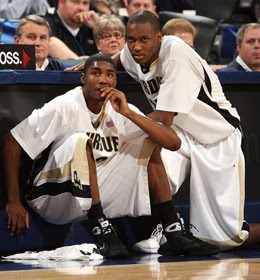 E'Twaun Moore and JaJuan Johnson could lead Purdue to heights they didn't reach this season.
(photo credit: SLAM)
Moore will likely not be drafted. As good as he is at the college level, he lacks the size and the explosiveness of an NBA two-guard. Johnson has some potential, but he still has quite a thin frame and settles too much for perimeter jumpers. Johnson has a better shot of going somewhere in the second round than Moore, but with the amount of talent available in this year's class, Johnson would probably have a better chance of getting that guaranteed contract if he came back.
Purdue has a chance to, once again, be a Final Four contender. With Robbie Hummel coming back from knee surgery and guys like Lewis Jackson, Kelsey Barlow, John Hart returning as well, the Boilermakers have a solid core. If they can get Moore and Johnson back, this is a team that can compete for a Final Four and potentially a national title. If they don't, Purdue may struggle to even make the NCAA tournament.
Gordon Hayward, Butler, sophomore: Butler became the feel good story of the decade in college basketball when they made their run to the national title game in their home city. The crazy part about that run was that it was made a year early. In other words, with the youth on Butler's roster, they have a chance to be even better next season, pending Hayward's NBA Draft decision. Willie Veasely and Avery Jukes both graduated, but the rest of Butler's roster will be back next season, including Matt Howard, Shelvin Mack, Ronald Nored, and even Brad Stevens.
If Hayward does return, Butler could end up being a top five team in the preseason. But he has a realistic shot at being a mid-to-late first round pick. It will be interesting to see what Hayward does.
Demetri McCamey and Mike Davis, Illinois, juniors: Illinois has a chance to be very good next season. The only player of significance that they graduate is Dominique Keller, they return both of their vaunted freshmen in the back court, and bring in a very good recruiting class. This is likely a tournament team if McCamey and Davis stay in the draft. But neither player is a lock to be a first rounder. Davis isn't even a lock to be drafted, while Draft Express is predicting McCamey to go somewhere in the second round.
McCamey really came on down the stretch last season. He has always been a talent at the point, McCamey's problem was shot selection and decision making. He's also had an attitude problem, at one point this season storming off the floor and bumping Bruce Weber as he walked by. Davis simply is not strong enough yet. A 6'9" forward, he does most of his damage on the offensive end with his jumper. That isn't going to cut it in the league.
With these two back in the line-up, Illinois has a chance to compete in what should once again be a top heavy Big Ten. And if McCamey can continue to improve from where he left off last season, seeing Illinois as a potential Final Four team is not out of the question.
Samardo Samuels, Louisville, forward: Let's face it: Samuels is not yet ready for the NBA. He's a bit undersized and not quite as athletic as NBA teams would like. While he does have a pretty advanced post game, he just simply doesn't have the tools that an NBA team is looking for in a post player. He's around 6'8" and 250 lb, but he's more of a center than a power forward. 6'8" centers don't last in the NBA.
Louisville certainly could use him. They lose Jerry Smith, Edgar Sosa, and Reginald Delk, Terrence Jennings has yet to prove he can be a consistent post presence, and Rick Pitino is hemorrhaging recruits. With Samuels, Louisville might be able to steal one of the four byes in the Big East tournament. Without him, they very well could be playing on the tourney's first day.
Continue reading...
2010 NBA Draft Early Entrants: The biggest mistakes |
The NBA Draft's Early Entry deadline came and went on Sunday. Today, we will provide you with a bit of fodder over how some of this year's decisions could sway the 2010-11 college basketball season. For a complete list of this year's crop of early entrants, click here.
The way I see it, there are four legitimate reasons for a player to leave school early:
- He is ready. He is a lock to be a first round pick (its even better if he is projected to go higher than that) and get a guaranteed contract. Contrary to popular belief, it is possible to develop at the NBA level. If you are able to develop while making a couple of million dollars instead of studying for exams, I say go for it.
- Financial issues. If you are good enough to think that you have a shot of getting drafted, odds are in your favor that you are good enough to make money playing basketball somewhere. If a kid comes from a family in dire financial straits, every one should support his decision to become a professional.
- He graduated. Like Derrick Brown last season and Eniel Polynice this year, if a player has earned his undergraduate degree, whether that is a result of redshirting a season or graduating in three years, I have no problem if he decides to go pro instead of using up his eligiblity as a grad student. Along those same lines, if a player is older than his class -- a 23 year old junior, for example -- I also think it makes sense to go pro. The older you get, the lower your ceiling for potential becomes.
- He's a "hot" prospect. If a player's stock is high -- whether that is a result of outstanding potential (think Hassan Whiteside) or he simply had a great NCAA Tournament (think Joakim Noah after the first Florida title) -- but that player is a fraud, so to speak, then it makes sense to capitalize on that higher stock. As they say, you strike when the iron is hot.
Tommy Mason-Griffin and Keith "Tiny" Gallon, Oklahoma, freshmen: Oklahoma had an incredibly disappointing season in '09-'10. Granted, no one was expecting the Sooners to win a national title, but with Willie Warren deciding to return for his sophomore season and the addition of two McDonald's all-american freshmen coming in, OU seemed like they were capable of, at the very least, competing amongst the best in the Big XII. For a variety of reasons, that didn't happen. And for a completely different set of reasons, both TMG and Gallon have entered the draft and hired agents.
 Tiny and TMG both should have stayed at Oklahoma.
(photo credit: Red Dirt Sports)
Gallon's hand may have been forced. Thanks to a report by TMZ Sports that a financial advisor in Florida had funneled money to Gallon, he may not have had much of a say in the matter. Gallon is 6'9", an underwhelming athlete, heavier than the ideal is for NBA fours, and far too perimeter oriented for someone of his size. When he actually decided to play this year, he was far too willing to hoist jumpers and far too unwilling to throw his ample weight around on the block. The trend in the NBA these days is fours in the mold of a Lamar Odom or a Shawn Marion, not the second coming of Oliver Miller.
TMG is not much of an NBA prospect either. He is small, looks for his shot first, and didn't really start to show his talent until Warren and Gallon were firmly entrenched in the dog house. He does have some talent -- he can put up points in a hurry, he has deep range on his jumper, and he may have had the nastiest cross over in the country this past season -- but he seems better suited for the And-1 mixtape tour than he does for an NBA roster.
Courtney Fortson, Arkansas, sophomore: Like TMG, Fortson has enough talent to be a star at the collegiate level, but his game doesn't exactly translate to the NBA. He's quick, he has a nice handle, and he is capable of creating off the bounce. But he is also smaller than an ideal NBA point guard, he doesn't have a jump shot, and he is a poor decision maker both on the court and off of it. Between his off-the-court issues at Arkansas and his 5.1 t/o's per game (he averaged more turnovers than most point guards average assists), odds are good that Fortson doesn't get drafted and you never hear his name again.
Lance Stephenson, Cincinnati, freshman: I think we all knew this was coming, but that doesn't mean that "Born Ready" is ready for the league after one year. There is no questioning his talent or his ability to score, but there are quite a few aspects of Stephenson's game that could have made him a much more ideal prospect if he had the chance to work on them. In terms of being a one-on-one player, Stephenson's ability to create is impressive. But he doesn't quite understand when is the correct time to attack, shot selection, or the workings of help side defensively. And while that ability can be developed as a professional, it is unlikely that he lands a guaranteed contract. Wouldn't it make more sense to work on his game playing in the Big East, where he will be on national television and sportscenter regularly, than in the D-League or overseas?
 Will Lance Stephenson go the way of Lenny Cooke?
(photo credit: BearcatsSportsPage)
AJ Ogilvy, Vanderbilt, junior: Ogilvy's biggest mistake may have been going back to school after his freshman season. There was a chance he would have been a first round pick in 2008, but since then he has done nothing to improve his profile as a potential pro. Yes, he is crafty in the post, he can rebound the ball, and he has a nice touch from the perimeter, but his flaws are still his flaws. He can't pass out of the post, he can't defend anyone, and he lacks a degree of toughness that he will need banging against NBA centers. In other words, Ogivly is still the same player he was two years ago, which is disconcerting for NBA teams. I'd be pretty shocked if he went in the first round.
Continue reading...


 Posts
Posts

