Over the coming weeks, we will be counting down our Top 50 teams in the country. Teams 26-50 will be posted in groups of five, while we will count backwards from No. 25 to the No. 1 team in the country. You can find a complete schedule of our 2011-2012 Season Preview coverage here. To browse through the rest of the Top 50, click here.
Last Season: 30-5, 19-1 (1st Atlantic Sun), lost in the first round of the NCAA Tournament to Wisconsin
Head Coach: Rick Byrd
Key Losses: John House, Jordan Campbell
Newcomers: Seth Cavera, Spencer Turner, Chad Lang, Holden Mobley, Reece Chamberlain
Projected Lineup:
- G: Drew Hanlen, Sr.
- G: Ian Clark, Jr.
- F: JJ Mann, So.
- F: Trevor Noack, Sr.
- C: Mick Hedgepeth, Sr.
- Bench: Scott Saunders, Sr.; Kerron Johnson, Jr.; Brandon Baker, Jr.; Blake Jenkins, So.
Outlook: The fact that Belmont lost in the first round of the NCAA Tournament too Wisconsin -- pretty handily as well, losing by 14 points -- put a bit of a damper on the 2010-2011 season, but it certainly didn't diminish what the Bruins were able to accomplish last year. Using a roster that had 11 players average between 10.3 and 24.6 mpg, nine of whom played all 35 games and averaged between 5.2 and 12.2 ppg, Belmont put together a 30 win season. Their four losses before Wisconsin? They lost at Tennessee by nine, at Vanderbilt by nine, another game at Tennessee by one, and the Battle of the Boulevard -- one of the most underrated rivalries in the country -- at cross-town rival Lipscomb.
Belmont rolled through the Atlantic Sun this season, going 19-1 and winning the league by three games while posting an average scoring margin of 17.5 ppg in what was one of the most dominating seasons in recent memory. The scariest part? This season was supposed to be Belmont's peak. They return four starters and nine of the 11 rotational players, blending talented youngsters with experienced leaders.
The leading scorer for this Belmont team is Ian Clark, a 6'3" shooting guard with a deadly stroke that also led the team in minutes played last season. Clark struggled against Wisconsin in the tournament, however, as he shot just 1-8 from the floor. At the point guard spot, the Bruins have a formidable duo that compliment each other perfectly. Drew Hanlan is the senior and the starter. He's a possession point guard, the kind of player that doesn't turn the ball over, although he has mastered the art of getting into the lane and finding one of Belmont's litany of jumpshooters. Kerron Johnson is the change-of-pace point guard. A terrific defender -- he led the team with 2.0 spg despite playing just 18.3 mpg -- Johnson's strength is his quickness and ability to get to the rim. 
The other strength for Belmont is going to be the center position, where they have another formidable duo. Mick Hedgepeth is the starter while Scott Saunders comes off the bench. Hedgepeth is the more skilled of the two, with range out to the three point line and a solid array of post moves. Saunders, on the other hand, is a high-energy guy that produces instantly. He had the highest usage rate of anyone on the roster last season, he drew fouls at a terrific rate, and he really got to the glass. Combined, the two average 20.7 ppg, 11.1 rpg and 1.7 bpg.
The rest of Belmont's rotation will be filled out by Trevor Noack, JJ Mann, Blake Jenkins, and Brandon Baker. Noack, a junior, started the last 23 games a season ago, playing the role of the blue-collar glue-guy. I expect Mann, a sophomore, to slide into the starting spot at the three. Mann was a well-regarded recruit but he had some issues finding a consistent jump shot. Jenkins and Baker both were energy guys last season, but it wouldn't be surprising to see their roles expanded this season. Belmont has five freshmen on the roster this year, but with the depth and the experience returning, they won't be playing huge roles. Don't be surprised to see Chad Lang, the son of former NBA center Andrew, may see some minutes inside while Spencer Turner could end up providing some depth in the back court.
Its important to note that what made Belmont successful last season wasn't the skills of the individual players but how well those players mesh in Byrd's system. Defensively, Belmont likes to press. They are terrific at forcing turnovers -- second in the country in turnover percentage at 27.5% -- and love to push the ball in transition. The fact that they go 10 or 11 deep allows them to consistently and continually put defensive pressure, and to do so with fresh legs for 40 minutes. Offensively, Belmont does two things -- they push the pace in transition and they thrive on the three-ball. With the exception of Hedgepeth and Saunders, every player on the Bruin roster is three-point shooter. When they are going down, Belmont is going to be a very tough team to beat.
Continue reading...
Monday, October 10, 2011
2011-2012 Top 50 Countdown: No. 20 Belmont Bruins |

Maurice Creek suffers another devastating injury |
This post can also be found at Beyond the Arc.
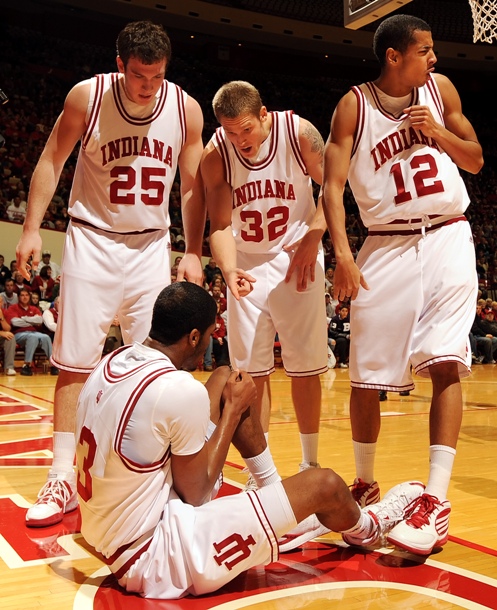
For the third time in less two years, Indiana's Maurice Creek has suffered a devastating injury that will cost him a significant amount of time.
In December of 2009, Creek -- then a freshman -- broke the patella in his left knee. He had last season cut short when he suffered a stress fracture in his right patella. And on Monday, Indiana officially announced that Creek had undergone surgery after tearing the achilles tendon in his left leg. He apparently suffered the injury in a non-basketball activity, but its unclear exactly what that activity was.
"This is a devastating blow for someone who has worked so hard to get himself in a position to help this program again," Indiana head coach Tom Crean said in a statement. "He is going to receive the best medical care possible and we will take his recovery one day at a time. I think the most important thing that we can do is to make Maurice know that despite his injury, he can serve a very vital role in helping our program and we will actively keep him involved every day."
His official status for this season in undetermined, but it should be pretty safe to assume that Creek will not be suiting up this year.
Frankly, I'm not sure how big of a loss this actually ends up being for Indiana. Don't get me wrong, Creek was a beast when he was a freshman. He averaged 17.6 ppg in the 11 games before he suffered that first -- gruesome -- injury, but Creek was just not the same player last year. There were flashes, going for 15 points at Boston College or scoring 12 points against Ohio State, but it was obvious that Creek wasn't his old self last season.
And as of September 20th, Creek still wasn't close to 100%. Crean told Yahoo's Jason King that "he’s not ready to practice. He’s done some one-on-one in limited settings but it hasn’t been with his teammates." I don't think off-base to assume that Creek likely would have struggled to even match the 8.4 ppg he averaged last season. With freshman Cody Zeller joining the now-upperclassmen Verdell Jones, Christian Watford and Jordan Hulls, the Hoosiers will have some pieces to work with. But if Crean is smart -- and I assume he is -- he has been preparing for this season as if Creek's availability would have been limited anyway.
In a way, that makes this injury even sadder. It sucks seeing a kid with a promising future in a sport suffer because of a serious injury. Seeing that kid suffer three devastating injuries in the span of 22 months is heartbreaking. Here's to hoping for a quick and complete recovery.
Continue reading...
You're surprised to hear about ESPN's role in expansion? |
This post can also be found at Beyond the Arc.
Like we've said over and over again, expansionocalypse is far from over.
For those that have been out of the loop over the Columbus Day weekend, here's a quick recap: TCU is expected to officially join the Big 12 today after receiving an offer from the league late last week; Missouri, who has been flirting with everyone from the Big 10 to the SEC over the last year, is trying to decide whether or not they will stay in the Big 12 and, more importantly, whether or not they actually have an offer from the SEC; and in an effort to try and shore up their league on the football front, the Big East is considering providing offers to Temple and Central Florida as well as Navy, Air Force and Boise State for football only. 
Boise State and Air Force in the Big East? So now, not only does the Big 10 have 12 teams and the Big 12 have 10 until Missouri leaves (and who can forget about the 14 team Atlantic 10), but the Big East now has teams that are farther west that current members of the Pac-12 and the West Coast Conference. Because that makes sense.
But the most talked about information to come out this weekend came from this article in the Boston Globe. For folks that live in the Northeast -- particularly folks like me, who spent the weekend in the state of Connecticut -- the big news from that story was Gene DeFilippo, the athletic director at Boston College, freely admitting that he and his school had been the driving force in the ACC adding Pitt and not UConn, whom the league originally wanted.
"We didn't want them in," DeFilippo told the Globe. "It was a matter of turf. We wanted to be the New England team."
Perhaps more interesting, however, was a different quote DeFilippo gave Mark Blaudschun where he all-but confirms what realignment conspiracy theorists have been stating all along.
"We always keep our television partners close to us," DeFilippo said. "You don't get extra money for basketball. It's 85 percent football money. TV - ESPN - is the one who told us what to do. This was football; it had nothing to do with basketball."
Why did this take people by surprise? Look, we've known all along that the juggling of conference alliances has been about nothing more than the money that can be generated by football and their TV contracts. Last summer, the ACC negotiated a deal with ESPN to televise their games that was worth $1.86 billion over 12 years, or $155 million annually which, more or less, comes to about $13 million for each school. With Pitt and Syracuse joining the league, the ACC will be able to renegotiate with ESPN for a bigger deal. And you're surprised that folks at the ACC had some communication with ESPN over who would be the most valuable addition?
This entire process is about money. The ACC did their due diligence in finding out from the folks that they have a television contract with which additions would make their (the ACC's) product the most valuable. And, for the record, you're naive if you believe this is the first time that ESPN has pulled some strings and influenced a change in the conference landscape.
That's why it seems so hypocritical when the folks at ESPN criticize schools for switching conferences. The company that signs their year-end bonus checks is the one that plays the role of Adam Smith's invisible hand.
Yeesh. Is anyone else sick of this yet? I'm going back to sleep. Wake me up when its over.
Continue reading...
Monday Morning Dump |
- TCU is as good as gone from the Big East
- Air Force is said to be heading to the Big East. But is it a done deal? The Academy is keeping it's options open
- The ACC is set with 14 teams, TV contract is the next big hurdle
- What does the future hold for the mid-major-conferences in this expansionocalypse mess? Don't think that the little-guys aren't thinking about it
- Boise State in the Big East? Sure, why the hell not? How many classes will a student athlete miss because of that Boise-to-Providence flight?
- Of course the new Big-XII chairman wants Missouri to stay
- According to The Boston Globe, ESPN played an important part in convincing Boston College to block UConn from joining the ACC in 2005
- John Calipari and Derrick Rose agreed to pay $100,000 in a settlement with fans threatening to sue because when the NCAA vacated the 2007-08 Final Four season
- Facts that support Rich Bozich’s clam that John Calipari is obsessed with Rick Pitino
- We should all be well aware that Bill Russell is suing EA Sports. But Deadspin wrote a fantastic article that you really must read
- Former-Big-XII commish Dan Beebe blamed Nebraska for the lack of equal rights deal
- Gary Parrish's "Five for the Weekend" is back. I don't care if it's Monday. Go read it
- John "Jet" Williams, aka "The Masked Dunker", was signed by the Harlem Globetrotters
- It's a good thing Marquette is better at basketball than they are at singing
- Rowing is not fun at all. But rowing at 5:00AM, that's just torture, or part of Temple's preseason conditioning regiment
- Washington head coach Lorenzo Romar compared freshman Tony Wroten Jr. to Magic Johnson
- Virginia Tech freshman Marquis Rankin had surgery on his injured knee and will be out of action for six to eight weeks
- UConn received their National Championship rings (#swaggy)
- Ray Mernagh explains why staying at VCU was an easy decision for Shaka Smart
- Former-Sacred Heart guard Chauncey Hardy was killed in Romania over the weekend
- Oklahoma State head coach Travis Ford is glad that the Cowboys aren't going to the Pac-12
- Now that Lawrence Bowers is out for the season, Missouri head coach Frank Haith is struggling to fill up the front court
- A November tournament primer for the Maui Invitational
- Devon Williams committed to New Mexico
- An inside look at the Seton Hall Pirates
- An inside look at the St. John's Red Storm. Speaking of St. John's, head coach Steve Lavin had surgery to treat his prostate cancer
- A fantastic primer of the Big South Conference provided by Rush The Court
- Andre Drummond is already impressing players and coaches at UConn
- Florida forward Cody Larson won't serve any jail time for his probation violation
- New Mexico State is shrinking the seating capacity in their arena with the hopes of creating a better home-court environment
- I'm not gonna lie, this is one of the worst opening sentences I've ever read
- There's a good chance that this is the shoe the Kentucky Wildcats wear this season
- I wish I could attend Matt Knight Madness at Oregon
I knew there was a reason why I love Mike Rice and Gil Biruta
Continue reading...
Friday, October 7, 2011
2011-2012 Top 50 Countdown: No. 21 Missouri Tigers |
Over the coming weeks, we will be counting down our Top 50 teams in the country. Teams 26-50 will be posted in groups of five, while we will count backwards from No. 25 to the No. 1 team in the country. You can find a complete schedule of our 2011-2012 Season Preview coverage here. To browse through the rest of the Top 50, click here.
Last Season: 23-11, 8-8 (t- 5th Big 12), lost to Cincinnati in the first round of the NCAA Tournament
Head Coach: Frank Haith
Key Losses: Mike Anderson, Justin Safford, Ricky Kreklow, Laurence Bowers
Newcomers: Frank Haith, Tony Lester, Kadeem Green
Projected Lineup:
- G: Phil Pressey, So.
- G: Marcus Denmon, Sr.
- F: Kim English, Sr.
- F: Ricardo Ratiffe, Sr.
- C: Steve Moore, Sr.
- Bench: Michael Dixon, Jr.; Kadeem Green, Fr.; Matt Pressey, Sr.
Outlook: Missouri was a bit of a disappointment last season. The Tigers returned a ton of talent from a team that won 22 games in 2009-2010 and went 10-6 in the Big 12. They started out the year ranked in the top 15 and climbed as high as No. 8 in the country at one point during non-conference play. But Missouri was never able to iron out their wrinkles. For starters, the Tigers were hit or miss defensively. While they were ninth in the country at forcing turnovers -- and probably the best in the country at forcing turnovers that led to wide open layups -- they struggled to force an opponent into a tough shot if their press was beaten, and were even worse when it came to the defensive glass, ranking 317th in the country in defensive effective FG%. While they were able to win their games at home, the Tigers went just 1-7 on the road in league play.
This season, however, with Frank Haith at the helm instead of Mike Anderson and his '40 Minutes of Hell' defense, the Tigers are going to be a team that plays much different. The good news is that the players on the roster are talented enough that they will be able to survive playing a different, more controlled style. The bad news is that they lost arguably their most important piece in Laurence Bowers.
Bowers tore his acl playing pickup in October and will miss the season, and there is a valid argument to be made that he was the most valuable player on this roster. On a team that doesn't have too much depth in the front court, Bowers was their second leading scorer last season and their leading rebounder and shot-blocker. A lanky, 6'8" power forward with some serious athleticism, Bowers was the most versatile defender on their roster, the perfect compliment to Ricardo Ratliffe on the front line.
Without him, Missouri will have a massive hole at the four spot. Ratliffe should be fine in the post, and may actually be better off playing in a slower system. He's a big body and a guy that has the ability to score on the block. He'll need to become a bigger presence on the glass this season, but he should be one of the better big man in the conference this season. Senior Steve Moore should get the first crack alongside Ratliffe, and while Moore was productive in limited minutes, it will be interesting to see how the 270 lb career reserve reacts to playing significant minutes for the first time in his career. The only other option up front will be Kadeem Green, a redshirt freshman from Canada with a similar physical profile to Bowers. Moore and Green are now the most important players on this roster.
Missouri's perimeter attack is going to be loaded. It starts with Marcus Denmon, an explosive scorer and sharpshooter at the off-guard spot. Denmon is one of the more underrated guards in the country and a guy that the stat gurus love. He was the 19th most efficient player in the country a season ago thanks to he sniper-esque 44.8% from long range, his impressive shot-selection and the fact that he doesn't turn the ball over. He averaged 17.2 ppg as a sophomore, so it will be tough to ask him for more, but the Tigers may end up needing it. 
Joining him on the perimeter will be Kim English, a 6'6" wing that had a season-long shooting slump last year. Mizzou will be counting heavily on him to return to his sophomore year form. If English can iron out the kinks in his jumper, he gives Missouri three players that are capable of going for 20 points on a given night. English may also be counted on to play bigger this season, as there will probably be times when he has to play the four spot if Haith is forced to use four guards. Another senior, Matt Pressey, rounds out the perimeter rotation.
Missouri also has two quality point guards on their roster in sophomore Phil Pressey, Matt's younger brother, and junior Michael Dixon. Pressey is the smaller of the two, but he's a lightening quick point guard that can get into the lane and create. Dixon is a better scorer and shooter than Pressey. Dixon isn't a big point guard, but he has more size than Pressey and is better at drawing contact in the paint. As a combination, they give Missouri a very good point guard rotation. Don't be surprised when you see them on the court together at the same time.
The Tigers will have a different feel than they have in the past, but they do have the talent to contend for the Big 12 title. That will be a more difficult task without Bowers, but its possible if English turns back into the scorer he was a sophomore and the Tigers get better both on the defensive end of the floor and on the glass.
Continue reading...
The Only Conference Preview You Need To Read: Atlantic 10 |
Over the next month and a half, we will be rolling out all of our 2011-2012 Season Preview posts. You can find a full schedule of all the preview posts here. If you want to browse through the rest of the conference previews, click here.
AWARDS
Player of the Year: Tu Holloway, Sr., Xavier
There is simply no argument that can be made for this award to go to anyone other than Holloway. The reigning Player of the Year, Holloway spent much of the season as one of only four players to averaged 20 ppg, 5 rpg and 5 apg -- Nolan Smith, Norris Cole and Charles Jenkins were the others -- before a five point performance against Marquette in the NCAA Tournament left him nine points short. Holloway is not overly explosive, but he is tremendously quick, which makes him difficult to stay in front of. He has a knack for drawing fouls and getting to the line, and one of the major reasons his scoring went up so much as a junior was the development of his mid-range game. I don't expect Holloway to post to same numbers he did last season -- 38.4 mpg, 19.7 ppg, etc. -- simply because I believe Xavier will have some more help offensively and improved depth. Holloway will still be the star, but he won't have to carry this team quite as often. One of the things that doesn't show up for Holloway in the box score is that he is at his best in the clutch. He wants the ball in his hands down the stretch, and he makes the big shots and the big plays late.
And a close second goes to...: Andrew Nicholson, Sr., St. Bonaventure
Nicholson is, hands down, the best post player in the Atlantic 10. Offensively, there isn't much that he can't do. He's got a very good low-post game. He can score on either block with either hand and he shows off solid footwork and fluid moves. Hopefully he added some strength to his frame, as being able to power through defenders is something he'll need at the next level. Nicholson also showed off a solid touch in the mid-range, out to about 15 feet. Seeing him get more active on the glass and better at recognizing the double-teams that will, no doubt, be flying as him all season long is going to be a key not only to how well he team does this season, but whether or not he's able to sneak into the first round of the NBA Draft after the season.
Breakout Star: Tyreek Duren, So., La Salle
Duren has the chance to become one of the better point guards in the conference. A well-regarded recruit coming out of Philly's Neumann-Goretti High School, Duren is everything you imagine when you think of a Philly kid. He can get out and push the ball in transition, something the Explorers did quite a bit of last season as they notched the seventh most possessions in the country. Duren can get to the rack, but he's also a capable creator, averaging 4.4 apg last year. Those assist numbers will likely go down as Duren become more of a focal point offensively; with La Salle losing a potential NBA forward and two 1,000 point scorers, there won't be as many options offensively.
All-Conference First-Team:
- POY: Tu Holloway, Sr., Xavier
- G: Juan Fernandez, Sr., Temple
- G: Mark Lyons, Jr., Xavier
- F: Ramone Moore, Sr., Temple
- F: Chris Johnson, Jr., Dayton
- C: Andrew Nicholson, Sr., St. Bonaventure
All-Conference Second-Team:
- G: Tony Taylor, Sr., George Washington
- G: Langston Galloway, So., St. Joseph's
- G: Tyreek Duren, So., La Salle
- F: Chris Gaston, Jr., Fordham
- C: Kenny Frease, Sr., Xavier
Four summer storylines
- Aaric Murray transfers to West Virginia: Aaric Murray just never bought into what John Giannini was selling. One of the most highly-regarded recruits to go to La Salle in a very long time, Murray had quite a bit of success of the stat sheet, averaging 15.2 ppg, 7.7 rpg and 2.3 bpg a season ago. But the versatile, face-up four never bought in on the defensive end of the floor and was, in fact, benched by Giannini on multiple occasions this past season. Murray made the decision to transfer to West Virginia, but he will leave a gaping hole in the front line of the Explorers, who expected another two seasons from the big man.
- Coaching changes: The biggest change in the coaching ranks was the decision of Brian Gregory to take over the head coaching position at Georgia Tech where Paul Hewitt had ben fired. It was a fairly smart decision by Gregory. He was starting to wear out his welcome in Dayton as his team's consistently underachieved, and with Chris Wright's graduation, the timing was right. The strangest decision came two months after Gregory left, as the new George Washington athletic director fired head coach Karl Hobbs just seven days into his tenure. Its interesting timing. While its true that Hobbs had not been able to sustain the success the program experienced in the mid-2000's, he had his best team in recent memory returning this year. As an interesting side note, Hobbs' firing meant that assistant Roland Houston lost his job. When he was hired at George Mason, his nephew -- top 75 center Eric Copes -- got a release from his letter of intent at GW and followed his uncle.
Perhaps the most surprising coaching maneuver of the summer didn't involve a coaching change. Richmond was able to keep Chris Mooney around, signing him to a 10 year contract, despite the fact that a number of bigger programs were interested in his services and that Richmond graduates four starters and their two first-team all-league players.
- Fran Dunphy's 'stache is no more: He lost a bet to Dionte Christmas, who got is degree this summer. So Dunphy paid his debt: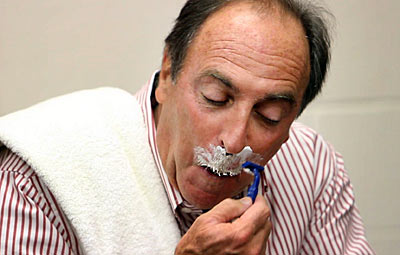
- Tornado's in Massachusetts: If what was an awful tornado season, the names and stories from Tuscaloosa, AL, and Joplin, MO, will not be forgotten anytime soon. And while the devastation wasn't on the same level as those two twisters, the tornado that ripped through Derek Kellogg's Springfield, MA, hometown caused plenty of damage. Three people died and a stretch of downtown was destroyed. Kellogg and some of his players helped in the rebuilding and relief efforts.
Four storylines heading into the season
- Can anyone challenge Temple and Xavier this season?: The battle for first place is, as always, going to be an entertaining one in the Atlantic 10 this season. Both Temple and Xavier bring back a number key pieces from last season and have enough talent on their roster that they will be in and out of the top 25 all season long. They only play once this season -- at 9:00 pm on Saturday, February 11th -- and if you haven't already circled that date in your calender, you are doing something wrong.
But perhaps more interesting is going to be the push for third place. After Temple and Xavier, things get messy. There are about six or seven teams that have a legitimate chance to finish third in the league. Watching the season play out will be quite entertaining.
- Is George Washington for real this season?: The Colonials have been an Atlantic 10 afterthought since 2007, but last season GW finished tied with Duquesne for fourth in the conference. They return the majority of that team, including star point guard Tony Taylor and Lasan Kromah, who was GW's second-leading scorer as a freshman before injuring his foot and missing all of last season. While there is new leadership in Foggy Bottom with Mike Lonergan taking over for Karl Hobbs, GW has the talent and the depth to be a factor in the conference race this season.
- How far does Richmond fall?: Its no secret that the Spiders lost as much as anyone in the conference to graduation. Kevin Anderson, the league's 2010 Player of the Year, graduated. So did star forward and NBA Draft pick Justin Harper. Dan Geriot and Kevin Smith, who both played huge roles for Chris Mooney's club are also gone. There are some pieces remaining on this team, however, but the talent is young, especially in the back court. Can Darien Breshers or Cedrick Lindsay become a star in the back court? Will Darius Garrett finally live up to the potential his athleticism gives him?
- Can Kwamain Mitchell return to the form that he had as a sophomore?: St. Louis was supposed to be the Atlantic 10's sleeper in 2010-2011, but a sexual assault allegation involving the team's two best players -- including Mitchell -- put a damper on that enthusiasm. But the Billikens didn't exactly have a disappointing season, as their freshmen developed and gelled late in the year. All five starters are back, and in addition to throwing Mitchell back into the fold this year, St. Louis adds Toledo transfer Jake Barnett, who averaged 12.9 ppg in 2009-2010. The one issue that may arise is that Mitchell plays essentially the same role as Mike McCall, a sophomore guard that led the team in scoring last season and averaged 14.6 ppg over his last seven games.
Power Rankings
1. Xavier: Last year was supposed to be the season that the Musketeers finally snapped that streak of consecutive NCAA Tournament appearances. Not only were they losing Jordan Crawford, but both Brad Redford (a torn acl) and Justin Martin (academics) were unavailable for coach Chris Mack. An 8-5 start to non-conference play only solidified that idea. But once league play started, the Muskies turned things around. Tu Holloway finished his transformation into one of the most unstoppable players in the country, Kenny Frease and Mark Lyons embraced and flourished in their roles as sidekicks and Dante Jackson and Jamel McLean were as blue-collar and valuable as they have ever been.
Obviously, Holloway will once again be the center piece of this team. There's not much to say about him beyond what is written above -- simply put, there is a reason that he will be all over preseason all-america teams. The key for Xavier is going to be ensuring that Holloway has plenty of help, and there are more than enough pieces to do so. In the back court it starts with Lyons, an athletic slasher that averaged 13.6 ppg as sophomore. He needs to be more consistent, however. Redford, who is one of the best shooters in the country, and Martin, who is a 6'7" small forward but has a reputation for being dangerous on the perimeter, will both be back in the fold, as will another freshman named Dezmine Wells. Wells is a very highly-regarded recruit, a terrific athlete that will be a star as he develops his offensive skills. Up front, Frease will be the focal point in the paint. Its taken time, but he is finally showing Musketeer fans why they were excited when he joined the program three years ago. His low-post game is finally developing and at 7'0", he can rebound and block shots. Four other players will get a crack at seeing minutes up front: junior Jeff Robinson is a defensive playmaker that would be a good fit replacing McLean; Monmouth transfer Travis Taylor averaged 17 ppg as a sophomore before sitting out last season; Vanderbilt Andre Walker is probably the most versatile of the group and can play both the three and the four if need be; and Griffin McKenzie is a face-up four with the jumper to spread the floor. Xavier will once again be a favorite to win the A-10.
2. Temple: Fran Dunphy finally broke his streak. 17 years and nine trips to the NCAA Tournament since the last time that he won a game in the Big Dance, Dunphy finally took his team past the first round thanks to a buzzer-beating leaner from Juan Fernandez. They almost won again, as the Owls took SDSU into a second overtime in the second round. It was the end of another very good season for Dunphy and Temple, one that saw them win 14 league games and 26 games overall.
Once again, Fran Dunphy has his Temple team in a position to make a lot of noise in the Atlantic 10. On the perimeter, the 2011-2012 version of the Owls is loaded. Point guard Juan Fernandez, who feels like he has been in college for a decade, returns for his senior season. His numbers dipped a bit as a junior, but don't be surprised when he has a big senior year as this team's leader. Ramone Moore turned into the Owl's go-to scorer as a junior, and should once again fill that role as a senior. Throw in a healthy Scootie Randall, talented junior Khalif Wyatt and a couple of hungry and capable youngsters in sophomore Aaron Brown (who performed well when moved into the starting lineup to replace the injured Randall late in the season) and freshman Will Cummings, and Dunphy will have plenty of options at his disposal. I would go as far as to say Temple has one of the best perimeter rotations in the country. Up front is a bigger issue, as Temple will have to replace Lavoy Allen, who was so important to this team's defensive attack. Michael Eric should be healthy and will be counted on for a big season defending the rim and cleaning the glass. Rahlir Jefferson should also see a bump in production as a junior and will be a factor rebounding the ball. Depth is the biggest issue on the front line. Behind Jefferson and Eric, Dunphy only has two big men in Anthony Lee and Jimmy McDonnell, both redshirt freshmen that still need to add weight and strength. Even with the front court question marks, Temple should give Xavier a run for their money at the conference title.
3. Saint Louis: Last season was supposed to be the year that the Billikens made a run at the Atlantic 10 title, but those plans were thrown into utter disarray when Kwamain Mitchell and Willie Reed, the two best players in the program, were kicked off the team and out of school over an alleged sexual assault. No charges were ever filed, and while Mitchell was readmitted to the school, midway through the season, he opted to redshirt instead of wasting a year of eligibility. As a result, St. Louis was left with a roster full of youth. The bad news was that meant the team started out the season slowly, but the good news is that a late-push combined with a couple of additions this season give SLU a reason to be hopeful for next year.
A second-team all-conference player as a sophomore, Mitchell had a shot at being the league's Player of the Year had he continued to improve. A 5'10" scoring guard, Mitchell is muscular and understands how to use that strength and his quickness. He's a big time player that hit a lot of big shots, but it will be interesting to see just how much sitting out a season affected him. Mitchell will only be a piece in what is a loaded back court for the Billikens. Sophomore Mike McCall was the team's leading scorer a year ago, going on a tear over the last seven games when he averaged 14.6 ppg. Senior Kyle Cassity and sophomore Jordair Jett also return in the back court, with sophomore Jake Barnett finally getting eligible after transferring in from Toledo. There are plenty of options on the front line as well. Senior Brian Conklin and sophomore Dwayne Evans were the second and third leading scorers, respectively, but both are short forwards. Rob Loe, Cody Ellis and Cory Remekun all started games as well. Throw in freshmen John Manning and Grandy Glaze, and front court minutes will be tough to earn. Seeing how all of the pieces will come together will be interesting, but this is a St. Louis team that can definitely make some noise this year.
4. George Washington: Karl Hobbs, who had been at George Washington for a decade, lost his job as the Colonial head coach after GW replaced their athletic director in May. It was odd timing for the coaching change. While understandable -- Hobbs had been unable to rebuild the program after fielding a top 10 team in the country in the middle of the decade -- it came at an odd time. The Colonials actually have a shot to do some damage this season. After winning 10 league games last season despite playing without Lasan Kromah, the Colonials essentially bring back everyone. Its not a bad situation for new head coach Mike Lonergan to be walking into.
GW's strength this season is going to be in their back court. As we mentioned, they will be getting Kromah back. Kromah is a 6'5" shooting guard that is dangerous when he gets hot. He missed last year after injuring his foot and getting surgery shortly before the season started, but as a freshman he averaged 11.8 ppg. He won't even be the best player in GW's back court as Tony Taylor, a senior that led the team in scoring and assists a year ago, is also back. Taylor is a playmaker, talented enough to make second-team all-league. Junior Bryan Bynes and and Aaron Ware and sophomore Dan Guest will round out the back court rotation. Junior Dwayne Smith and sophomore Nemanja Mikic should once again start at the forward spots. Smith is more of a small forward and a slasher, although he is the team's best offensive rebounder, while Mikic is the definition of a face-up four. Despite being 6'8", Mikic took 172 of his 205 shot attempts last season from beyond the arc, hitting 43.6%. The key for the Colonials may end up being what kind of production they get in the paint. Senior Jabari Edwards, who has had knee issues through his career, is a terrific shot-blocker, but can he become a bigger threat in the post and on the glass? Will junior David Pellom be able to score on the block? With Mikic's ability to shoot the ball at the four, there will be plenty of space in the paint for those two to operate, either with the ball or on the offensive glass. There is enough talent here for a top four finish in the league, but it is all going to depend on how Lonergan makes the pieces fit and whether or not the players buy into his system.
5. St. Bonaventure: Looking at their overall record, it wouldn't appear as if St. Bonaventure has made any progress over the past three seasons, as 15-15 turned into 15-16 and, in 2010-2011, 16-15. But for the first time since 2002, the Bonnies made a postseason tournament in 2011, losing in the first round of the CBI. That 2002 season was also the last time that they had finished above .500 overall. Throw in the fact that the Bonnies also finished at .500 in Atlantic 10 play and return four starters, and you start to understand why there is finally some optimism around this program.
The biggest reason for that optimism is their biggest player, Andrew Nicholson. Nicholson is a big-time scorer with a possible NBA career in front of him. He will, in all likelihood, averaged over 20 points again this season, and what makes him so dangerous is that he can do it with his back to the basket or by stepping out and knocking down a 15 footer. Nicholson is joined up front by 6'8" senior DaQuan Cook, a bruiser that was the team's best offensive rebounder. Marquise Simmons will provide front court depth. In the back court, starters and double-figure scorers Michael Davenport and Demetrius Conger both return, but the major loss will be Ogo Adegboye, who started at the point and was the facilitator for this team. Depth was, and still is, an issue for the Bonnies, highlighted by the fact that Adegboye averaged an obscene 39.0 mpg last year. With Derrick Millinghaus opting to enroll at prep school instead of at St. Bonaventure, where he may have ended up starting, the Bonnies will be forced to rely solely on Eric Mosely, a point guard transfer from Austin Peay.
6. Dayton: The 2010-2011 season was the end of a couple of disappointing eras. It starts with Chris Wright's graduation. Wright was a talented small forward with an unbelievable amount of talent and potential, and while he scored 1,600 points and will leave as a member of the winningest recruiting class in Dayton history, Flyer fans always believed that he could have been so much more. The other is head coach Brian Gregory. In his last few seasons at Dayton, Gregory -- who replaced Paul Hewitt at Georgia Tech -- fielded a team that underperformed given their expectations. And while its frustrating for the fans to watch a team expected to compete for conference title consistently finish in the middle of the pack, the fact that back-to-back 20 win seasons was a disappointment should tell you something about the program he built. 
The big loss of the offseason wasn't Gregory, however. It was Juwan Staten, a freshman point guard that was the team's third-leading scorer and the conference's leader in assists. Staten had a chance to be a special player for new head coach Archie Miller, but even with his departure, Sean Miller's kid brother should have plenty on options on the perimeter. Senior Chris Johnson, the second-leading scorer and rebounder for Dayton last year, appears primed to become the star of this team. He'll be joined on the wing by Paul Williams. Both Johnson and Williams are good enough shooters that they will be able to keep the floor spread. It will be interesting to see who takes over the point guard spot. Josh Parker is the senior veteran that backed up Staten last year, but fellow MVC cast-off Kevin Dillard (Dillard transferred in from Southern Illinois, Parker from Drake) has the talent to be a difference-maker for Dayton. Dillard dominates the ball and is more of a scorer than a distributor, which could end up being a problem. Dayton is deep up front, but with Wright gone it will be interesting to see who capitalizes on the available minutes. Josh Benson looks like he may end up being the anchor as he is the most dangerous low-post presence, but sharp-shooting senior Luke Fabrizius, junior Matt Kavanaugh, sophomore Dean Oliver and freshman Alex Gavrilovic will all see time as well. Dayton should finish near the top of the league, but we've all heard that before.
7. Duquesne: Midway through conference play last season, the Dukes looked like a team that was prepping to make a run at the NCAA Tournament. Despite being unable to earn a win against some of their bigger name opponents, Ron Everhart's club was sitting pretty at 8-0 in Atlantic 10 play, taking over the lead in the conference at one point. But a two-point loss to St. Bonaventure on the road sparked a downward spiral that Duquesne was never able to pull themselves out of. They would go on to lose six of their last eight games in league play and drop the opener of the A-10 tournament, taking themselves right out of contention for an at-large bid and sending themselves straight to the CBI. The worst part about that tumble is that the Dukes lost their two best players to graduation, and while the pieces are there to be able to fill the void left by Clark's scoring, finding a replacement for the all-around game that Damian Saunders possessed will be difficult.
Everhart will have a number of pieces to work with in his back court. It will start with sophomore TJ McConnell, who came in and started 30 games at the point last season. McConnell can do a lot of things well -- he was the fourth-leading scorer, the most consistent perimeter shooter and the leader in both assists and assist-to-turnover ratio -- and he should only get better as he continues to develop. Fellow sophomore Mike Talley and senior BJ Monteiro, the team's leading returning scorer, will start along side McConnell in the back court. Expect Monteiro to be the guy that gets Clark's shots and becomes the go-to scorer for the Dukes. Junior Sean Johnson, who players the role of lightening in a bottle for Everhart off the bench, and senior Eric Evans will provide perimeter depth. The front court is going to be a major question mark, as Duquesne had size issues last season as well. Andre Marhold is the best returner, but even he only managed 20 games and 45 points on the season. Derrick Martin, an athletic 6'9" post, could end up seeing a lot of minutes, but he's only a redshirt freshman coming off of a year in which he didn't qualify. With a couple of other freshmen joining the fold, it will be interesting to see how Everhart handles this team. With their back court strength, this is a team that can finish in the top five in the league. But with their lack of a front line, they could just as easily finish in the bottom five.
8. Richmond: The 2010-2011 season was arguably the best in the history of the Richmond program. They won a school-record 29 games. They won their first A-10 title, making a run from the three-seed to the tournament championship. As a capper, they knocked off both Vanderbilt and Morehead State en route to the Sweet 16 as a No. 12 seed. The bad news, however, is that so much of that success was the result of a stellar senior class -- Justin Harper was an NBA Draft pick, Kevin Anderson was a former A-10 Player of the Year, and Dan Geriot and Kevin Smith were both starters that played key roles.
And while the cupboard is certainly not bare, the most important returner this season is head coach Chris Mooney. Mooney made the decision to return to the Spiders despite the fact that he likely had a chance to make the jump to a bigger school in a more powerful league. This season will, in all likelihood, be a rebuilding year for Mooney, but that's more of a result of youth than it is of a lack of talent on the roster. In the back court, Darien Brothers -- a junior off-guard that started last season -- and sophomore point guard Cedrick Lindsay will likely get the first crack at starting. Both are talented players that should be expected to see their scoring jump up into double figures. Behind those two, three freshmen will be battling for minutes -- diminutive point guard Kendall Anthony, redshirt freshman Wayne Sparrow and swingman Trey Davis -- with junior Greg Robbins. In the front court, senior Darius Garrett is a terrific athlete and makes a lot of things happen in the paint, but his skills still need to develop to be effective. Francis-Cedric Martel, a senior, split starts with Kevin Smith, although he's more of a shooter than a defender or playmaker. Senior Josh Duinker and a couple of freshmen -- Luke Piotrowski and Alonzo Nelson-Ododa -- will provide depth. Richmond will probably still finish in the top half of the league, but it will be at least a year before they are competing for a league title again.
9. St. Joseph's: Its hard to believe that just eight seasons ago, Phil Martelli had an NBA back court on a team that was one of the best of the decade not only in the Atlantic 10, but nationally. But when you put together back-to-back 20 loss seasons, people tend to forget about your successes. That said, there is reason to be optimistic about the group that St. Joe's is bringing back. After starting out the year 5-16, St. Joe's rallied down the stretch of the season, going 6-6 in their final 12 games and making the semifinals of the A-10 Tournament.
The Hawks essentially bring back every important piece from last season's team, with the exception of Idris Hilliard. This group is going to be built around their back court of junior Carl Jones and sophomre Langston Galloway. Jones is a lightening quick, 5'10" point guard that averaged 17.0 ppg last season. Galloway is more of an off-guard than Jones, but he has the potential to develop into a first-team all-league player before he leaves Hawk Hill. Daryus Quarles will likely return to the starting lineup, where he plays the three, but the x-factor appears to be Chris Wilson, a freshman point guard that Martelli believes will be the missing piece in his back court. There is a ton of potential on the front court. CJ Aiken and Ronald Roberts Jr. were both highly regarded recruits, and both played well as freshmen. The key up front, however, may end up being Hofstra transfer Halil Kanacevic, a 6'8" sophomore that will provide some bulk (Kanacevic is listed at 258 lb, Aiken at 190 lb) on the interior. The Hawks should be more competitive this season, and I don't think finishing in the top half of the conference is out of the question. The best news? Everyone is back again for the 2012-2013 season.
10. Rhode Island: The Rams 2010-2011 season was what we've come to expect out of the Rhode Island program over the last few years. After performing well during the non-conference portion of their schedule, Jim Baron's club finished smack in the middle of the conference after a loss to St. Bonaventure in their regular season finale. The bad news? The end of the 2010-2011 season brought with it the end of an era. Delroy James, the Ram's leading scorer and rebounder last season, has graduated along with fellow starters Marquis Jones and Will Martell and reserve Ben Eaves. Throw in Daniel West's decision to leave school, Akeem Richmond's transfer and the fact that PJ Lockridge no longer appears on the team roster, and URI is going to have quite a bit of rebuilding to do.
There will be some pieces on this team, however. In the front court, senior Orion Outerbridge and junior Nikola Malesevic both return. Malesevic is a 6'7" face-up power forward with an a deadly stroke. If Outerbridge, who was productive in fairly limited minutes off the bench as a junior, can become a presence on the block, he and Malesevic will form a solid inside-outside duo. Junior Ryan Brooks should see minutes this season, as should Jonathon Holton, a 6'9" freshman with a similar skill set Malesevic. The back court will be a question mark until the semester break, when Billy Baron and Andre Malone both become eligibile. Baron is a sharpshooting sophomore that started his career at Virginia before deciding he wanted to play for his dad at URI, while Malone was a starter and a double-figure scorer at Auburn before transferring out. When they become eligible, they will give URI a solid perimeter attack when senior Jamal Wilson and freshman Dominique McCoy are factored in. But until those two are available, Rhody will be short-handed in the back court. Expect senior Anthony Malhoit and freshmen Mike Powell and TJ Buchanan to fill in. The Rams will be a middle-of-the-pack A-10 team once their roster is complete, but midseason additions are always a risk to team chemistry.
11. Charlotte: Last season could not have gone much worse for Charlotte. After a promising start to non-conference play, which included a four-game winning streak in their 8-6 record, the 49ers went just 2-14 in league play, missing the conference tournament when they lost to St. Joe's by one point on the final day of the regular season. It was more than just losses, however. Shamari Spears, who was the most talented player in the program, was suspended at the start of the season before eventually getting thrown off the team after just five games. Phil Jones was declared academically ineligible after the first semester. Throw in the injuries to a couple of bench players and a first-year head coach in Alan Major, and it should come as no surprise that Charlotte struggled.
The season did have its moments, however. Charlotte knocked off Tennessee by one in December and handed Xavier their only conference loss of the season. The 49ers also lost seven league games by single digits, including three in overtime. Despite their issues, this team was still competitive at times and they do have some talent returning. It will start with the back court. Senior Derrio Green and junior Jamar Briscoe both proved themselves to be talented scorers, capable of going off for big games. But they struggled with their consistency, as neither shot over 40% from the floor. Green took 207 threes on the season despite shooting just 27.1%. Part of that can be attributed to the fact that Charlotte needed them shooting to compete. One of the keys for Major will be to find a way to put those two kids in a position to score with needing them to force shots. There is some depth on the perimeter as well. Jarvis Barnett started 25 games and proved to be a consistent three point threat. Georgia transfer DeMario Mayfield should have an impact, as well as sophomore Luka Voncina, a talented guard that was ineligible last season. Throw in a couple of recruits, and Major has pieces to work with in his back court. The key returner up front is Chris Braswell, a junior that had a couple of big games inside. He'll need help from guys like KJ Sherrill, E. Victor Nickerson and Ijilia Ivanovic. There is some talent on this team, especially in the back court, but finding the right way to utilize that talent -- and getting some front court help -- will determine whether the 49ers can approach .500 in the A-10 this season.
12. Fordham: I say this without any hint of sarcasm -- Fordham's 7-21 season was a step in the right direction for the program. Not only were they able to win two more games than they had in the previous two seasons combined, but the Rams, under new head coach Tom Pecora, knocked off St. John's and ended a 41 game conference losing streak by knocking off UMass in the last game of the regular season. With only one player graduating and a number of key pieces with multiple years of eligibility left, the Rams are at least moving in the right direction.
For Fordham, it all starts with junior Chris Gaston, who averaged 15.9 ppg, 11.3 rpg and 1.5 bpg as his numbers dipped from his freshman season. Seeing his numbers go down was actually a good thing. It means that Gaston is starting to get some talent built up around him, that he isn't being asked to do everything when he is on the floor. Joining Gaston up front will be big senior Kervin Bristol, the team's leading shot-blocker and second-leading rebounder who averaged less than a shot-and-a-half per fame. Sophomore Marvin Dominique will also see time in the front court and should push Bristol for minutes. The back court will be anchored by senior Alberto Estwick and sophomores Lamont Samuell and Branden Frazier. Throw in a solid crop of freshmen, headlined by big man Ryan Canty, and Pecora has some pieces to build on. How much gets built this season depends on how that sophomore back court develops, but I'd expect Fordham to, at the very least, be more competitive this year, maybe even sneaking their way into the Atlantic 10 Tournament.
13. La Salle: Last year was the year for the Explorers. With a starting five that was as talented as any in the conference -- featuring a potential pro in center Aaric Murray, two 1,000 point scorers in Jerrell Williams and Ruben Guillandeaux, a Big East transfer on the perimeter in Earl Pettis and stud freshman point guard Tyreek Duren -- La Salle was a team built to make a push for the top of the A-10. But for all that talent on the offensive end of the floor, the Explorers simply could never find a way to get enough stops to win games consistently. The Explorers were atrocious defensively, which is a big reason they ended up finishing the year 15-18 and just 6-10 in the A-10.
While La Salle will lose both of those 1,000 point scorers to graduation, they also lose Murray after just two seasons. Murray didn't enter the NBA Draft, but whatever divide had built up between him and head coach John Giannini -- he was suspended twice during the season -- had become too much to overcome. Losing Murray could end up being a blessing in disguise, however, has he became a distraction last year. La Salle will also still have some pieces to work with next season. Duren will be the center piece of the La Salle attack and the sophomore, who averaged 9.8 ppg and 4.4 apg last year, has the potential to become one of the best point guards in the conference. Throw in Rutgers transfer Pettis, who started and averaged 9.1 ppg last season, and South Carolina transfer Ramon Galloway, who received a hardship waiver and will be eligible immediately after averaging double figures with the Gamecocks, and the Explorers have a very good perimeter attack. Sophomore Sam Mills will likely be the first guard off the bench, with freshmen DJ Peterson and Rohan Brown providing depth. The front court is a different story. Devon White is really the only returner, and he played all of 12 mpg last season. Matt Lopez is a redshirt freshman that still needs to add some weight, while true freshmen Steve Zack and Jerrell Wright will also be on the roster. La Salle's back court could be enough to get them in the neighborhood of .500 next year, but unless some size develops during the year, their potential as a team is limited.
14. UMass: Derek Kellogg's club started out the 2010-2011 season 7-0, finally looking like they were a team that could make a tun at finishing near the top of the Atlantic 10. But as their schedule got tougher, the Minutemen fell apart. The biggest problem? They couldn't find a scoring option outside of Anthony Gurley, who averaged 18.7 ppg, which was more than double the team's second-leading scorer. Unfortunately, both Gurley and back court mate Gary Correia graduated, leaving the Minutemen not only without a go-to scorer in the program, but also without one of the team's leaders and most experienced players.
The biggest issue for UMass next season is going to be finding back court play. With Correia and Gurley gone, Darryl Traynham having been kicked off the team and Trey Davis being ruled ineligible, the Minutemen are going to be forced to rely on some youngsters to provide the engine for a team that liked to get up and down the floor. Junior Freddie Riley, the team's third-leading scorer from a year ago that should move into the starting lineup this season, and sophomore Jesse Morgan are the returners of note. Freshmen Jordan Laguerre, an athletic left hander, should have an impact simply based on the way he plays, but the key could end up being Chaz Williams. Williams is a transfer from Hofstra, where he averaged 7.4 ppg and 4.2 apg as a freshman in 2009-2010. The UMass front line will remain intact next season. Junior Javorn Farrell will be counted on to play a bigger role, as will classmates Terrell Vinson and Sampson Carter. Sean Carter will provide some height on the interior, as will sophomore Raphiael Putney and redshirt freshman Maxie Esho. Expect UMass to fall somewhere in the middle of the A-10 this year.
Continue reading...
Thursday, October 6, 2011
2011-2012 Top 50 Countdown: No. 22 Florida State Seminoles |
Over the coming weeks, we will be counting down our Top 50 teams in the country. Teams 26-50 will be posted in groups of five, while we will count backwards from No. 25 to the No. 1 team in the country. You can find a complete schedule of our 2011-2012 Season Preview coverage here. To browse through the rest of the Top 50, click here.
Last Season: 23-11, 11-5 (3rd ACC), lost to VCU in the Sweet 16
Head Coach: Leonard Hamilton
Key Losses: Chris Singleton, Derwin Kitchen
Newcomers: Antwan Space, Terry Whisnant, Kiel Turpin, Jeff Peterson
Projected Lineup:
- G: Jeff Peterson, Sr.
- G: Michael Snaer, Jr.
- F: Deividas Dulkys, Sr.
- F: Okaro White, So.
- C: Bernard James, Sr.
- Bench: Luke Loucks, Sr.; Xavier Gibson, Sr.; Jon Kreft, Sr.; Ian Miller, So.; Terrence Shannon, Jr.; Antwan Space, Fr.; Terry Whisnant, Fr.
Outlook: For the first time in his tenure as Florida State head coach, Leonard Hamilton won a game in the NCAA Tournament. In fact, the Seminoles won two games, advancing to the Sweet 16. And if it wasn't for some questionable decision making by Derwin Kitchen at the end of regulation and on the final possession of overtime, Hamilton's club would have gone even farther. This wasn't necessarily a one-year flash in the pan, either -- Florida State has won 10 ACC games and 20 games overall the past three seasons, making the NCAA Tournament all three years. Duke is the only other ACC program that can make that claim. That's good company to keep.
The test for Hamilton's program is what happens this season. Not only does he loses Chris Singleton -- the Seminole's leading scorer and the best defender in the country last season, a player that Florida State built their vaunted defense around -- but Derwin Kitchen finally exhausted his eligibility as well. That means that Hamilton will be heading into this season without the only two guys who could score from one of the worst offensive attacks in the high-major ranks.
Florida State's strength is going to be in the front court. Bernard James -- a 26 year old senior who did multiple tours in Iraq as a Staff Sergeant in the Air Force -- will be the anchor along the front line. James, a JuCo transfer last season, took a while to really acclimate to playing this high of a level of basketball, but he became a capable scoring option and a quality shot-blocking and rebounding presence by the end of the season. In March, he averaged 11.8 ppg, 6.8 rpg and 3.0 bpg while shooting 70.3% (26-of-37) from the floor.
He is far from alone along the front line, as the Seminoles will go at least five deep. Sophomore Okaro White would be my pick to start alongside James. White is probably the most talented offensive option, even showing that he can step out and knock down a three, but he is also a good offensive rebounder and may be able to slide over and play the three if Hamilton wants to go big. Xavier Gibson and Jon Kreft are both centers that will see significant minutes. Gibson may start some games if Hamilton goes big. He was an important piece as a junior -- he's the second-best shot-blocker on the roster -- before a nasty fall in a game left him with a sprained mcl and a broken hand. Kreft's story is interesting, as he finally got himself eligible in December, which came after most of the other members of the high school Class of 2006 have graduated. Junior Terrence Shannon will also be in the front court rotation.
With the system that Hamilton runs, it almost doesn't matter who is actually on the court out of this front court quintet. Florida State is so defensive-minded that their role will be, essentially, to be big. Florida State plays physical on the perimeter, all-but daring their opponents to put the ball on the floor and try to finish around the rim. The Seminoles weren't the most efficient defensive team in the country because they were great at forcing turnovers or overwhelming their opponents on the defensive glass. But they were great at forcing teams to miss shots. Their perimeter players knew if they crowded their man and forced a drive or a challenged jumper that no one was scoring in the paint. 
Even with the loss of Chris Singleton, Florida State will still be an elite defensive team next season. Their biggest issue is going to be finding someone -- anyone -- that can score. The crux of that pressure will likely fall onto the shoulders of Michael Snaer. Snaer was one of the best recruits to ever pick Florida State, but he has yet to find any kind of consistency with the Seminoles. One of the issues is that Snaer tends to fall in love with the three-ball. He has the range to hit that shot, but he's too athletic to be settling for jumpers when he can get to the rim.
Snaer and Deividas Dulkys are probably the Seminole's best perimeter defenders that return. Offensively, Dulkys does some things well, but he needs to become more of a consistent spot-up shooter. The same can be said for Luke Loucks. In fact, one of the keys to Florida State's season is finding some one that can be a zone-buster, a player that is a good enough shooter to keep defenses honest and prevent them from packing a zone into the paint. Both of Hamilton's perimeter recruits -- Antwan Space and Terry Whisnant -- have a reputation as good shooters, which will definitely help.
The other key offensively is at the point. Ian Miller had some hype coming in as a freshman but failed to live up to it. He'll be battling for minutes with Jeff Peterson, who will become the first player to ever play in the Big Ten, the SEC and the ACC -- he transferred to Arkansas after two years at Iowa, earning his degree in the process and transferring to FSU without penalty for a grad year. Peterson started at both schools, but also lost a lot at both schools. One of these two will have to be able to break down a defense and create a scoring opportunity -- whether it is an open look on the perimeter for a teammate, a dump-off to a big man or their own good look at the rim. That is a must. Without it, Florida State's offense may just end up being too abysmal for their defense.
The Seminoles should once again compete for the third-spot in the ACC, but just how good they end up being on a national scale is going to depend upon how well their perimeter guys develop offensively.
Continue reading...
Thursday Morning Dump |
Ughh..... More Expansionsocalypse.
Question:
Why should we believe that these stuffy, old, out-of-touch (predominantly-white) gasbags in-charge know whats best for college sports?
How about we realign their job descriptions.
- Notre Dame is still monitoring the re-alignment landscape
- Missouri is now a free agent, and it looks like they want in the Big-Ten.... Or the SEC. If Missouri leaves the Big-XII, Kansas head coach Bill Self wants to end "The Border War". What exactly are the ramifications of Missouri's departure?
- SEC athletic directors met yesterday to discuss the integration of Texas A&M into the conference
- Louisville remains a candidate to join the Big-XII
- Word on the street is that Syracuse tried to join the ACC in 2003, but Virginia politicians kept them out
- SMU, Navy, Central Florida and Temple are being targeted by the Big East. Temple really wants back in
- Luke Winn hits yet another one out of the park. the Sports Illustrated writer recaps the entire recruiting season. Seriously people, he's the best writer in college basketball, and it's not even close
- I knew there was something bizarre about playing basketball on a boat, but I couldn't put my finger on it. Diamond Leung, thank you
- Just what the AAU hoops scene needs right now.... A wanted criminal
I swear there is no more talk of expansion after the jump
- Glen Logan gathers some web-reactions to John Calipari's ignorant geography lesson
- Diamond Leung did some good work on the couple of programs taking a stance against bullying (B.I.A.H remains steadfast in their "pro-bullying" beliefs.....Sarcasm, folks....Sarcasm)
- Jeff Eisenberg caught up with former-New Mexico star Daniel Faris to get his thoughts on the 2011-2012 Mountain West Conference
- Dana O'Neil provides us with a fantastic profile of Vermont head coach John Becker, who provides some very entertaining quotes. In order for Becker to get his shot at head coaching, former-head coach Mike Lonergan had to get offered his dream job, and he did
- Jason Groves breaks down the top juniors and seniors in the WAC
- There is a difference between a rivalry and "a very good game". The mid-'00s Patriots/Colts series wasn't a rivalry, and neither is the budding UK/UNC series
- The Oregon student section is getting it's own Nike shoe
- The "Brain Trust" over at the WWL continues their great series of non-con breakdowns for entire conferences. Eamonn Brennan tackles the CAA. Dana O'Neil rolls with the Atlantic-10. Andy Katz clearly got first pick, breaks down the Big East
- I guess it's about time to fire up the "This is the year Virginia Tech beats the bubble" chatter
- Speaking of Virginia Tech, here's a great profile on the two men making sure the hokies follow the rule
- Florida redshirt-freshman Cody Larson could end up facing jail time for violating terms of of his suspended sentence
- The Atlantic-10 continues to make changes to it's post-season tournament. Starting in 2013, the first-round home games will be eliminated
- New Mexico-freshman Hugh Greenwood once again proves that Australian is a funny language
- Some excerpts from a pretty-good interview with UNC head coach Roy Williams. Speaking of UNC, sophomore Reggie Bullock says he's back and ready
- I do hate linking to Jeff Borzello, but he does provide a pretty-solid read on Memphis' Will Barton and the example he is setting for future recruits
- A solid Q&A session with all-name all-star Andrew Andrews
- An awesome breakdown of Ric Barnes' flex offense (This post is in mid-season form. Great stuff)
- Florida Atlantic nabbed themselves another recruit
- I won tickets to the Charleston Classic (#TheTruth) so why not provide you with a preseason tournament primer
- According to Bobby Hurley, UCLA-bound Kevin Anderson is a cross between Magic Johnson and Larry Bird (MAYBE!?!)
- Jameer Nelson heads the 2012 class of Saint Joseph's Athletic Hall of fame inductees
- A quick-look at the most famous alumni in UMass basketball history
- St. John's head coach Steve Lavin is set to undergo surgery on Thursday to treat his prostate cancer
- OF COURSE you need to know more about the 2011-2012 DePaul Blue Demons squad. Speaking of DePaul, Star-forward Cleveland Melvin is hoping to build off of his standout freshman season, one in which he was named Big East Rookie of the Year
- Rutgers is getting a burst of energy from a talented crop of freshman guards
- Rush The Court provides a solid primer on the America East Conference
- Former-Weber State player Brad Barton was found dead on Tuesday. The cause of death is still being determined
- If you are a fan of the Ohio Valley Conference or any of it's teams, you might want to make sure you get ESPNU. Ten OVC conference games will be aired on ESPN's college station
- Reason #29 why we love college basketball
I think I'm going to enjoy Vanderbilt this season
(H/T Anchor of Gold)
Yeah, this looks kinda awesome
Prayer for a Perfect Season from Blowback Productions on Vimeo.
This is just entirely too easy for Syracuse fans

Continue reading...
Wednesday, October 5, 2011
Rivalry games and why not playing them is bad business, literally |
The latest in conference realignment talk -- which is a long way from finishing its spin cycle -- centers around Missouri and their not-so-subtle efforts to get into the SEC. This news comes just days after the Big 12 seemingly had created stability in a league on shaky legs by agreeing to pooling the money made off of Tier I and Tier II media rights and through a six-year grant of rights to the conference.
As you might imagine, Kansas head coach Bill Self was less than thrilled with this news, and I don't blame him one bit. He's the head coach of one of the biggest, most popular and most influential basketball programs in the country at Kansas, but since his school is lacking in football success and tradition, most projections of the eventuality of super-conferences have the Jayhawks on the outside looking in. Missouri jumping ship to the SEC, thus further weakening the Big 12, would make that inevitability one step closer.
"To me it's a great rivalry, one of the best in college basketball without question, but I don't think I would be interested in having a once a year game like I did when I was at Illinois, playing Missouri," Self told the Journal-World on Tuesday night.
"I could probably change my mind (but) trust me, we would have no trouble finding another non-league game to play. I love the rivalry. Playing home and home in the league is great and all those things ... (but) I can't imagine, why would we continue playing? If they choose to be somewhere other than with us and with the other schools that they’ve been a part of and could jeopardize the future of the other schools ... I'm not going to make a commitment now that we'd ever play again. I'm not saying we won't. I'm certainly not going to pretend that we would."
I strongly suggest you click and read through that link if you haven't already. Self is pissed, and if that's him holding back in the media, I'd hate to be the guy that committed four turnovers in the first half during one of his halftime lectures.
Now, it goes without saying that the worst part of this process of conference expansion is the death of rivalries, and The Border War is one of the best there is. It has been played uninterrupted since 1907, with Kansas leading the series 171-94. But this rivalry isn't just a case of two teams having played a lot of games over the years or a number of great games in recent seasons. And this isn't a case of one school simply not liking the other school.
The rivalry between the University of Kansas and the University of Missouri stems from the rivalry between the state of Kansas and the state of Missouri, which dates all the way back to before the Civil War. When our country was being settled and people were starting to spread out west, tensions rose between the two over the issue of slavery -- Missouri was a slave state while Kansas was a free state. The conflict turned bloody, particularly during the War.
Games between the two schools are always going to be heated. It doesn't matter if the teams involved are in a position to compete for a league title, because a .500 season can be defined with a win in the Border War. That's what a true rivalry is all about.
And taking that away from the fans because one school or one coach is butthurt over their rival's luck in landing a spot at the cool kid's table is not only a shame, but it would be dumb and shortsighted.
I'm calling out Bill Self here because he is the guy whose quotes made the rounds on the blogs this afternoon, but the same can be said for everyone on in the athletic departments and coaching staffs at schools like Texas and Texas A&M, or Syracuse and Georgetown, or Pitt and West Virginia.
Conference realignment has only stoked the flames of each of the four rivalries I've mentioned in this post. Georgetown fans are pissed that their program, which was a major reason that Big East basketball became the Big East basketball that we know and love today, is going to eventually be relegated to playing in a Catholic League that's on par with the Atlantic 10. Pitt and Syracuse fans are pissed their team is getting blamed for the death of the Big East when they simply made a move that everyone else would have made. West "f*cking" Virginia fans are pissed that Pitt was able to find a comfortable landing spot while they are getting denied by the SEC and the ACC. Texas A&M fans are pissed about the Longhorn Network while Texas fans are pissed Aggie fans are pissed about the Longhorn Network.
And all of that gets thrown on top of the hatred that already exists between the two schools. Think about the anticipation that would lead up to those games if they are only played once every season. Think about how many tickets would be sold. Think about how many folks would watch the games at home. Think about how many gimmicky t-shirts and bumper stickers and hats and posters can be sold.
This is supposed to be all about money, right? We are destroying the fiber of our collegiate athletics system because these schools are trying to make a quick buck, amirite?
So why would they pass up on a marketing opportunity like this? Because they are are pissed at each other? Because the opposite sides of the rivalry is holding a grudge against one another?
If people were smart, they would capitalize here, turning anger into a more intense rivalry, and those rivalry games into a more profitable event.
But if people were smart, we probably wouldn't be in this situation in the first place.
Continue reading...


 Posts
Posts