
Remember all that talk about James McAdoo enrolling at North Carolina a year early?
Well, we can put it to rest.
"I'm going back to high school," McAdoo told Adam Zagoria. "I made that decision like a week ago."
"I was telling myself that I wanted to go to Carolina, and that I really wouldn't mind missing my senior year and the McDonald's game. But once I thought about it, its something that I really wanted to do"
Personally, I think this is the right decision. During your senior year in high school, there are a lot of experiences that are once in a lifetime. Prom, graduation, senior week, the chance to be the star of his high school. You don't want to pass those up. I would love to be able to go back to college, but I'd never give up my senior year in high school to do so.
I understand the argument for enrolling early. It's incredibly impressive that McAdoo has prepared himself physically and academically to get to college a year early. He deserves praise for that. I also understand that he would face infinitely better competition in Chapel Hill than in high school not just in games but every day in practice.
But McAdoo is too young to be able to enter the NBA Draft until next season. And based on what we have seen from Andre Dawkins and Daniel Hackett, the last two players to enroll in school early, its not a guarantee to be successful.
Finish out high school. Enjoy your senior year and senior season. Come to UNC in 2011 and dominate against your age group.
There's no need for a 17 year old kid to rush his childhood.
Continue reading...
Tuesday, June 22, 2010
James McAdoo to return to high school, enroll at UNC in 2011 |

NBA Draft Prospects: Hassan Whiteside, Marshall |
Click here to find all of our 2010 NBA Draft prospect breakdowns.
Stats: 13.1 ppg, 8.9 rpg (2.7 off), 5.4 bpg, 52.4% FG, 1.9 t/o's
Size:
- Listed: 7'0", 235 lb, 21 yrs old
- Combine: 6'11 1/2" (with shoes), 227 lb, 7'7" (wingspan)
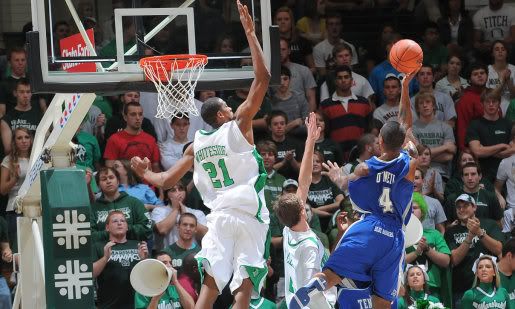
About Him: Hassan Whiteside basically came out of nowhere. He was a 19 year old that was coming off the bench for The Patterson School, a prep school in North Carolina, before committing to Marshall, a school in Conference USA, without a ton of fanfare from the recruiting services. But he set the world on fire in his one season at Marshall, leading the country in blocked shots, notching three triple doubles, and setting the Thundering Herd's all-time record for blocked shots. Not the single-season record, mind you. Whiteside is Marshall's all-time leader in blocks.
As a prospect, Whiteside is one of the more intriguing players in this draft. Whiteside is just a shade under seven feet with shoes one, and when combined with his 7'7" wingspan, he has a standing reach of 9'5", which is quite impressive. In addition to that length, Whiteside is a natural shotblocker coming over from the weak side. He has great timing and shows pretty good discipline when it comes biting on a pump fake.
He also projects well as a rebounder. He's active going to the glass, especially on the offensive end of the floor, and aggressively pursues the ball in the air. He's a good defensive rebounder, and will only get better as he adds strength. Where as most raw big man prospects struggle with natural scoring instincts, Whiteside is actually a good finisher in and around the basket. He has a very soft touch and is capable of knocking down perimeter jumpers, even hitting a couple three pointers this season. His length allows him fantastic extension finishing closer to the basket, and one numerous occasions during the season, Whiteside threw down a dunk he had no business finishing.
While Whiteside's strengths are as obvious as they can get, his weaknesses are as well. Whiteside has a long way to go in terms of his back-to-the-basket game. The majority of his points this season came as a result of catch-and-dunks, putbacks, and mid-range jumpers. That said, with some work, there's no reason that Whiteside can't become a post-up option in the NBA. We already know he has a soft touch, and he gets great extension on jumphooks and turnaround jumpers.
The bigger issue is Whiteside's strength. While he is pushing seven feet, Whiteside checked in at just 227 lb at the combine. He's thin, he has a frail frame that doesn't necessarily look like it can handle too much weight, and he has a long way to go in strengthening his lower body. Defensively, he really struggles at establishing position, getting backed down by big men at the mid-major level. He developed a bad habit of allowing a player to make a move and try to recover by blocking the shot, which was relatively successful at Marshall, but will not work in the NBA. Whiteside, right now, is a much better defender -- and shot blocker -- coming from the weak side than one-on-one. This lack of strength also means that he loses position too easily on the block offensively, which is why Whiteside had a tendency to float around the perimeter.
The biggest red flag are Whiteside's intangibles. He's not a typical freshman in college -- Whiteside just turned 21 years old, which limits his upside. He also comes in with a reputation of having a bad attitude and a poor work ethic. That is not a good thing for someone with the amount of development that Whiteside still has to do. Late in Marshall's season, Whiteside was benched for a multitude of reasons, which seemed to center around his eye on the NBA. Whatever the reason, that's not exactly a good sign for a prospect.
Comparison:
- Best Case Scenario: The obvious comparison is Marcus Camby. If Whiteside can fulfill his potential, he can be one of the best defensive centers in the NBA and possibly make a couple of all-star teams.
- Worst Case Scenario: Whiteside might be the most boom-or-bust prospect in this draft. Its just as likely that you never hear Whiteside's name again after Thursday night. I like the comparison of Patrick O'Bryant here.
Highlights:
Continue reading...
NBA Draft Prospects: Greivis Vasquez, Maryland |
Click here to find all of our 2010 NBA Draft prospect breakdowns.
Stats: 19.6 ppg, 6.3 apg, 4.6 rpg, 1.7 apg, 3.4 t/o's, 35.9% 3PT, 42.9% FG
Size:
- Listed: 6'5", 195 lb, 23 yrs old
- Combine: 6'6 1/2" (with shoes), 211 lb, 6'7" (wingspan)

About Him: There may not have been a more exciting player to watch in the country this past season than Greivis Vasquez. He stuffed the stat sheet, he played with loads of enthusiasm, and he made as many big shots as anyone this season. He was the ACC player of the year and for good reason.
Greivis Vasquez has an impressive all-around skill set. His scoring ability is evident by looking at his ppg averages over the course of his career. Averaging just a shade under 20 ppg as a senior, the place where Vasquez is the most dangerous is as a jump shooter. He's made impressive strides in this area during his career in College Park, knocking down a respectable 36% of his threes this past season, a number that is probably brought down by the degree of difficulty on some of the shots he takes.
Vasquez is an effective shooter off the catch and off the dribble, and that shooting ability is what sets up his penetration game. Vasquez is not a great scorer off the dribble -- he is an inconsistent mid-range shooter and does not have the length or the vertical explosiveness to be a finisher around the rim -- but he is an excellent passer and playmaker. While he still has a tendency to try and make the spectacular play as opposed to the smart, simple one, there's no two ways around the assist numbers he put up throughout his career. As a senior, his 3.4 t/o's are a bit unsettling, but when you consider how much Maryland relied on having the ball in Vasquez' hands and where his turnover numbers were when he came into Maryland, that stat gets a little less worrisome.
The two areas where Vasquez really excelled were in the pick-and-roll and in transition. He has tremendous court vision, and really understands how to get the ball to his teammates in a position that they can score.
The biggest knock on Vasquez as a potential NBA player is his athleticism. He entered the draft after his junior season, and his 26.5" max vert was the lowest at the combine (he didn't test this year). He's not explosive enough to finish in and around the rim. He doesn't have a great first step, and his lacking quickness made it difficult at times for him to penetrate against collegiate competition. While he did come up with some steals in his college career, his relatively frail frame, short wingspan (6'7" on a 6'6 1/2" player), and his poor lateral quickness make him a huge question mark on the defensive end.
This lack of athleticism means that Vasquez will completely have to makeover the way he plays in the NBA. Vasquez dominates the ball. He needs to ball in his hands to truly be effective, whether it is getting a shot for himself or a shot for his teammates. In the NBA, he is not going to be able to dominate in the same fashion. The biggest question mark -- other than his lack of athleticism -- is whether Vasquez can actually be a role player.
Comparison:
- Best Case Scenario: Vasquez is a difficult player to compare given his unique skill set. Marko Jaric is a name I've seen thrown out there a couple of times, and it is a comparison I like. A tall playmaker, Jaric did average 10 points and 6 assists one season.
- Worst Case Scenario: The worst case scenario for Vasquez is that he ends up in Europe, which isn't all that bad. He has more of a European game as it is, and playing in a lesser league, Vasquez can still make a quality living.
Highlights:
Continue reading...
NBA Draft Prospects: Damion James, Texas |
Click here to find all of our 2010 NBA Draft prospect breakdowns.
Stats: 18.0 ppg, 10.3 (3.1 off) rpg, 1.7 apg, 1.2 bpg, 50.1% FG, 38.3% 3PT
Size:
- Listed: 6'7", 225 lb, 22 yrs old
- Combine: 6'7 1/4" (with shoes), 227 lb, 7'0 3/4" (wingspan)

About Him: James declared for the NBA Draft after his junior season, electing to return to school after he failed to receive a guarantee that he would be picked in the first round. During his senior season, the Longhorns had an up-and-down year, starting 17-0 and climbing to a No. 1 national ranking before seeing their season collapse and end with a first round NCAA Tournament exit.
Individually, however, James' senior season was quite successful. James has always been known as a hard-worker, a junkyard dog, so to speak. He always hit the glass, he always ran the floor hard, he always dove on the floor for loose balls. Playing hard, playing the way that James does, is a skill, and there are few in this draft better than James.
The knock on James, however, has always been his ball skills, but as a senior James showed a lot of improvement in this area. While he is still a long way from being Ray Allen, James has become at the very least a capable jump shooter. He is at his best when he has the chance to spot up and be a catch-and-shoot player, but he also showed the ability to hit a pull-up jumper this season.
His handle was also much improved this season. He's not going to be running the point, and he's not going to be on the and-one mixtape anytime soon, but James is capable of squaring up his defender and getting to the rim. For the most part, this comes on straight lines drives as he tends to get himself into trouble when he is forced to change directions or crossover, but his length, strength, and athleticism allows him to finish through contact. Creating space for himself around the rim is not a requirement for James to score.
The problem? While James is greatly improved in both of these aspects of his game, he's still a long way from what you would consider at threat at the NBA level. In fact, his only NBA-ready skill is his ability to rebound. He goes after misses as hard as anyone in this draft class, has the strength to carve out some space in the paint, and seems to have an excellent feel for where a rebound is going to come off.
Defense is another question mark for James. While he has a solid frame, length, and size, he's still a bit undersized as a four in the NBA and he doesn't quite have the lateral quickness to guard a three on the perimeter. While he strength and toughness will help in these areas, James doesn't seem to project as a great defender at the next level.
Comparison:
- Best Case Scenario: If James can successfully develop the quickness to be able to defend an NBA three, I can see James becoming a rich man's Luc Richard Mbah a Moute. He is stronger, a better rebounder, and a better shooter.
- Worst Case Scenario: A guy that comes in and plays 8-12 mpg, providing defense, toughness, and versatility, maybe a Stephen Graham.
Highlights:
Continue reading...
Tuesday Morning Dump |
- Yesterday, we discussed at length whether or not the Washington Post writer made the correct decision in telling John Wall what his father had actually done to be sent to prison. He spoke with a blog yesterday, answering a few of those questions.
- Gary Parrish thinks the NCAA is actually trying to do some good in regards to cleaning up recruiting.
- Andy Katz has a bunch of updated news for us, including thoughts on Patric Young and Florida.
Da'Sean Butler on Outside the Lines:
- Jay Bilas takes a look at 2010's best prospects. His take on Cousins is quite interesting. Speaking of Cousins, he worked out with Derrick Favors yesterday for New Jersey, who has the third pick.
- Last week, we talked about a couple of quotes that Matt Jones was able to get out of John Calipari regarding his portrayal in the media. In the post, I wrote:Kentucky Sports Radio, the preeminent Kentucky sports blog run by Matt Jones, has been Calipari’s first line of defense, especially when dealing with the media. Two days after the Thamel story broke, Jones went off on Pat Forde — with his collateral damage being Mike Freeman and Thamel — questioning the ethics of the three sportswriters. It isn’t the first time that Jones has thrown someone under the bus in his defense of the Kentucky program. Anyway, if you can get past the blind homerism, Jones actually does make some good points.
Yesterday, on KSR, Jones responded:Here is an article from Ballin is a Habit, a national blog that I enjoy under the "even if they dont like us, that doesnt mean we cant like them" theory ... I would suggest that I didnt "throw someone under the bus" in defense of anything, and simply pointed out an obvious hypocrisy. I dont agree with the "blind homerism" (was I a blind homer when I lambasted Gillispie for a full year?), but hey that isnt the first or last time I will get called that name. Still an interesting blog and the first of many we will link up over the course of the summer to expand the internet reading of the Big Blue Nation.
For what its worth, I don't actually hate Jones or KSR. I actually think he runs one of the best team-specific blogs you'll come across. Its informative, they have a very good team of writers, and there's always new content being posted. If you're a Kentucky fan, and you don't read that site, you're not a very good Kentucky fan.
Liking and appreciating the work the guys do at KSR is a much different beast than actually agreeing with what they have to say. I have a differing opinion on some of the stuff that is written over there, but that doesn't mean I don't enjoy, and take advantage of (I used the quotes they got from Calipari in a post), the work they do.
Many thanks to KSR for the kind words.
- Good read on Jacob Pullen. The line everyone is talking about is where Michael Beasley said if he could do it all over again, he would stay in college for four years.
- Jamar Smith, the Illinois guard that almost killed former teammate Brian Carlwell when driving drunk, transferred to Southern Indiana and is looking to get drafted on Thursday.
- Utah State's 'Wild Bill' Sproat looks like he is going to pull through. He has a long road in front of him, however. Keep fighting, big man.
- USC recruit commits to play football and basketball in 2012-2013.
- A bit old, but Brett McMurphy spoke to some coaches about the one-and-done rule.
- Six weeks into his new job, St. Bonaventure assistant Michael Adams quits
- LaRob Dendy transferring from Iowa State to Middle Tennessee
- B.J. Young, a top-50 recruit in the class of 2011, dishes about his summer camp experience
- Ricky Stokes is back in basketball
- Ed Davis might be developing an ego a bit too soon
- Baltimore City recruit Nick Faust was a suprise-star at the Top 100 Camp
- Retired ACC commissioner Frank Barakat passed away yesterday
Continue reading...
Monday, June 21, 2010
Did a Washington Post writer cross the line? |
The article that set the world ablaze this morning was Eric Prisbell's profile of John Wall in this Sunday's Washington Post.
It is a tremendous read. Prisbell really gets Wall to open up to him about his relationship with his father, who spent much of Wall's childhood in prison. Seriously, if you haven't read it, go do it now.
Like I said, it is a tremendous read, and if it doesn't make you want to root for Wall, then you don't have a heart.
The article isn't perfect, however. At the very end, Prisbell reveals to Wall what exactly his father was in prison for. Wall did not know why his dad had been sent to jail -- he believed it was only for a robbery, but in fact his father had a much longer rap sheet, including second degree murder -- and Prisbell not only revealed it to him, but wrote about his reaction in the article.
Some, including myself, had a problem with this decision. From Kentucky Sports Radio:Now imagine that scene for a minute. Just days before John Wall reaches a goal that he has worked for his entire life, a reporter for a newspaper, someone who is likely a stranger to Wall, looks at him and informs him for the first time that his father had killed someone. To me, that action is wholly inappropriate and somewhat shameful ... [W]hile I probably would not have done that research into his father’s past and included it in the story, I dont think it is malicious to do so. But once the reporter knew that Wall was not aware of his father’s criminal past, I find it highly inappropriate for him to believe that he should be the one to break the news to Wall. It is clear that both his mother, and for that matter John, have made a conscious decision not to bring up that part of the past in their lives. For a reporter to believe he has the right to report that past is one thing. But then to take the next step and personally tell John and THEN to record his comments and include them in the story, to me that crosses the line ... [T]here are lines that reporters should not cross. If Prisbell felt like he owed the readers a look into Wall’s deceased father’s past, then so be it. But Prisbell should not have made himself the self-appointed messenger to personally tell Wall what is likely one of the most hurtful truths that could exist in his life. And even if he were to do that, to quote his natural reaction in a newspaper story is not a journalistic potrayal, but simply sensationalism.
I wholeheartedly agree with this.
Wall is 19 years old. Wall is still a kid, but he's a kid that has made a conscious decision not to find out why his father was in prison. Maybe it was because he didn't want to tarnish the memory of his father. Maybe it was because his mother didn't want him to know. Maybe Wall simply did not care.
Whatever the reason, it was not Prisbell's place to disclose this information to Wall.
The issue, however, is that this is Prisbell's job. He's a reporter, and if he is writing an article on the relationship between John Wall and his father, how can he not include these facts if he has them. And if he has this information, how can he not get Wall's reaction? Prisbell addressed these issues in a live chat on the Washington Post's website (consider everything sic'd):i was uncomfortable being in the position knowing such information that John may not have known (I didn't know what he knew before I talked with him). But when I got the records, it was then that I realized how long of a record the dad had. Before that, I just wanted to get the gist of what he had done if we had to include the background information.
I understand, and sympathize, with the position that Prisbell was put in. He's right -- the article was about the relationship between John Wall and his father, and if Prisbell had this information, he had to include into the article, no?
Once I got the records, then I found myself in a situation that I found to be unsettling. I've been in a lot of odd situations in my career, but this made me uncomfortable. First, I wrestled with the idea of IF I should tell John, etc. But, hey, the driving force in his life is his dad, and he cherishes the memories from those prison visits. If I incldue that, how do I not include what the dad did and how long he was in there?
Then the question became how to do it. I talked all this through with editors, of course. We wanted to handle this with extreme care. We wanted to be sensitive, delicate, respectful. Both in how we wrote it and how I talked about it with john. I did not want to mention specifics with John, and I did not. John and I got into the heavy stuff about 12 minutes into a 45-minute talk. We talkd for a long while after that. The fact is: Even after I told John, it did not change his feelings toward his father. That says something pretty strong about John and his relationship with his father. The three words that jump out to me when thinking about John: humble, polite and mature.
I udnerstand reasonable people can and will disagree on the disclosure issue. But i am comfortable with the decisions we made because of how I handled it.
Its a tough call. While I don't necessarily believe Prisbell crossed the ethical guidelines of journalism, I do believe he crossed a line of morality. John Wall may be the subject of an article you are writing, he may be the future of the Washington Wizards franchise, but this is still a human being who was delivered an incredibly important, meaningful, and potentially hurtful piece of information by a reporter.
But being a reporter, isn't his job to get the story? To ask the tough questions?
It is an incredibly difficult position to be in for Prisbell. And, to his credit, I think he handled it well. My one hope is that he ran this by Wall's mother before divulging it to Wall.
And for what its worth, Prisbell said that he disclosed this to Wall about a third of the way through a 45 minute conversation. If the information was that hurtful, would Wall have continued the interview?
Wall knew his father was in prison for a long, long time. If you're in prison for a long, long time, odds are pretty good that you committed a serious crime. Wall knew this, and it didn't bother him.
Maybe the crime his father committed truly didn't matter to him.
I've gone back and forth with this in my head all day, so I'll leave it at this: a reporter handled a difficult situation about as well as he could have. Hopefully, it didn't take away from what was a sensational article about how John Wall became the person that he is today.
Continue reading...
Taylor King leaves the Villanova team |
Taylor King was once a McDonald's all-american at Mater Dei High School in Los Angeles, a 6'9" forward with unlimited range and a scholarship to play basketball at Duke.
Today, King is a regular college student at Villanova.
It began as a message board rumor this morning, and was later confirmed by both ESPN's Dana O'Neil and the Villanova athletic department. Taylor King, who transferred to Villanova in the spring of 2008 after playing as a freshman at Duke, has decided to leave the Villanova basketball team. He will remain at the university to finish up his graduation requirements, but will not play basketball. King has two years of eligibility left.
 Taylor King has left the Villanova basketball team.
(photo credit: Zimbio)
You can search the Villanova message boards if you want to see the specific rumors, but what has officially been reported is that King violated team rules and, according to O'Neil's source, he has some "personal issues" to deal with.
It is debatable how much this loss will actually affect Villanova next season. King did average 7.5 ppg and 5.3 rpg last season, but his minutes decreased dramatically by season's end. Villanova head coach Jay Wright benched King for the final regular season game against West Virginia as a "teaching point", and King played sparingly in the Wildcat's three postseason games.
Villanova returns their anchor up front, senior Antonio Pena, but the Wildcats also have a lot of young talent along their front line. Mouphtaou Yarou and Isaiah Armword both showed flashes of potential as freshman and will benefit from more playing time as sophomores. Jay Wright also brings in freshman JayVaughn Pinkston, a 6'7" bruiser from Brooklyn, who should be able to contribute right away. While King's loss will hurt Villanova from a depth and experience perspective, King's preference to fire threes from 25 feet never really fit in with Wright's system.
Hopefully, King will graduate and find success in life without basketball.
While he may seem like a failure to some based on his lofty expectations coming out of high school, if all he has to show for his collegiate basketball career is a degree from Villanova, I think he made out pretty well.
Continue reading...
NBA Draft Prospects: Luke Babbitt, Nevada |
Click here to find all of our 2010 NBA Draft prospect breakdowns.
Stats: 21.9 ppg, 8.9 rpg, 2.1 apg, 41.6% 3PT, 91.7% FT
Size:
- Listed: 6'8", 215 lb, 21 yrs old
- Combine: 6'8 3/4" (with shoes), 218 lb, 6'11 1/4" (wingspan)

About Him: Like Paul George of Fresno State, Luke Babbitt is a talented forward from the WAC that has been shooting up draftboards, possibly landing somewhere in the lottery come Thursday night. Babbitt, a McDonald's all-american back in 2008 that had originally committed to Ohio State, doesn't have the upside of a Paul George, but thanks to an impressive showing at the NBA Combine, Babbitt has become one of the hottest prospects this season.
Babbitt's an excellent talent on the offensive end of the floor. Just a shade under 6'9" in shoes, Babbitt is a face-up combo-forward. Where as most combo-forwards are tremendous athletes that are long and rangy, but have neither the ball skills to play on the perimeter or the strength to play strictly in the post, Babbitt is the opposite. His skill set lends itself to being a perimeter player, but he doesn't necessarily have to quickness to be capable of being a three.
Babbitt's game is based around his jumper. He is a terrific shooter, especially in the mid-range and off the dribble, but he has also shown that he has NBA range. He doesn't have a tremendous first step, but he is quite a crafty player, able to use a multitude of jabs and fakes to create space and keep his defender off balance. At odd aspect of Babbitt's game is that he showed more prowess as a shooter off the dribble than off of the catch, but a large part of that could be just how much he had the ball in his hands.
Babbitt isn't only effective on the perimeter. While he will need to add some weight and some strength if he is going to be an effective low-post player, he already has a well developed high post game. He's not a powerful player -- he isn't going to be backing many people down from 15 feet -- but he does have a nice finesse game from the high post, mainly centered around an excellent turnaround jumpshot.
Babbitt is a capable ball-handler in the open floor and while attacking the basket, but he runs into some trouble when he is forced to change direction or when he faces ball pressure. When he does attack the basket, Babbitt shows great body control and decision making, capable of finishing around the rim and drawing a foul or pulling up for a short jumper or a floater.
Coming into the combine, the biggest knock on Babbitt was from the people that didn't think he would be a good enough athlete to warrant a pick in the teens. Babbitt put that theory to rest with an excellent visit to the draft combine. His max vert was an impressive 37.5" and his wingspan was 6'11 1/4", both two inches more than Blake Griffin tested out at last season. He also showed above average quickness and speed in the shuttle run and 3/4 sprint during the combine. Safe to say, Babbitt put some of the athleticism fears behind him.
But there are still those that aren't convinced. The biggest concern with Babbitt as a prospect seems to be what position he will be able to guard. He's not exactly quick enough on the perimeter to defend twos and threes, but he needs to add quite a bit of strength if he is going to be a post defender at the NBA Level.
Comparison:
- Best Case Scenario: A more athletic Troy Murphy in terms of offensive skill set, but I'm not sure that Babbitt will be able to get 10 rpg. I also like the comparison with Rashard Lewis, although I think Lewis might be a bit taller than Babbitt.
- Worst Case Scenario: Adam Morrison. If Babbitt can't defend anyone and can't get his shot off, where will he be able to play?
Highlights:
Continue reading...
NBA Draft Prospects: Elliot Williams, Memphis |
Click here to find all of our 2010 NBA Draft prospect breakdowns.
Stats: 17.9 ppg, 4.0 rpg, 3.8 apg, 1.3 spg, 36.6% 3PT, 45.9% FG
Size:
- Listed: 6'4", 175 lb, 21 yrs old
- Combine: Did not attend (injury)

About Him: After watching Elliot Williams ride the bench at Duke for much of his freshman season, you would be hard-pressed to believe that the sophomore swingman was considered a potential first round pick. But after averaging over 17 ppg as the focal point of the Memphis offense last season, that's exactly what Williams has become.
Offensively, Williams' game is based almost completely on his quickness. The 6'4", 175 lb, Williams has a tremendous first step and is excellent at beating his defender. This first step is part of the reason he is so good at getting to the foul line, taking 7.5 freebies a game, many of the and-one variety. The problem is that Williams, who is a lefty, really struggles when he is forced to go right. Not only is he much, much better at getting to the basket going left, Williams seemingly has zero confidence in his right hand around the rim. He routinely switches the ball back to his left hand, even if it means having to force up a much tougher shot.
This wouldn't be a huge problem if it wasn't for the fact that Williams has almost no mid-range game. Pull-up jumpers are a foreign concept for Williams, and he doesn't have much of a floater or runner in his arsenal either. That's not to say he isn't a good shooter. Williams knocked down a respectable 37% of his three balls this season. Most of those, however, came as the spot-up variety. When he has time, he can be an effective shooter, which leads one to believe that developing a mid-range jumper is a possibility.
What makes Williams intriguing as a prospect is his ability to pass. Williams averaged nearly 4 apg, and really looked for his teammates if he drew an extrta defender. There definitely seems to be some potential there as a playmaker at the next level. When he did get minutes his freshman season at Duke, he played the point, and while he's not a pure point guard, he definitely has the handle to give minutes as a primary ball-handler.
Defensively, Williams has excellent quickness, the size and length to defend the two, and good anticipation in the passing lanes. The problem is that Williams has a slight frame, weighing in at just 175 lb. He needs to add strength and weight if he is going to be an above average defensive player -- especially at the two -- in the NBA.
Comparison:
- Best Case Scenario: The comparison I've seen often is Jason Terry. Williams isn't quite as good of a shooter as Terry just yet, and he has a bit of size on Terry, but in terms of their style of play and role on the team, it is a good comparison. Cuttino Mobley is another name I've seen tossed around.
- Worst Case Scenario: I've seen Michael Dickerson thrown out there, which is decent. Maybe a poor man's CJ Miles.
Highlights:
Continue reading...
NBA Draft Prospects: Dominique Jones, South Florida |
Click here to find all of our 2010 NBA Draft prospect breakdowns.
Stats: 21.4 ppg, 6.1 rpg, 3.6 apg, 1.7 spg, 2.9 t/o's, 45% FG, 31.1% 3PT
Size:
- Listed: 6'4", 205 lb, 21 yrs old
- Combine: 6'5" (with shoes), 216 lb, 6'9 1/4" (wingspan)

About Him: South Florida found a diamond in the rough when they landed Dominique Jones three years ago. The Lakes Wales, FL, native averaged 17.1 ppg and 18.1 ppg, respectively, in his first two seasons for the Bulls, but USF didn't have much to show for it in terms of the win column. This past season, however, Jones averaged 21.4 ppg while leading USF to a 20 win season, a 9-9 finish in the Big East, and a trip to the NIT.
Jones' game is based around his ability to get to the basket. Jones is a muscular 6'5", 216 lb, and has a tremendous first step. He uses that strength and quickness when he puts the ball on the floor, and defenders in the Big East had a lot of trouble keeping him out of the paint. He isn't the most explosive leaper, which wasn't as much of an issue at the college level. He had the length (6'9 1/4" wingspan) and the strength to draw fouls and finish through contact, and developed a floater that he was able to knock down consistently.
Perhaps the best aspect of Jones' game is his ability to draw fouls. He has tremendous body control and coordination, and with his frame he is able to bounce off of bigger defenders in and around the paint. He averaged 8.5 FTA a game as a junior an knocked them down at a 74% clip.
Jones ability to penetrate becomes all the more impressive when considering the two areas of his game that are lacking on the offensive end. Jones almost exclusively attacks going to his right hand, showing more confidence and more ability to get all the way to the rim. When he went left, he was much more likely to pull-up in the mid-range. The problem is that the biggest weakness in Jones offensive arsenal is his jumpshot. He has a slow release and pretty poor form, which results in very inconsistent results from the perimeter. It is going to take considerable work to get his jumper to the point that it can be considered a weapon offensively, but if he does, watch out.
Jones projects as a combo guard in the NBA, but he can absolutely play the point. He's not necessarily averse to being a playmaker -- he averaged 3.6 apg this past season. He dominated possession of the ball during his time at South Florida, but for the most part it seemed like he made the effort to find open teammates. His Bull teammates just weren't always that talented. Jones is effective creating in the pick-and-roll, and is a willing passer as well, which is something that will be an asset for NBA teams as Jones seems to be destined to be a sparkplug off the bench.
On the defensive side of the floor, Jones has the potential to be very good. As we mentioned, his physical profile is outstanding. He has the size, strength, and lateral quickness to physically overwhelm a point guard, and given his length he should be able to defend two guards -- especially those on the second team -- effectively. He's an aggressive defender as well, unafraid of going chest to chest with his man when that player has the ball.
Another aspect of his game that deserves mention is Jones ability to rebound the ball. He averaged 6.1 rpg on the season, and collected quite a few of those on the defensive end. He's capable of grabbing a rebound and leading the break.
Comparison:
- Best Case Scenario: The comparison that I have seen quite a bit is Rodney Stuckey, which is a pretty good best case for Jones. Stuckey is a starter and puts up points with a lacking jumper.
- Worst Case Scenario: A DaJuan Wagner type of career arc. If Jones can't add a jumper and can't improve his left hand, he won't be playing for long in the NBA.
Highlights:
Continue reading...
Monday Morning Dump |
- ESPN's Outside The Lines featured DeMarcus Cousins: Perception v. Reality. For my money, I think Cousins will hang around the league for a while, but I don't necessarily believe he will become a star.
- Fantastic read on John Wall and his relationship with his father.
- Transcripts of a draft Q&A session with Fresno State's Paul George (Make sure you read the response he gives regarding the WAC competition)
- The Dagger is putting together an interesting list of NCAA underachievers that have had success in the NBA. DeAndre Jordan and Jrue Holiday were the first two players profiled.
- An incoming-Ball State recruit was denied access to the school even though he met academic standards by the end of the season. (Sounds like BSU is trying to wiggle out of the NLI.) However the case, Niagara U. saw no problems with his grades, and the former BSU-recruit will become a Purple Eagle.
- Cal Bears coach Mike Montgomery would not be a happy camper if his school was split up from USC and UCLA in the Pac-12.
- People in Tennessee are still fans of Tyler Smith. He got a standing ovation when he returned to Knoxville for a summer league game.
- Most NBA players go broke spending their money on cars, clothes, and women. Manute Bol went broke building schools and hospitals in his native Sudan. Few people loved and helped their country as much as Manute Bol did. RIP.
- Lance Stephenson and the NBA.
- An awesome breakdown of the high school class of 2006.
- Clearly, Jim Boylan is happy about Utah's move to the Pac-10. Hopefully, the Utah-BYU rivalry will continue.
- Top Kentucky high school player Chane Behanan will be a future star, just not at Kentucky. Behanan was named MVP of the NBA top 100 camp at UVa over the weekend.
- Tom Izzo is a hero in East Lansing.
- Longtime Mississippi State assistant Robert Kirby will leave Starkville for the Nation's capital. Kentucky signs Kenny Payne as an assistant.
- A good-read on why athletes are short-changed by the "one-and-done" rule
- Yet Another Basketball Blog details the state of coaching: 2010 edition
- Get to know recruit Luke Mergerson
- Come 2012, remember the name Ian Baker
Continue reading...
Sunday, June 20, 2010
NBA Draft Prospects: Ed Davis, UNC |
Click here to find all of our 2010 NBA Draft prospect breakdowns.
Stats: 12.9 ppg, 9.7 rpg, 2.7 bpg, 57.8% FG
Size:
- Listed: 6'9", 215 lb, 21 yrs old
- Combine: 6'9 3/4" (with shoes), 227 lb, 7'0" (wingspan)

About Him: After a freshman season that saw Davis put together some impressive performances as the sixth man for a national title winning UNC team, there were some lofty expectations for the youngster coming into the 2010 season. An up-and-down year ended when Davis broke his wrist in February, and after a bit of speculation regarding his draft status, Davis decided to turn pro.
Davis has quite a bit of upside, but as a player he is still quite raw. Athletically, Davis is quite impressive. Almost 6'10" in shoes, he's capable of getting out and running the floor. He is quite explosive as well, sporting a 36" max vert. Combine that with his solid wingspan, and Davis has the tools to be an effective pro.
The problem is that Davis currently has no idea how to use those tools. Despite being as athletically gifted as he is, Davis isn't all that coordinated. He moves well when running end to end, but he isn't great when he is forced to get into a defensive stance or make a move in the post or on the perimeter. And while he has a frame that looks like it can hold quite a bit of strength and weight -- broad shoulders, long arms, etc. -- it is going to be a while before he fills outs. This becomes an issue in the post defensively. Far too often, Davis gave up good post position to an offensive player.
As a player, Davis does a couple of things really well. For starters, his length and athleticism allow him to be an excellent target and finisher around the rim. The majority of his points the last two seasons came as a result of finishing off offensive rebounds or dump-offs around the basket. He's also a very good shot-blocker and rebounder, showing an understanding of helpside defense and the discipline not to bite on a shot fake. On the glass, he is active -- on both ends of the floor -- and has the ability to go and get rebounds out of his area. As he improves his strength, and thus his ability to box out, Davis could turn into a very good rebounder at the next level.
Offensively, Davis is still quite raw. His back-to-the-basket game consists almost solely of a left-handed jump hook, which is actually quite effective. Beyond that, however, he looks weak and mechanical when attempting anything more complicated or advanced. His perimeter game is non-existant. According to Draft Express, Davis took four jump shots all season long. He has almost no ball-handling ability, and is not much of a passer. In other words, he has a long way to go before he would be considered an offensive threat in the NBA.
Comparison:
- Best Case Scenario: The comparison I've seen the most of lat has been Al Horford. I think Davis is a little more athletic, while Horford definitely has more strength than Davis, but it Horford is a pretty good best case scenario. A rebounder and shot-blocker that can get you 12-15 ppg.
- Worst Case Scenario: The other comparison I've seen quite a bit is another former Tar Heel, Brandan Wright. Both long, slender athletes that left school quite raw offensively. Wright averaged 8 points and 4 boards for the Warriors this year. If his offensive never comes around and Davis spends time in the weight room, a career path along the line of Dale Davis isn't out of the question either.
Highlights:
Continue reading...
Saturday, June 19, 2010
NBA Draft Prospects: Jordan Crawford, Xavier |
Click here to find all of our 2010 NBA Draft prospect breakdowns.
Stats: 20.5 ppg, 4.7 rpg, 2.9 apg, 1.3 spg, 39.1% 3PT, 46.2% FG, 2.4 t/o's
Size:
- Listed: 6'4", 195 lb, 21 yrs old
- Combine: 6'4 1/2" (with shoes), 198 lb, 6'7" (wingspan)

About Him: After a solid, yet unspectacular freshman season at Indiana where he averaged 9.7 ppg on a team that included Eric Gordon, Armon Bassett, and DJ White, Crawford -- the younger brother of former Kentucky star Joe Crawford -- bounced after Kelvin Sampson imploded the Hoosier program, transferring to Xavier. A relative unknown, Crawford put his name on the map during the summer of 2009 when he caught the King himself getting lazy on helpside defense with the dunk heard 'round the world.
Crawford hasn't slowed down since. The 21 year old sophomore got off to a slow start to the season, but finished the year averaging 20.5 ppg as the main offensive option for a Xavier team that tied Temple as the A-10's regular season champ. Crawford is a gunner, through and through. Simply put, the kid can flat out score, and he does so in a variety of ways. He has awesome range on his jumper, which he can hit off the catch or off the dribble, with a hand in his face, out to (no exaggeration here) about 30 feet. Ask Kansas State. He takes quite a few (very) low-percentage three-point shots this season, and he still managed to shoot over 39% from deep. Think about that.
Crawford has also become proficient in the mid-range game. He can knock down pull-up and step-back jumpers at a pretty consistent rate. And while he is at his best with the ball in his hands -- a "slasher" is the term most have used here -- Crawford is much better in the mid range than he is at finishing around the rim. The dunk on LeBron aside, Crawford was just a slightly above average athlete at the college level. He's not terribly explosive, and his slight frame doesn't help him absorb contact all that well. He can does have a few floaters, short jumpers, and runners in his arsenal, but he is inconsistent at knocking those down, mainly because they end up being very difficult shots.
There are two main problems that Crawford has as a prospect. The first is that he needs the ball in his hands to be effective. He's not the kind of player that is going to run off of a screen and knock down jumpers. He's not as effective spotting up on the wing. He's at his best when he has the ball in his hands and is allowed to break down a defense to create a shot for himself. Unfortunately, Crawford is not going to be afforded the opportunity that he had at Xavier; he won't be allowed to take 15-20 shots per game and dominate possession of the ball. If he doesn't develop the ability to play off the ball, he may find his minutes limited at the next level.
The other issue is his shot selection. Crawford makes a lot of very difficult shots, but he also takes quite a few dumb ones as well. Chris Mack had to live with it at Xavier this season because the Musketeers only had limited offensive options. But in the NBA, Crawford isn't going to be able to take contested 27 footers with 15 seconds left on the shot clock.
Defensively, the potential is there. He's got decent lateral quickness, good length, and the size to cover a point guard or a two guard if need be. But at the college level, he gambled too much and never really put in the effort. Part of that was how much Xavier relied on him offensively, the question is going to be, however, how big of a part was it?
Comparison:
- Best Case Scenario: Jamal Crawford is pretty good comparison for Jordan. Similar size and skills sets, and Jamal had some good seasons in New York. A more realistic best case is probably a more athletic Flip Murray or a bigger Will Bynum, a sparkplug off the bench that gets minutes because they can put up points in a hurry.
- Worst Case Scenario: Maybe a guy like an Eddie House, if Crawford can get used playing off the ball. A role player that gets limited minutes as a shooter to spread the floor.
Highlights:
Continue reading...
Friday, June 18, 2010
NBA Draft Prospects: Xavier Henry, Kansas |
Click here to find all of our 2010 NBA Draft prospect breakdowns.
Stats: 13.4 ppg, 4.4 rpg, 1.5 apg, 1.5 spg, 41.8% 3PT, 1.9 t/o's
Size:
- Listed: 6'6", 210 lb, 19 yrs old
- Combine: 6'6 1/2" (with shoes), 210 lb, 6'11 1/4" (wingspan)

About Him: Xavier Henry looked like he was going to be a superstar early on in the season. With the loaded Jayhawks playing a relatively easy schedule in November and December, Henry shined, hitting over 50% from deep for a while and averaging 17 ppg. He had come back down to earth by the end of his freshman campaign, finishing the season with respectable averages of 13.4 ppg and just under 42% from three point range.
As you might imagine, Henry's game centers around his ability to knock down spot-up jumpers. When he gets he feet set, shoulders squared, and a decent look at the rim, Henry is a dangerous shooter off of the catch. He got quite a few of these looks playing alongside Tyshawn Taylor and Sherron Collins as a freshman, taking nearly 50% of his FGA from beyond the arc.
Henry still needs to develop some all-around offensive polish, however. He really struggles when he is forced to shoot off of the dribble, as he just doesn't look comfortable pulling up. Where his form is picture perfect on a catch-and-release, he looks a bit herky-jerky and far less fluid shooting off the bounce. He also struggles a bit when he is forced to get all the way to the rim. While he can really get up when he is given time and space, he's not quite as explosive in traffic. He's a decent finisher around the rim, but given the fact he has a 36.5" max vert (he's only at 28.5" on a no-step vert, which is a huge increase), an excellent wingspan, and one of the stronger frames at his position in this draft, you would expect him to be a better finisher and better at absorbing contact around the rim.
As a passer, Henry only averaged 1.5 apg, but he showed willingness to move the ball within the Jayhawk offense and also proved to be at least capable of finding the open man when he put the ball on the floor. But again, he didn't put the ball on the floor all that much as a freshman, which limited his opportunities.
One other aspect of Henry's offensive game that impressed me during the season was his ability to get out and run a lane on the break. Granted, he was playing with one of the best point guards in the country, but Henry seemed like he really understood spacing on the break, getting quite a few wide open threes and finishing off highlight reel alley-oops with thunderous dunks.
Defensively is where the question mark resides. Henry is a good, not great, athlete, struggling a bit with his lateral quickness. He seemed to have some trouble staying in front of smaller, quicker guards last season, which could be a problem if he is going to play the two in the NBA. He feasibly could be a three, but at 6'6" he might be a touch on the small side (although he nearly 7'0" wingspan helps in that department). To play for Bill Self, you have to be able to defend, so clearly Henry puts in the effort and, at the very least, has an understanding of the fundamentals.
Comparison:
- Best Case Scenario: Draft Express lists James Posey as Henry's best case, and while I like the comparison as far as roles go, I think Henry has more of an upside than Posey. He's better offensively. How about Jason Richardson late in his career?
- Worst Case Scenario: A CJ Miles or a Martell Webster.
Highlights:
Continue reading...
NBA Draft Prospects: Avery Bradley, Texas |
Click here to find all of our 2010 NBA Draft prospect breakdowns.
Stats: 11.6 ppg, 2.9 rpg, 2.1 apg, 1.6 spg, 37.5% 3PT, 1.5 t/o's
Size:
- Listed: 6'3", 180 lb, 19 yrs old
- Combine: 6'3 1/4" (with shoes), 180 lb, 6'7 1/4" (wingspan)

About Him: Avery Bradley entered this season with a ton of hype, even being ranked as the No. 1 overall recruit by ESPN over John Wall. And while its difficult to talk negatively about a freshman averaging almost 12 ppg, Bradley did not quite live up to expectations in his one season in Austin. While some of that was a result of being on a Texas team that simply could not figure out their issues, the major reason Bradley disappointed some people is because of the type of player he is.
Bradley is not a great offensive player. He's an excellent shooter off the catch or pull-ups off of one or two bounces, but that is about the only area he really excels offensively. He's not a great passer or shot creator. In fact, when he put the ball on the floor this past season, it was a virtual certainty that a shot was going up. He simply does not see the floor well at all.
This would not be a huge issue if Bradley was a great scorer, but he isn't. He really struggles once he gets inside about 10 feet. An exceptional athlete in terms of quickness and explosiveness, he seems to be the kind of player that can only get off the ground when he has a runway to do so. He struggled at finishing in and around the rim this year and he was very poor at drawing fouls and getting to the line. Some of this can be remedied by improving his upper body strength (he was only able to bench 185 lb twice at the combine) and teaching him how to elevate in traffic. What Bradley really needs to do is develop a floater and short runner. If he struggled to finish at the rim in college, it won't get any easier at the next level.
Players with Bradley's size generally project as point guards or combo-guards. Both of those roles require the ability to create shots, either for yourself or others. Bradley does not excel at either of those two facets of the game.
Where Bradley does excel -- and where he will have to find his niche in the NBA, at least in the early years -- is as a defender. He may very well be the best one-on-one defender in this draft. He's exceptional defending off the ball, capable of fighting through screens and keeping the ball out of the hands of a star. If that player does get the ball, Bradley has great length (over a 6'7" wingspan) and extremely quick feet. At the college level, he made life difficult for each and every player for which Bradley drew the assignment. Difficult to get the ball in a position to score, and difficult to make a move or get a shot off once that player made the catch.
The problem is that in the NBA, if Bradley is ever going to be a starter, he will have to be an off-guard. Will he be able to defend when night-in and night-out he is checking bigger and stronger players? Quick feet don't help when you are backed down to the block and you watch someone four inches taller take a turnaround jumper over you.
Comparison:
- Best Case Scenario: Comparing Avery Bradley with a guy in the NBA is difficult to do, because there really aren't that many players with his skill set. Russell Westbrook is a decent comparison, but even the raw Westbrook is a better offensive player than Bradley, and he's a point guard. Maybe a more athletic George Hill? ESPN is comparing him to Monta Ellis, which I like in regards to athleticism, but not as much in style of play.
- Worst Case Scenario: Again, its really tough to compare Bradley to anyone given his skill set. Who is a lock down defender and 12 ppg scorer in Spain's top division?
Highlights:
Continue reading...
Friday Morning Dump |
- The Mountain West Conference won't expand anymore, instead settling for having Boise State replace Utah. Andy Katz said there is no reason the rivalry between the Utes and BYU cannot continue with Utah heading to the Pac-10.
- Lawmakers in Houston are pushing for the University of Houston to be accepted into the Big XII. I don't see this happening, not with Texas hoarding Big XII TV money. Hopefully it will be awhile before the Big XII does anything; apparently, the ten teams signed a ten year deal to remain together.
- The Big East has denied that Orlando TV report that they are close to adding Memphis and UCF.
- Thankfully, it doesn't appear that Maryland has any interest in joining the Big Ten. As of now, the biggest question seems to be how the league will break up their divisions.
- Speaking of the Big Ten, Iowa State's Fred Hoiberg, who has no head coaching experience, has hired former Charlotte head coach Bobby Lutz.
- Good read from Luke Winn on incoming UNC freshman Harrison Barnes. That kid is for real.
- Draft Express caught up with Da'Sean Butler.
- I'm sure you've heard about Evan Turner's childhood by now -- Dana O'Neil had this fantastic piece back in November -- but here's a good read from the Philly Daily News.
- Billy Donovan made the right decision returning to Florida.
- Marcus Jordan, who averaged 8.0 ppg for Central Florida, doesn't like Kobe being compared to his pops.
- John Wall unveils his new, very-wizard-like Reebok sneakers. He then challenged Obama to 1-on-1 after his workout in DC yesterday.
- The Knight Commission Report came out yesterday.
- University of San Francisco get's 2-year probation after more than a dozen athletes improperly spent more than $13,000 in scholarship money
And here is the rest of it.
Continue reading...
Thursday, June 17, 2010
How good can Kyrie Irving be? |
Adulation of a star recruit is far from an uncommon occurrence. In fact, I'd go as far as to say its an anomaly when a coach doesn't turn up the hype machine for an incoming freshman, especially one that is a consensus top five recruit.
That's why it should come as no surprise that Kyrie Irving, seemingly the next great Duke guard, is getting shown quite a bit of love from those around the Duke program.
Steve Wojciechowski, the former Duke point guard and current Duke assistant coach, compared Irving to Bobby Hurley and Jay Williams. That's pretty good company to share a sentence with.
 Is Kyrie Irving the next great Duke guard?
(photo credit: NJ High School Hoops)
Williams himself weighed in, saying that he thought that Irving was better than John Wall. Yes, that John Wall, the soon-to-be No. 1 pick in the 2010 draft.
Howard Garfinkel, the legendary recruiting guru, did both of them one better. "He can pass the ball with either hand brilliantly," Garfinkel told Adam Zagoria. "He's got great moves to the basket. He's very unselfish. He's an outstanding 3-point shooter. And he's lightning quick. What's left? Irving could make them back-to-back champions, he's that good."
Not just one national title, but back-to-back?
That, ladies and gentlemen, is what we call the hype machine.
Having said that, isn't it possible that Irving is actually this good? Could it be that Irving isn't just on the receiving end of the typical Duke recruit love-fest (Josh McRoberts, Shavlik Randolph, DeMarcus Nelson, Ryan Kelly, need I go on?), that he may end up being the best point guard in the country next season?
Before you answer that, digest this quote from Coach K, pulled from the same Zagoria article:
"We'll change our whole offense, the way we play because of Kyrie. Just like we did when we had Jason Williams. He'll make a big impact right away. He's going to be very, very good."Jay Williams had a big impact as a freshman. I'm talking 14.5 ppg, 6.2 apg, and the national freshman of the year award.
But Irving is walking into a much different situation than Williams.
You see, Williams' freshman season was the 1999-2000 campaign. That team had to replace their top four scorers -- Elton Brand, Trajon Langdon, Corey Maggette, and William Avery -- all of who ended up in the lottery in the 1999 draft.
Duke is the reigning national champion. They bring back all-american and reigning Final Four MOP Kyle Singler. They still have the Plumlees anchoring what should be a big, athletic, and versatile front line. Lest we forget that their back court already consists of Nolan Smith (who will make an appearance on quite a few all-american lists), Seth Curry (Steph's little brother that spent a year working on his game after averaging 20 at Liberty as a freshman), and Andre Dawkins.
Jay Williams joined a team that was looking to retool and that needed a star.
Kyrie Irving is joining a team that would be a Final Four and national title favorite if he had gone elsewhere.
And Coach K is still going to build his offense around Irving.
Maybe it isn't just 'hype' after all.
(Just because I love youtube videos, here are some clips of Irving for your viewing pleasure. Make your own decision on Irving.)
Continue reading...
NBA Draft Prospects: Gordon Hayward, Butler |
Click here to find all of our 2010 NBA Draft prospect breakdowns.
Stats: 15.5 ppg, 8.2 rpg, 1.7 apg, 29.3% 3PT
Size:
- Listed: 6'8", 200 lb, 20 yrs old
- Combine: 6'8" (with shoes), 211 lb, 6'7 3/4" (wingspan)

About Him: Gordon Hayward decided to forego his final two years of eligibility to enter the NBA Draft after leading the Butler Bulldogs on an impropable run through the NCAA Tournament. Hayward was the go-to option and, for the most part, the star for Butler, who came within inches of pulling off one of the greatest upsets in NCAA Tournament history. Seeing as his stock was as high as it would ever get, he made the jump.
As a prospect, Hayward does not have the ceiling of someone like a Paul George or an Al-Farouq Aminu. As an athlete, his tools are fairly limited. His wingspan is actually less than his height, he's not an overly explosive guy, and he doesn't have the lateral quickness or the strength of a lot of guys at this position. He's not a kid that relies on his natural gifts in order to be an effective player.
Hayward does have a very high basketball IQ, however. He understands the game and how to be effective despite his physical limitations. As a freshman, most off Hayward's offense came off of his ability to shoot, whether it was knocking down a catch-and-shoot jumper or taking advantage of a defender closing out long. He has a pretty quick first step and is a capable ball-handler when slashing to the basket.
A big concern for a lot of NBA people is going to be the decline in Hayward's three-point shooting percentage -- he dropped below 30% for the season -- but that number is misleading. For starters, Hayward is at his best when he can be a catch-and-shoot kind of player, and seeing as Butler lacked a real playmaker, he did not get a ton of open looks this past season. When he did, they came as a result of his ability to use a screen; he moves very well without the ball and understands how to v-cut and set up the man guarding him. His shooting ability was no secret this season, and teams forced Hayward to put the ball on the floor.
This forced Hayward to show off a bit more of his all-around game, which he has in his arsenal. He looked much better in the mid-range this season, knocking down quite a few tough pull-up jumpers. He has also developed an excellent step-back jumper which he can hit out to the three point line. His handle is ever improving -- Hayward was a guard before a growth spurt in high school -- and was actually considered at asset at the college level given his size.
While he's not going to be dunking over many players in the league, Hayward actually developed into a pretty good finisher around the rim. He has tremendous coordination and body control, and as he continues to put on strength, he has been better at absorbing contact. He's active on the glass as well, showing willingness to get into the paint and hit the offensive glass.
The biggest question mark is on the defensive end. Butler was arguably the best half-court defensive team in the country by the end of last season, but Hayward's ability as a 1-on-1 defender has been questioned. He's not incredibly quick laterally, has relatively short arms, and he still needs to add some strength to his frame. In college, Willie Veasley usually matched up with the best player at the three or four spot, while Hayward would defend the other. That was in the Horizon League. He's going to be defending twos and threes in the NBA. That is a big step up.
Comparison:
- Best Case Scenario: Somewhere between a Mike Miller, a Mike Dunleavy, and a John Salmons.
- Worst Case Scenario: Adam Morrison, buried on a bench somewhere.
Highlights:
Continue reading...


 Posts
Posts

