Showing posts with label Gordon Hayward. Show all posts

Thursday, June 17, 2010

NBA Draft Prospects: Gordon Hayward, Butler

Click here to find all of our 2010 NBA Draft prospect breakdowns.

Stats: 15.5 ppg, 8.2 rpg, 1.7 apg, 29.3% 3PT

Size:

  • Listed: 6'8", 200 lb, 20 yrs old
  • Combine: 6'8" (with shoes), 211 lb, 6'7 3/4" (wingspan)


About Him: Gordon Hayward decided to forego his final two years of eligibility to enter the NBA Draft after leading the Butler Bulldogs on an impropable run through the NCAA Tournament. Hayward was the go-to option and, for the most part, the star for Butler, who came within inches of pulling off one of the greatest upsets in NCAA Tournament history. Seeing as his stock was as high as it would ever get, he made the jump.

As a prospect, Hayward does not have the ceiling of someone like a Paul George or an Al-Farouq Aminu. As an athlete, his tools are fairly limited. His wingspan is actually less than his height, he's not an overly explosive guy, and he doesn't have the lateral quickness or the strength of a lot of guys at this position. He's not a kid that relies on his natural gifts in order to be an effective player.

Hayward does have a very high basketball IQ, however. He understands the game and how to be effective despite his physical limitations. As a freshman, most off Hayward's offense came off of his ability to shoot, whether it was knocking down a catch-and-shoot jumper or taking advantage of a defender closing out long. He has a pretty quick first step and is a capable ball-handler when slashing to the basket.

A big concern for a lot of NBA people is going to be the decline in Hayward's three-point shooting percentage -- he dropped below 30% for the season -- but that number is misleading. For starters, Hayward is at his best when he can be a catch-and-shoot kind of player, and seeing as Butler lacked a real playmaker, he did not get a ton of open looks this past season. When he did, they came as a result of his ability to use a screen; he moves very well without the ball and understands how to v-cut and set up the man guarding him. His shooting ability was no secret this season, and teams forced Hayward to put the ball on the floor.

This forced Hayward to show off a bit more of his all-around game, which he has in his arsenal. He looked much better in the mid-range this season, knocking down quite a few tough pull-up jumpers. He has also developed an excellent step-back jumper which he can hit out to the three point line. His handle is ever improving -- Hayward was a guard before a growth spurt in high school -- and was actually considered at asset at the college level given his size.

While he's not going to be dunking over many players in the league, Hayward actually developed into a pretty good finisher around the rim. He has tremendous coordination and body control, and as he continues to put on strength, he has been better at absorbing contact. He's active on the glass as well, showing willingness to get into the paint and hit the offensive glass.

The biggest question mark is on the defensive end. Butler was arguably the best half-court defensive team in the country by the end of last season, but Hayward's ability as a 1-on-1 defender has been questioned. He's not incredibly quick laterally, has relatively short arms, and he still needs to add some strength to his frame. In college, Willie Veasley usually matched up with the best player at the three or four spot, while Hayward would defend the other. That was in the Horizon League. He's going to be defending twos and threes in the NBA. That is a big step up.

Comparison:
  • Best Case Scenario: Somewhere between a Mike Miller, a Mike Dunleavy, and a John Salmons.
  • Worst Case Scenario: Adam Morrison, buried on a bench somewhere.
Outlook: At Butler, Hayward was asked to do a lot of things he isn't going to need to do in the NBA. He isn't going to be the main shot creator. He's not going to be the focal point of an offense. He's going to be a role player, which fits his skill set perfectly. If he can refind that jump shot, he will spread the floor. He's a good enough and smart enough scorer to be effective as a complimentary option, and will be dangerous with his well-rounded offensive arsenal. Unlike a lot of players in this draft, his effectiveness as a pro is going to be determined by his ability to defend. Will he be able to guard someone like a Paul Pierce or Danny Granger? If he can, than I can see Hayward ending up as a guy that averages 11-13 ppg and knocks down 40% of his threes. That's not bad for someone projected to go somewhere in the 12-20 range.

Highlights:


Continue reading...

Thursday, May 6, 2010

Gordon Hayward is staying in the draft

If the title didn't give it away, Gordon Hayward has made the decision to keep his name in the NBA Draft.

"I'm pretty ready," Hayward told the Indy Star. "My mind's pretty made up, and it's been made up for a while now, at least since talking to my dad about it after the (college basketball) season. I've never really wrestled with it, at least in a pure basketball sense; it was no decision for me."

Like it or not, this is the right decision. Hayward is all but guaranteed to go in the first round of the draft, and there is a very good chance he could climb up into the lottery with a few good workouts. Remember, Hayward had a bit of an underwhelming season. If he hadn't help carry Butler to the national title game, I don't think his name would be mentioned as a potential lottery pick.

The question now becomes what to do about Butler. If Hayward had returned, they would, without a doubt, be a top five team in the preseason.

But without him? Are they still a top 25 team?

While guys like Shelvin Mack, Matt Howard, and Ronald Nored return, keep in mind this is a team that really struggled to score at times last year, and now they are losing their most talented offensive player.

I wonder if Brad Stevens is going to regret passing up on Oregon's millions when he had a chance.

Continue reading...

Monday, April 26, 2010

2010 NBA Draft Early Entrants: The biggest impact

The NBA Draft's Early Entry deadline came and went on Sunday. Today, we will provide you with a bit of fodder over how some of this year's decisions could sway the 2010-11 college basketball season. For a complete list of this year's crop of early entrants, click here.

While we all have issues with the earlier withdrawal deadline, the good news is that there actually is an option to withdraw from the draft. As you all know, players are allowed to test the waters one time -- they can enter the draft, go to some of the workouts with NBA teams, get a feel for where they would be getting drafted and what they can do to improve that standings, and then return to school to improve their overall game.

Who are the guys who can change the landscape of college basketball if they decide to return?


Jordan Crawford, Xavier, sophomore: Crawford had the kind of NCAA Tournament performance that makes a player an NBA Draft prospect. He was nothing short of incredible has he averaged 29.0 ppg in leading a young and relatively inexperienced Xavier team into the Sweet 16. The Muskies return most of that young talent as well, with power forward Jason Love the only player that is graduating.

Jordan Crawford could make Xavier next year's Butler.
(photo credit: Indy Star)

If Crawford stays in the draft, which is something many expect him to do -- he has a shot of going in the first round -- Xavier still should end up being a tournament team. A back court of Terrell Holloway, Mark Lyons, and Dante Jackson combined with a front line anchored by seven-footer Kenny Frease should be enough to get the Muskies an at-large bid. But with Crawford on the roster, is it too much to say that Xavier would be the hands down favorite in the Atlantic 10, and a team that may sneak into some top 10's?


E'Twaun Moore and JaJuan Johnson, Purdue, juniors: Both Moore and Johnson said back in March that they would be returning to school next season, and like we said back then, you always need to take that kind of statement with a grain of salt. Both juniors have declared for the draft, but both would be better suited by returning to school for their senior seasons.

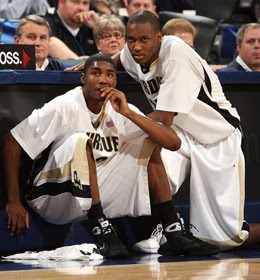
E'Twaun Moore and JaJuan Johnson could lead Purdue to heights they didn't reach this season.
(photo credit: SLAM)

Moore will likely not be drafted. As good as he is at the college level, he lacks the size and the explosiveness of an NBA two-guard. Johnson has some potential, but he still has quite a thin frame and settles too much for perimeter jumpers. Johnson has a better shot of going somewhere in the second round than Moore, but with the amount of talent available in this year's class, Johnson would probably have a better chance of getting that guaranteed contract if he came back.

Purdue has a chance to, once again, be a Final Four contender. With Robbie Hummel coming back from knee surgery and guys like Lewis Jackson, Kelsey Barlow, John Hart returning as well, the Boilermakers have a solid core. If they can get Moore and Johnson back, this is a team that can compete for a Final Four and potentially a national title. If they don't, Purdue may struggle to even make the NCAA tournament.


Gordon Hayward, Butler, sophomore: Butler became the feel good story of the decade in college basketball when they made their run to the national title game in their home city. The crazy part about that run was that it was made a year early. In other words, with the youth on Butler's roster, they have a chance to be even better next season, pending Hayward's NBA Draft decision. Willie Veasely and Avery Jukes both graduated, but the rest of Butler's roster will be back next season, including Matt Howard, Shelvin Mack, Ronald Nored, and even Brad Stevens.

If Hayward does return, Butler could end up being a top five team in the preseason. But he has a realistic shot at being a mid-to-late first round pick. It will be interesting to see what Hayward does.


Demetri McCamey and Mike Davis, Illinois, juniors: Illinois has a chance to be very good next season. The only player of significance that they graduate is Dominique Keller, they return both of their vaunted freshmen in the back court, and bring in a very good recruiting class. This is likely a tournament team if McCamey and Davis stay in the draft. But neither player is a lock to be a first rounder. Davis isn't even a lock to be drafted, while Draft Express is predicting McCamey to go somewhere in the second round.

McCamey really came on down the stretch last season. He has always been a talent at the point, McCamey's problem was shot selection and decision making. He's also had an attitude problem, at one point this season storming off the floor and bumping Bruce Weber as he walked by. Davis simply is not strong enough yet. A 6'9" forward, he does most of his damage on the offensive end with his jumper. That isn't going to cut it in the league.

With these two back in the line-up, Illinois has a chance to compete in what should once again be a top heavy Big Ten. And if McCamey can continue to improve from where he left off last season, seeing Illinois as a potential Final Four team is not out of the question.


Samardo Samuels, Louisville, forward: Let's face it: Samuels is not yet ready for the NBA. He's a bit undersized and not quite as athletic as NBA teams would like. While he does have a pretty advanced post game, he just simply doesn't have the tools that an NBA team is looking for in a post player. He's around 6'8" and 250 lb, but he's more of a center than a power forward. 6'8" centers don't last in the NBA.

Louisville certainly could use him. They lose Jerry Smith, Edgar Sosa, and Reginald Delk, Terrence Jennings has yet to prove he can be a consistent post presence, and Rick Pitino is hemorrhaging recruits. With Samuels, Louisville might be able to steal one of the four byes in the Big East tournament. Without him, they very well could be playing on the tourney's first day.

Continue reading...

Wednesday, April 7, 2010

"Sports Science" on Gordon Hayward's shot

We've all said it.

Gordon Hayward was mere inches from hitting what would have gone down in history as maybe the great moment in sports of all-time.

But just how close was he?


Less than the width of a shoe lace. Wow.
Continue reading...

Thursday, November 5, 2009

2009-2010 College Basketball Season Preview: Small Forwards

The season is fast approaching. The first games are on Nov. 9th, and the BIAH live blog during ESPN's season kickoff is just two weeks away. So with just a week until actual games are played, we figured the best way to finish up our 2008-2009 season previews is to give you our Top 10 players at each position. You know how much we love a good Top 10 list here.

A few caveats. First, we're talking about how good these guys are as college players, not how well they project as a pro. Second, while it may be too much power for me, I am making the executive decision on what "position" a player is (and it may not necessarily be what he is listed as on a roster). Third, I am not putting the freshman in the list. As much as I've read about these guys and as many Youtube clips as I have watched, I have yet to see many of them play a real game (the all-star games don't count), and I don't think that I could give an accurate assessment until I see them play. Lastly, I love me a good argument, so if you think someone is too low or too high or the wrong position, leave a comment and let me hear about it.

Here are the point guards.
Here are the shooting guards.
These are the small forwards.

Best Freshman

  • Jordan Hamilton, Texas
  • Jamal Coombs-McDaniel, UConn
  • Noel Johnson, Clemson
Best of the Rest
  • Tasmin Mitchell, LSU
  • Edwin Ubiles, Siena
  • Quincy Pondexter, Washington
  • Patrick Christopher, Cal
  • Klay Thompson, Washington State
  • Marcus Ginyard, UNC
  • Wesley Witherspoon, Memphis
Top 10
  • 10. Raymar Morgan, Michigan State: As a junior, Raymar Morgan battled mono all season, and thus had the least productive year of his career. Morgan has great size and strength for a wing, which is only complemented by his athleticism. He is still a bit of an enigma offensively. He is not a great shooter and looks out of control at times when he penetrates, but he is excellent around the rim, whether it is off of a drive, a break, a post-up, or an offensive rebound. With a disappointing season culminating in a loss in the title game, expect Morgan to come out hungry this year.

  • 9. Chris Wright, Dayton: Wright, who has earned the nickname "Top Flyght", may be the best athlete in the country. At 6'8" with a near-40" vertical, he soars around the rim. The problem is, he is still very much just a dunker and a rebounder. To his credit, however, the rest of his game has been coming along. Wright has a decent mid-range game and has improved his handle to the point that he can get to the rim from the wing. Where Wright excels, however, is his ability to make plays defensively, on the offensive glass, and in transition. A potential A-10 player of the year, Wright will be one of the most exciting players in the country to watch.

You'll see a lot of this out of Chris Wright this year.
(photo credit: Dayton.edu)
  • 8. Da'Sean Butler, West Virginia: Butler is one of the best kept secrets in the country, and will be the most important player for a West Virginia team with Final Four aspirations. With Alex Ruoff graduating, Butler is really the lone offensive threat on the Mountaineers. And he is quite a threat, averaging 17.1 ppg last season. Butler's offensive game starts with his shooting ability, where he is very dangerous when he has a chance to get his feet set and his shoulders squared. He's not an overwhelming athlete, but he is long and strong. At 6'7", he is a good finisher around the rim and has a decent post game. If he can improve his ability to create his own shot using the dribble, he will likely be a first team all-conference selection.

  • 7. Tyler Smith, Tennessee: Smith is one of the most versatile players in the country. He is built like a power forward, but he has the skills and athletic ability of a small forward. Smith is at his best when he is attacking the basket. Not only is he an excellent passer (and probably the best creator on the Vols), but he can get to the rim and finish or draw a foul. A capable shooter, the key for Smith is to avoid falling in love with the three-ball.

  • 6. Robbie Hummel, Purdue: Hummel had a disappointing sophomore season as he spent the year battling a painful stress fracture in his spine. Now that he is back healthy, expect Hummel to return to his freshman year form. Hummel is first and foremost a shooter, as he knocked down 45% of his threes in his injury-free freshman season. Hummel is also excellent moving without the ball, whether it is coming off of a screen or cutting to the basket. He does struggle a bit when he is forced to put the ball on the floor, but given the system that Purdue runs, Hummel will not be asked to drive to the basket all that often.

  • 5. Wesley Johnson, Syracuse: Johnson is still a bit of an enigma at this point in his career. He had an outstanding freshman season for Iowa State, but transferred after an injury plagued sophomore year. He sat out this past season, but given his tools and his skill set, Johnson should fit in perfectly with the Orange. Johnson is a long, 6'7", athletic wing. His offensive game is based on his outside shot, but his athletic ability makes him dangerous in the passing lanes and on the glass. He has drawn quite a few comparisons to Shawn Marion, which is a fair assessment. If he stays healthy this season, Johnson will be one of the best scorers in the Big East.

Wesley Johnson shouldn't sneak up on anyone this season.
(photo credit: syracuse.com)
  • 4. Manny Harris, Michigan: Out of everyone on this list, Harris is the only guy that could be considered a two guard. But given his ability to affect the game in a multitude of ways, I decided to slide him over to the three. Harris is first and foremost a scorer. A slender 6'5", he uses a quick first step and long strides to get to the rim. Harris is a natural scorer, meaning he just seems to know how to get buckets, but it really is just a nice way of saying "the kid relies too much on athleticism, and not enough on advanced skill, to score." That's true for Harris. He is still a bit toolsy. If he can improve his jumper and his handle, he has the ability to average 20. One place where Harris made significant strides last season, and hopefully will continue to make strides this season, is his efficiency. He forced some shots and some passes last season, but as he continues to get more comfortable in his third season playing for John Beilein, that should become less of an issue.

  • 3. Kyle Singler, Duke: With Duke lacking in perimeter players and deep in the front court (especially when it comes to perimeter oriented fours), Singler is moving to the three spot this season. What makes Singler so good is that there really isn't anything that he can't do on a basketball court. If a smaller guy is guarding him, he can score in the post. If a bigger guy is, he can step out to the perimeter and knock down a jumper or put the ball on the floor and get to the rim. He can rebound. He can pass. He can defend. He hustles. Add to that the combination of Singler being immensley talented and 6'8", 230 lb, and what you get is one of the best players in the country.

  • 2. Gordon Hayward, Butler: Just a sophomore, Hayward doesn't get the recognition he deserves nationally as he is a huge reason the Butler Bulldogs will be in and around the top ten this season. Hayward's game starts with his jump shot, which is as pure as it gets. Standing 6'8", there aren't many people that Hayward can't shoot over. He also proved to be adept at slashing to the basket last season. Not blessed with greeat athleticism, Hayward is able to penetrate from perimeter due to his craftiness - he knows how to get a defender off balance using an array of fakes, jabs, and hesitation moves.

Evan Turner is such a well-rounded player.
(photo credit: SI)
  • 1. Evan Turner, Ohio State: Turner may be the most complete player in the country - he was one of two guys to average 17 ppg, 7 rpg, and 4 apg last season. Standing 6'7", Turner is going to play a point forward role this season for the Buckeyes. Why? Because he is such a good play maker and passer. He isn't the greatest athlete in the world, but he is smart and fundamental, especially with the ball in his hands. He makes good decisions - shooting when he's open, passing when he's not - and rarely forces the issue. If improved his stroke from the perimeter (he shot 44% from deep last year, but only attempted 25 threes) over the summer, Turner will be near unstoppable.

Continue reading...

Tuesday, November 3, 2009

No. 8: 2009-2010 Team Preview: Butler Bulldogs

2008-2009 Record: 26-6, 15-3 Horizon (1st)

Key Losses: None.

Key Returners: Gordon Hayward (13.1 ppg, 6.5 rpg, 45% 3's), Matt Howard (14.8 ppg, 6.8 rpg), Shelvin Mack (11.9 ppg, 4.4 rpg, 3.5 apg), Willie Veasley (8.9 ppg, 4.3 rpg)

Newcomers: Andrew Smith, Chase Stigall, Emerson Kampen

Butler returns their entire team from last year's 26 win season.
(photo credit: IndyStar)

Brad Stevens has quite a program in Indianapolis. The Bulldogs have reached the NCAA Tournament the past three seasons, making the Sweet Sixteen in 2007 under Todd Lickliter. They won 30 games in Stevens' first season at the helm before losing basically everyone, including Mike Green and AJ Graves. Not much was expected out of Butler last year, but on the strength of an excellent recruiting class, the Bulldogs won 26 games and their third consecutive regular season title. The best news? They bring everybody back.

Butler's recruiting class last season was anchored by Gordon Hayward and Shelvin Mack, who both made the U19 team over the summer. Hayward, who stands 6'8", ends up playing the power forward spot for a good number of minutes, but he is much more of a perimeter oriented player. Easily one of the best shooters in the country (he knocked down almost 45% of his threes), Hayward uses the threat of his jumper effectively to sell pump fakes. His biggest limitation as a prospect is his limited athletic profile, but he makes up for it with incredible smarts and craftiness. He knows how to get a defender off balance using jabs, fakes, and hesitations, and once he gets in the lane is satisfied with finding an open teammate instead of forcing a tough shot in the paint. Defensively is where the issue lies. Hayward, as I said, is a match-up nightmare on the offensive end because he plays the four, but his slight frame doesn't hold up against some of the bigger guys on the block.

Mack is as good of a point guard as you are going to find. He is strong with the ball, an excellent defender, and a very good rebounder for his size. He isn't the quickest guy when he puts the ball on the floor, but he is big and strong enough (6'3", 215 lb) that if he gets his shoulders by a defender, he is going to get to the rim. Butler is going to be very talented this season, which means that Mack, once again, won't have to carry the load offensively as much as he will be asked to run Stevens' system. But, as he did last year, Mack is a good enough scorer that if things start to get bogged down, he can carry the team.

Butler likes to lay a four-out, one-in offense, meaning the surround one post with four perimeter players. The other two guys that will be starting on the perimeter are sophomore Ronald Nored and senior Willie Veasley. Nored is a tenacious defender that will harass opposing point guards. He is quick and can get to the rim and out in transition, but he really struggles offensively otherwise, hitting just 23% from deep and 46% from the line. Willie Veasley, a 6'3" wing, is the perfect senior for this team. He does everything well on the court - he can shoot when open, he rebounds the ball, he defends. He turns the ball over a little more than one would like, but beyond that he is exactly what you look for out of a senior leader.

The "one-in" on this team may be the most valuable guy on this roster. Matt Howard, a 6'8" junior and reigning league player of the year, is a bit of a throw back big man. A land warrior, Howard does not have the overwhelming athleticism of many guys playing on the blocks these days. To compensate, he is excellent at gaining position, sealing his man, and finishing inside. He is a strong kid, and has developed a very nice back to the basket game. As the only real threat in the post, Howard is going to be so important to how far Butler can make it this year.

The Bulldogs don't have the deepest bench, but they do have some quality role players. Zach Hahn, a 6'1" junior, is the Bulldogs resident sharp shooter. 6'0" Shawn Vanzant is a scrappy point guard coming off the bench. Avery Jukes, a 6'8" senior, is the guy that will spell Howard inside. And don't be surprised when 6'11" freshman Andrew Smith, who has a nice game on the block and plays with a great deal of energy, sees some quality minutes this season.

Outlook: Butler has been very good for a while now, but this is probably their best team to date as Hayward, Howard, and Mack form one of the best inside-outside-wing combos in the country. Their biggest issue is going to be inside, where they are smaller than most power conference teams. Hayward will need to play big on the block if the Bulldogs have any hope of reaching a Final Four. That said, expect the mismatch that Howard creates to force teams to go small to match-up with them. An excellent defensive team that plays with a great deal of smart, Bulldog fans should expect another Horizon League title, and 30 wins and a deep tourney run is well within their reach.
Continue reading...