
It was a weak draft. It had no all-stars. It was the worst draft in NBA history. yada-yada-yada.
Say what you will about the 2011 NBA draft, but since the upcoming season is still in doubt, it is hard to project how this draft class will turn out. But we here at B.I.A.H pride ourselves on going the extra mile, and fighting for every inch. So instead of projecting how this draft class will pan out in 12 months, we are taking a five-year look-forward-look-back at the 2011 NBA Draft class. The accuracy of these projections is questionable at best, but the entertainment value can not be understated.
So read ahead and enjoy our yearbook-esque "In Five Years" look at the 2011 NBA Draft Class.
#1 Cleveland Cavaliers: Kyrie Irving, Duke
Kyrie Irving will spend five mediocre seasons averaging 12-points and four assists for a mediocre Cleveland team. He will then leave the mediocre state of Ohio via free agency in a mediocre publicity stunt called "The Announcement" held on Ustream by mediocre "video-vixen" @RealMissHawaii. Kyrie's toe will achieve much greater success, as it is inducted into the athletic Hall of Fame at UNC-Chapel Hill in the Spring of 2014.
#2 Minnesota Timberwolves: Derrick Williams, Arizona
Williams will be the first player from this draft to play in an All-Star game. Unfortunately, it will go largely unnoticed in the state of Minnesota, where most fans will still be under the impression that he is a one of the nine defensive tackles for the Minnesota Vikings with the last name Williams.
#3 Utah Jazz: Enes Kanter, Kentucky
The Mormon nation of Utah will deem Kanter ineligible to participate in the state due to his affiliation with John Calipari. However, Kanter will have to most productive career out of anyone in this class. He will just have to find an organization willing to let him participate.
#4 Cleveland Cavaliers: Tristan Thompson, Texas
There must be a reason why the Cavs took Thompson so high. Hopefully five years is enough time for us to figure out why they did. But in all seriousness, next too Zydrunas Ilgauskas, Thompson will be the best foreigner ever drafted by the Cavaliers (He's Canadian).
#5 Toronto Raptors: Jonas Valanciunas, Lithuania
Valanciunas is a key-cog for the Raptors towards the end of the decade. Unfortunately, the Raptors will still stink and they will still play in Toronto, where nobody gives a crap about basketball. But in hindsight, the Raptors made a good pick in the first round of the 2011 NBA Draft.
#6 Washington Wizards: Jan Vesely, Czech Republic
In five years Vesely's career highlight will be one of two things: 1) The first European to win a NBA Slam dunk contest, 2) His epic makeout session with Mrs. Central Europe 2011 in the NBA draft Green Room.
#7 Sacramento Kings: Bismack Biyombo, The Republic of Congo (Traded to Charlotte)
Like many Bobcats first round selections, he will get traded no less than three times in three years, finally landing in Memphis, where he becomes a halfway-decent starting forward. However, officials find out that Biyombo was 27 years old when he was drafted, instead of 18 as draft reports indicated. His knees start to deteriorate and is out of the League before 2016. He uses his NBA earnings to help raise the quality of living in his home country of Congo.
#8 Detroit Pistons: Brandon Knight, Kentucky
Knight will be one of the names you remember from this draft class. He will spend 2-3 unhappy years with the Pistons before Dwight Howard will announce his intentions to stay in Orlando, and the Magic will trade their spare parts to Detroit for Greg Monroe and Knight. Orlando makes it to the the NBA Finals in 2014 with Knight as the team's starting point guard.
#9 Charlotte Bobcats: Kemba Walker, UConn
In five years, Walker will be the only first-rounder from this class to win an NBA Championship. In his third season, he will lead the Bobcats to the playoffs for the first time since 2009. Like he did so often in college, Kemba will "Go Ham", averaging 23 ppg, 8 apg, 5 rpg, and 3 spg en route to the organization's first Championship. Oh yeah, they will do it by going a perfect 16-0 in the post-season. This will give Walker a post-season record of 28-0 since 2010.
#10 Milwaukee Bucks: Jimmer Fredette, BYU (Traded to Sacramento)
Jimmer will be a life-long King. His arrival will be a blessing for the city of Sacramento. The team's attendance will steadily increase, as will their popularity amongst the Mormon community. In future year's they will refer to Jimmer as "The Man That Saved Sacramento". By 2013, Sacremento will trail only Salt Lake City in number of Mormon residents. By his fifth year, Jimmer will be the NBA leader in jersey sales and number of offspring. He will win the 2014 and 2015 NBA Three Point contest, forcing the NBA to added a second line to the court, which will be referred to as "From beyond Jimmer range". Shots from here are worth four points.
#11 Golden State Warriors: Klay Thompson, Washington State
Two scenarios for Thompson in five years: 1) The tides turn in the West. The Lakers, Spurs, Suns and Mavericks fall to the back of the pack and teams like the Warriors, Clippers, Thunder and Blazers become the cream of the crop. Thompson will be a key contributor for the Warriors, who make consecutive playoff runs for the first time since the 80s. 2) Thompson takes full advantage of California's marijuana legalization, becomes good friends with Snoop Dogg and Katt Williams, but ends up getting traded...to the Nuggets or Blazers.
#12 Utah Jazz: Alec Burks, Colorado
Burks will become one of the better players from this draft class. Teamed with Enes Kanter, Al Jefferson, Paul Milsaps, Devon Harris and Harrison Barnes, who they will draft in the first round of the 2012 draft, the Jazz will become one of the best teams in the West. They will make it to two consecutive Western Conference finals, but will come up short, causing the organization to do an unnecessary overhaul of the team. Burks will get traded to Denver, where he will become a fan-favorite.
#13 Phoenix Suns: Markieff Morris, Kansas
After a brief stint in Phoenix's version of the Big-3, known as "The Brothers From Another Mother" featuring Taylor Griffin and Brooke Lopez, 'Kieff will leave Phoenix in order to be closer to his brother Marcus. Unfortunately for him, this comes in the form of a D-League contract with the Austin Toros.
#14 Houston Rockets: Marcus Morris, Kansas
Marcus will have a lengthy pro career in which he spends the majority of his time in Houston. in 2016, he will have played 342 NBA games. However, 78 of those games will be played by his brother Markieff, unbeknowst to Rockets fans or League officials.
#15 Indiana Pacers: Kawhi Leonard, San Diego State (Traded to San Antonio)
Kawhi Leonard will make it eventually. He will continue to improve on a year-to-year basis. He will never be an All-Star, and will never win any individual accolades, but he will be a starter for a NBA team at some point or another. It's not the sexiest "Five Years From Now" prediction, but well, the dude will still be in the League. And that can't be said for everybody in this draft.
#16 Philadelphia 76ers: Nicola Vucevic, Southern California
Vucevic will have a much better career than people expected. He will be part of the 2011-2012 Rookies vs. Sophomores game at All-Star weekend and will be a surprise candidate for Rookie of the Year. But a few years into his young career, he will get into an altercation with a fan. (The details are sketchy, but Ric Flair-style knife-edge chops were involved), The Philly Phaithful will chase Vucevic out of town. He will fail to regain the form that brought him success in Philly, and will be on his way out of the league by 2016.
#17 New York Knicks: Iman Shumpert, Georgia Tech
Shumpert does not last long in New York City. Not even a cameo in a Spike Lee joint can save him from the enraged Knicks fans He ends up finishing his first contract in in Oklahoma City, New Orleans or Brooklyn, as part of a large trade that gives the Knicks a superstar point guard.
#18 Washington Wizards: Chris Singleton, Florida State
Singleton will become a long-term pro because of his defense. He will be nothing more than a stopper, as his offensive game will not improve playing next to ballhogs like JaVale McGee and Andray Blatche. But Singleton will have had moderate success by 2016, which will make New York Knicks fans even more irate at Iman Shumpert.
#19 Charlotte Bobcats: Tobias Harris, Tennessee (Traded to Milwaukee)
Say hello to the 2011-2012 Rookie of the Year. Yup that's right, Tobias Harris won the 2011-2012 Rookie of the Year Award. The Bucks will be a top-5 team in the east and compete for the Central Division title on a yearly basis with the Chicago Bulls. Harris will become the face of the "NBA Cares" program, spending time starting water balloon fights with underprivileged teens in the greater-Milwaukee area.
#20 Minnesota Timberwolves: Donatas Montiejunas, Lithuania (Traded to Houston)
In 2016, Montiejunas will be on a NBA roster, and here's how it happens. He will have stayed in Europe for the 2011-2012 season, then played a starring role for the Lithuanian National Team that wins the Bronze Medal at the 2012 Summer Olympics in London. in 2013, he's touted as the next Arvydas Sabonis. After a successful "rookie" season a la Louis Sciola, he gets traded to Oklahoma City. But like Sabonis, he's already old (21 in 2011) and has the knees of a 50-year old. He finishes out his "career" on the pine.
#21 Portland Trailblazers: Nolan Smith, Duke
Smith spends two seasons in Portland as a moderately-used backup guard. But he will ultimately end up where all the prolific, well-known college players of the last decade end up: As a member of the Indiana Pacers.
#22 Denver Nuggets: Kenneth Faried, Morehead State
Unfortunatly for professional scouts and draftniks, Faried is not the next Dennis Rodman. He becomes an excellent "energy guy" but that is about it. Luckily, he is paired together with Denver's other "energy guy", Chris "The Birdman" Anderson. The two join forces to form a tag team known as "High Voltage". They become spokeman for various local companies. Fried chicken throughout Denver is renamed "Faried Chicken".
#23 Houston Rockets: Nikola Mirotic, Montenegro (Traded to Minnesota, then to Chicago)
Do you remember the last native of Montenegro to get drafted? You know, that guy who got picked between LeBron and Carmello? Well, things don't end up much better for Mirotic. Picked No. 23rd overall, Mirotic is the first member of the 2011 draft class to crash and burn. In five seasons he plays a total of 26 games for six different teams. He ends up having a hot girlfriend, but that's about it.
#24 Oklahoma City Thunder: Reggie Jackson, Boston College
Jackson becomes the full-time starter for the Thunder after an locker room altercation takes place between him and Russell Westbrook. The Thunder cut ties with Westbrook, and Jackson goes on to make one all-star game as a reserve. He also becomes the second player from the draft to win a title, as the Thunder defeat the Orlando Magic in the 2015 NBA Finals.
#25 Boston Celtics: Marshon Brooks, Providence (Traded to New Jersey)
In 2016, Brooks will be a member of the Brooklyn Nets and will average just under 6ppg. He will have set a D-League single game record, dropping 94 points against the Maine Red Claws in 2013. The following year, he's a reserve player for Nets but also starts a brand of low-price alcoholic energy drinks with Net's co-owner Jay-Z. A year after that, he's engaged to Kim Kardashian.
#26 Dallas Mavericks: Jordan Hamilton, Texas (Traded to Denver)
Hamilton plays five games for the Mavericks and a full-season in the D-League before he realizes the NBA is no place for an uncoachable forward who can't shoot and won't play defense. He ends up in Italy, not playing defense and missing shots, but making good money.
#27 New Jersey Nets: Ja'Juan Johnson, Purdue (Traded to Boston)
In five years Ja'Juan Johnson will be be solid every-day NBA player. But he will have taken five years worth of Kevin Garnett nut-shots, politically-incorrect statements and general douchebaggery in order to get there.
#28 Chicago Bulls: Norris Cole, Cleveland State (Traded to Minnesota, then to Miami)
By 2016, Norris Cole will have a solid role on one of the top teams in the Eastern Conference. Cole will make it to the NBA Finals six, seven or maybe even eight times in his career. Unfortunately Lebron James will play hide-and-seek during the fourth quarter every time.
#29 San Antonio Spurs: Corey Joseph, Texas
Corey Joseph will be the second of three Texas players taken in this draft to be out of the league with-in five years. After what seems like a decade worth of great late-first-round draft picks, the Spurs draft an absolute bust. But as a consolation prize, Joseph will become the leading scorer on the Canadian National team.
#30 Chicago Bulls: Jimmy Butler, Marquette
Jimmy Butler will have a longer NBA career than 96% of the first round picks taken in this draft. His stats will not not be overwhelming but his presence on the court and in the locker room will be. Multiple teams will be upset that they a) drafted a European and b) passed on Butler.
Continue reading...
Monday, June 27, 2011
Projecting the Future: The 2011 Draft Class in 2016 |

Thursday, April 28, 2011
No more testing the NBA Draft's waters |
The NCAA has officially done away with the testing the waters process in the NBA Draft.
The NCAA's board director's had the opportunity to overturn proposal 2010-24, a measure approved by the NCAA's legislative council that will move the deadline for declaring for the draft to the day before the spring signing period.
This is, simply put, utter horse shit.
The rule is solely designed to protect the needs of college basketball coaches. These coaches don't want the uncertainty of a prospect with his name in the NBA Draft pool and don't want the headache of having to help that prospect determine his standing on NBA Draft boards.
So what do they do?
Eliminate the process that allows these players to evaluate whether they are ready for the NBA; whether they should give up their remaining eligibility for a chance to pursue a professional career. If you're team makes it to the Final Four, you will have a grand total of seven days to make the most important decision of your life.
And you will be forced to make a relatively uninformed decision.
Like I said, a horse shit decision pushed through by a group of self-serving coaches looking out for themselves.
If you can't tell, this decision pisses me off, so I'm done ranting about this for now before I say something dumb. I wrote extensively on the topic here, here, and here.
Continue reading...
Wednesday, April 13, 2011
The NCAA eliminating the testing the waters process would be terrible for the players |
We've talked at length, numerous times, about the stupidity of moving the deadline for collegiate players to withdraw their names from the NBA Draft to May 8th.
Well, the NCAA is on the verge of making an even worse move:
The Division I Legislative Council adopted a proposal on Wednesday that would “require student-athletes interested in testing the waters of the NBA draft to remove their name from consideration before the first day of the spring National Letter of Intent signing period." (Ed. Note: Today was the first day of the NLI signing period.)The change, which will take effect next year, isn't final until April 28th, after the Division 1 Board of Directors' meeting. But if this is what they ultimately decide on, its just about the worst possible scenario for the actual student-athletes themselves.
This would completely eliminate the process of testing the NBA Draft waters. For those unfamiliar, before last season, players were allowed one opportunity to declare early for the NBA Draft with a chance to pull their names out prior to a mid-June deadline. It allowed them to gauge their standing on draft boards, giving the players a chance to see if it was worthwhile for them to give up their remaining eligibility. They were able to workout for NBA teams and get feedback from front office types about where they stood to get picked. If you were a first round lock, you stayed in the draft. If you got feedback that it was in your best interest to return to school, you pulled out.
Last year, that deadline was moved up to May 8th, which handcuffed the players. The teams that were drafting weren't prepared to start evaluating prospects, and based on the rules for retaining eligibility (players can't miss class and they can't start working out for teams until after the deadline to declare has passed) it created a microscopic window for these kids to make potentially life-altering decisions.
And now that window will be closed.
This is nothing more than an effort to protect the coaches.
Having a player test the waters is difficult for coaches to handle. With a limited number of scholarships available to give out, coaches were left in limbo. Should they hope that the player testing the water returns, or should they recruit a player to fill the vacated scholarship in that player decides to leave?
Roster stability -- or, as Mike DeCourcy puts it, an opportunity for coaches to "play golf or go fishing in May without having to call NBA general managers and coaches on behalf of players trying to determine the best course for their futures" -- is valuable to coaches.
But allowing these kids the opportunity to make the best, most informed decision for their future should trump that.
College basketball (and football) players are already getting the short end of the stick. They are forced by the NBA to compete for at least one season -- with the new collective bargaining agreement, it may end up being two seasons -- at the collegiate level, where their talents generate revenue for the school and the NCAA instead of building up their back account. Personally, I believe that there should be some form of monetary compensation for players at this level of the sport, but that is far from a universal opinion.
What should be universal, however, is the opinion that forcing these athletes to make an uninformed and rushed decision about entering the NBA Draft less than two weeks after the national title game is completely unfair.
If this rule was in effect in 2008, North Carolina would not have had Ty Lawson, Danny Green, or Wayne Ellington return, meaning that the Tar Heels would not have won the national title in 2009.* It would have forced a guy like Scottie Reynolds, who played in the 2009 Final Four as a junior, to make a rushed decision on his draft status. This year, kids like Ashton Gibbs and Kim English would have had to make their decision on their basketball future by today.
*(The most ironic part of this mess? It is the coaches in the ACC that pushed the hardest to reduce, and eliminate, the process of testing the waters.)
"All this stuff: For the good of college basketball? This should be about these kids," Kentucky head coach John Calipari told DeCourcy. "They've done their good for college basketball. This should be about, 'How can we help these kids make a good decision?'"
And that's exactly right.
The draft process should be about coaches helping their players make the best decision for their future.
It should not be about the coaches making their job easier.
Continue reading...
Tuesday, April 12, 2011
Expect to see more players like Travis Leslie and Malcolm Lee stay in the draft |
Georgia's Travis Leslie and UCLA's Malcolm Lee are the latest underclassmen to make a decision on their basketball playing future.
But unlike lottery locks Perry Jones and Jared Sullinger, Leslie and Lee, both juniors, signed with agents on Tuesday. They are, for better or for worse, no longer college basketball players.
"After talking it over with my family, I have decided that I will forgo my senior year and enter into the NBA Draft," Leslie said in a statement. "I would like to thank UGA for giving me the opportunity, as well as Coach Fox and the staff in helping me to improve my game. Last but not least, I'd like to thank the Georgia fans for their support over the past three years."
The 6'4" wing forward, who averaged 14.4 ppg and 7.2 rpg as a junior, is currently considered a borderline first round pick. He's one of the best athletes in the draft, but he's a bit undersized for his natural position as a small forward and he lacks the perimeter skills to be a two-guard.
Lee's statement was much of the same: "After speaking to my family, I have carefully weighed all of my options, and at this time, I have decided to hire an agent and withdraw from my classes. My three years at UCLA were the best time of my life. I will miss my teammates, coaches, faculty, friends and all of the great fans at UCLA. I have had a lot of fun being a Bruin and I appreciate everything Coach [Ben] Howland has done for me. I am very proud to be a Bruin and I will always call this place home. My dream has always been to play in the NBA and I think that this is the best time for me to try and make that a reality."
The difference, however, lies in Lee's potential as a professional.
He's an excellent defensive player and has the size (6'5") and the frame (210 lb) to matchup with NBA two-guards and the quickness to defend point guards. The questions lie is his skill set and understanding of the game. He can score, but he's not an NBA level penetrator or spot-up shooter. Lee lacks a position on the offensive end of the floor, and his lack of production doesn't bode well. (To be fair, those were the same knocks that Jrue Holiday and Russell Westbrook had coming out of UCLA.)
Leslie's decision to hire an agent was much less of a surprise than Lee's, and as such, Lee's decision was questioned by folks on twitter.
And while we can all question the intelligence in squandering a final year of collegiate eligibility to chase an NBA dream, we should get used to it. Because over the coming two weeks, there will likely be a number of other "questionable" draft decisions.
The 2011 draft is one of the weakest in recent memory, especially when looking at the players coming from the college ranks. Five of the top ten in the Draft Express mock draft never played any college basketball. With the number of lottery picks and first rounders that are returning to school, it only strengthens what already appeared to be a loaded 2012 draft class.
For prospects that have borderline first round pick kind of talent, leaving this year ends up being the better option. While they may get a chunk of their 2011 guaranteed salary eaten up by the NBA's lockout, at least they will have that guaranteed contract. That may not be the case next season.
A strong draft means more talent will be available late in the first round and into the second round. But it also means that kids that would have had a chance to make some guaranteed money if they left this season will be stuck trying to play their way onto a team.
You can question the decisions that Leslie and Lee made if you like.
But be prepared to see more "questionable" decisions made before the May 8th deadline to withdraw from the draft.
Continue reading...
Monday, April 11, 2011
Perry Jones decides to return to Baylor |
With names like John Henson, Tyler Zeller, Tristan Thompson, and Jared Sullinger already pulling their names out of the NBA Draft, its hard to believe that we would get a bigger surprise staying school.
Cue Perry Jones III.
Not only is the Baylor freshman a virtual lock to be taken in the top five, but he also will be suspended for the first five games of the 2011-2012 season and will have to repay about $700 in impermissible benefits stemming from a trip to see a football game that was paid for by an AAU coach that also helped out Jones' mother with her rent.
"This is the decision I think is right," Jones told reporters on Monday. "The whole college experience with my teammates. That was a big part of this decision. Having fun with them. Just enjoying everything, just enjoying life with them. I do not want to cut that short and just leave out of nowhere. I want to have another good time like I did this year."
This decision will immediately vault Baylor back into the conversation for the top ten in the preseason. With Jones joining a front court that will also include Quincy Acy, Anthony Jones, and Quincy Miller, the Bears are loaded with length and athleticism. Throw is Deuce Bello in the back court, and their may not be a more athletic team in the country next season.
Baylor's issue this year, however, wasn't their front court. It was that they lacked a point guard. It will be interesting to see how AJ Walton develops, and whether or not Stargell Love and JuCo signee Pierre Jackson can fill the void. Also keep in mind that Gary Franklin, the former top 100 guard that transferred out of Cal during the middle of the season, will become eligible in December.
The bigger issue, however, is how many players actually are returning to college hoops. Most believe that the NBA will, in fact, be locked out starting on July 1st, which means that they players with their name currently in the draft pool will have to survive on endorsements and loans from their agents. How many more players will the lockout scare off?
Will this affect the decision of kids like Harrison Barnes, Terrence Jones, and Brandon Knight? Will borderline first rounders like Klay Thompson, CJ Leslie, and Khris Middleton decide to declare because they have a better chance of being taken in the first round? Will a kid like Kawhi Leonard or Jordan Hamilton leave because of the higher likelihood of being taken in the lottery?
By coming back to school, these kids will have a chance to actually play and improve their game by returning to school should the lockout last a significant portion of the season. But by taking a gamble and declaring, some players have a chance of significantly improving the money that they are guaranteed should the lockout end earlier than expected. The fact that next year's draft will be absolutely loaded will also be a serious consideration for the players that aren't guaranteed to be taken in the first round.
It also sets up an interesting situation for college basketball next year. There could end up being a number of very, very good teams at the top.
This process will be fun to follow, but it will be a fluid situation until we have passed the May 8th deadline and know for certain what next year's rosters will look like.
Continue reading...
Sunday, April 10, 2011
The NBA's new CBA may include a two-and-done rule |
Quite often in the world of sports you come across a topic of discussion where the two sides of the argument are so passionate and steadfast in their belief that no amount of compromise will close the gap between the two sides.
One of those arguments is the designated hitter rule in baseball. Another is the helmet-to-helmet hit rule that the NFL instituted this season. A third is whether or not we should pay college athletes.
In the college basketball world, one of the great debates involves the NBA Draft. When should kids be allowed to enter? Should there be no restriction? Should they implement the baseball rule, where you can go straight from high school to the pros but must stay in college for three years? Should there be a one-and-done rule or a two-and-done rule? Which is best for the kids? Which is best for the game of college basketball?
The ironic part?
The NCAA has absolutely no say in the decision. The NBA may listen to what NCAA president Mark Emmert wants and what his institution recommends, but at the end of the day the decision lies in the hands of the folks that create the league's Collective Bargaining Agreement.
I'm bringing this up now because, with the NBA's season coming to a close and a potential lockout looming (and looking more and more likely), a new CBA is going to have to be written. Yahoo!'s NBA reporter Marc Spears wrote that it is very possible that the NBA will end up implementing a two-and-done rule:Several high-ranking NBA team executives told Yahoo! Sports they wouldn’t be surprised if the age limit in the new CBA is pushed to two years in college and 20 years old by the end of that calendar year. One NBA general manager says about two-thirds of teams are in favor of that change.
If this were to happen, the effects on the college game would be interesting.
On the surface, it looks spectacular.
Can you imagine what Kevin Durant would have down with a second year of college? Think about how good Kentucky would have been this season if the four freshmen picked in the first round of the 2010 draft with on the UK's 2011 Final Four team. Think about how good they would be next season with Terrence Jones, Brandon Knight, and Doron Lamb being joined by Calipari's latest loaded recruiting class. And if North Carolina were to get Harrison Barnes back, the Tar Heels may actually be better than Kentucky next season.
For the fans and the writers (and the folks at CBS and the NCAA that cash the checks), this is would be great.
Like it or not, forcing these kids to spend a year, or two years, on campus is a good thing for college basketball. The NCAA needs stars, because people want to watch the stars. People like me -- and likely anyone that reads this blog -- will watch college hoops and the NCAA Tournament regardless of who is playing. But the casual fan? They need a reason to pay attention to the college game instead of the NBA, the NHL, or the start of baseball. The best way to do that is to audition the next crop of NBA talent.
This season's national title game had an enormous fan backlash. It was an ugly game, especially on the offensive end of the floor, and one that needed a critical eye to behold its defensive beauty. Most fans don't have that critical eye. They want to see talent. They want to see future superstars playing like future superstars. By keeping those future superstars on campus for an extra season, college hoops will only draw more eyeballs and more interest.
The question, however, is the cost of making such a move.
Will it persuade more players to head to Europe or the NBDL? It could. Pro teams may be more willing to sign american high school players if they know they are going to be getting a two year commitment out of it. It may also open the door to more fierce recruiting battles. What are coaches going to be willing to do to get two years out of players like John Wall or Kyrie Irving?
There is only one certainty in this equation -- if the NBA does decide to make collegiate hoopers wait two years to enter the draft, we will only hear the rumblings of discontentment over the inability for these kids to profit off of their talents grow louder.
Continue reading...
Friday, June 25, 2010
Looking back at the NBA Draft |
Best Picks:
- Sacramento: The Kings may have had the best draft in the league. For starters, DeMarcus Cousins, the only player outside of John Wall with real star potential in this draft, falls into their lap at the 5th pick. Cousins has his issues -- he needs to continue to get into shape, he needs to mature, he needs to learn to control his emotions -- but he may be the only NBA ready center selected. With the 33rd pick, the Kings landed Hassan Whiteside, a potential lottery pick from Marshall. Whiteside has a long way to go if he is going to reach his ceiling as a prospect. If he does, the Kings just landed the next Marcus Camby at 33rd. Both Whiteside and Cousins are going to need some babysitting and coddling as they mature into professionals, but can you imagine the Kings front line in three years? And they have Tyreke Evans? Here's to hoping they can develop talent in Sacramento.
- Houston: The Rockets got a gift with Patrick Patterson falling to 14th. Patterson is not going to be a star, but he's a big, strong, meat-and-potatoes kind of player. He'll rebound, he'll defend, and he's got enough talent offensively to contribute 12-15 ppg. The Rockets always seem to have excellent drafts.
- San Antonio: James Anderson may end up being the best perimeter player taken in this draft. He's a legit 6'6", he is a lights out shooter that can carry a team when he gets it going, he's a much better athlete than people once believed, and he got picked up by a team that will be able to use him. The Spurs are another team that always seem to have great draft classes.
- Dallas: Dominique Jones was sent to Dallas by Memphis, which is a great pick for the Mavs in the 25th spot. I think Jones has a lot of value here. He's a scoring guard that is strong and aggressive going to the rim and drawing fouls. He's also a tough defender. I definitely think he will be a rotation guy for this team.
- New Orleans: New Orleans sent the 11th pick, Cole Aldrich, to OKC for the 21st pick, Craig Brackins, and the 26th picks, Quincy Pondexter. I don't love the Craig Brackins pick, as I've never really thought he was going to be much of an NBA player. But I'm a big fan of Pondexter. He's an athletic 6'6" wing who can efficiently create his own shots and will defend, rebound, and play hard. He'll hang around the NBA for a while.
- Pheonix: The Suns gobbled up Gani Lawal and Dwayne Collins late in the second round. While neither will be able to replace Amare Stoudamire should he decide to leave, both players are big, strong, athletic forwards that play hard, rebound the ball, and could eventually make the rotation down the road.
- Toronto: Dallas traded the rights to their 50th pick, Solomon Alabi, to Toronto, which is a great pickup for the Raptors. Alabi isn't a potential all-star because of a lack of offensive potential, but he was in the first round of most mock drafts (he dropped because of something that came up in his physical). I can see Alabi being another Samuel Dalembert, which is a pretty good pickup this late.
- LA Clippers: I'm not a huge fan of Willie Warren. He's a 6'3" shoot first point guard that isn't all that great of a shooter and that turns the ball over too much. That said, here's a kid that might have been a top five pick in the 2009 draft have he decided to leave, and the Clippers got him 54th. In the second round, you look for value picks and you looks for steals, kids that have slipped throught he cracks for whatever reason. Warren is well worth the risk that late.
Head Scratchers:
- Minnesota: The T-Wolves had four of the top 35 picks. They took Wes Johnson, traded for Martell Webster, and then added Lazar Hayward and Nemanja Bjelica. All four of those players are small forwards. After taking all point guards last year, the Wolves should have a full team in three years.
- New York: The Knicks picked Andy Rautins and Landry Fields at 38th and 39th. Don't get me wrong, I like both of those players. I think both could one day be contributors in the NBA. But the Knicks could have had them as undrafted free agents. Instead, they skipped over a number of kids that could have been first round picks. I'm not sure what the Knicks were doing here.
- Washington: The Wizards really had a chance to do big things in this draft. They started out correctly, picking John Wall first. But after that? They added Kirk Hinrich's contract to get Kevin Seraphin at 17th? They traded the 30th and 35th picks to get Trevor Booker at 23rd?
- Oklahoma City: Indiana made this pick for the Thunder, who wanted Ryan Reid? Reid was a decent role player at Florida State, averaging 6.8 ppg and 4.0 rpg. But why was he drafted? This makes no sense.
Other thoughts:
- Last night, Kentucky had five players get drafted in the first round. They were knocked out of the NCAA Tournament in the Elite 8 by West Virginia. The Mountaineers had two players taken in the second round. The only player that saw action in the Final Four to be taken in the first round was Gordon Hayward. I make this point not to pick on John Calipari or Kentucky basketball. I make this point because its becoming more-and-more clear that to succeed in college basketball, loading up on talented freshman isn't the way to do it. (Right, Paul Hewitt?) Land the talented players that will hang around for a few years, mix in an early entrant every now and then, and you very well may find yourself in the Final Four in a few years. We will have a much more in depth post on this in the coming weeks.
- As a college basketball fan, I understand that some of the best and most beloved players aren't talented enough to make a big splash in the NBA. But it still saddens me to see guys like Sherron Collins, Scottie Reynolds, Jon Scheyer, Jerome Randle, Matt Bouldin, and Omar Samhan go undrafted. It wasn't unexpected, but when head cases like Lance Stephenson, Tiny Gallon, and Derrick Caracter are getting scooped up late, I really start to wonder what the NBA teams are looking for in the second round.
- Chris Bosh is gone from Toronto. Why else would they pick Ed Davis and trade for Solomon Alabi?
- Has anyone made a worse decision than Willie Warren to return to school? The kid went from a high lottery pick to a low second rounder in the span of 12 months. That's brutal.
- Nevada was one of nine schools to have multiple players taken in this draft, with Luke Babbit going 16th and Armon Johnson going 34th. Yet the still couldn't win either the regular season or tournament title in the WAC?
Continue reading...
Some dreams turned into nightmares last night |
Yesterday, Dana O'Neil posted on the ESPN CBN blog with a couple of memories from covering players in past NBA Drafts. One of those players was Matt Walsh, who left school as a junior to enter the NBA Draft. Walsh wasn't drafted, and based on O'Neil's story, it seems like Walsh was devastated and embarrassed he wasn't drafted.
That was the point of the story. Last night was great for kids like Quincy Pondexter, Trevor Booker, and Lazar Hayward, who worked their tails off over four years to earn a guaranteed contract, or kids like John Wall, Derrick Favors, and DeMarcus Cousins, who realized their NBA dreams.
 Remember Matt Walsh? No? That's the point.
(photo credit: as.com)
But what about Samardo Samuels? Manny Harris? Sylvan Landesberg? AJ Ogilvy? Those are four kids that were stars at the college level, and all of them had eligibility left.
Call me a college basketball apologist if you want to. Point out that Matt Walsh is living a pretty good life overseas, winning the Belgian League MVP in 2009. Great. I'm happy for him, truly. In fact, I'd be willing to bet that all four of the guys listed above will be cashing pretty sizable checks overseas come wintertime.
That isn't the point.
Matt Walsh didn't leave school early to become the Belgian League MVP. He was a 21 year old kid that listened to some bad advice, entered his name in the NBA Draft, and threw a party at his house -- which included members of the media -- because he thought he had a first round guarantee. Instead, he probably had the most mortifyingly embarrassing night of his life.
Did Manny Harris leave Michigan with visions of Serbia dancing in his head? Do you think AJ Ogilvy wants to play pro basketball anywhere other than the NBA? You don't think that Samardo Samuels would have loved to get that guaranteed contract to help out his family?
I understand there are mitigating circumstances in many of these decisions. I also understand that many of these kids just aren't cut out for college.
But as we celebrate kids like Paul George and Jordan Crawford, Gordon Hayward and Luke Babbitt, keep in mind that not every kid in the draft had their dreams fulfilled last night.
Continue reading...
Thursday, June 24, 2010
NBA Draft Prospects: Daniel Orton, Kentucky |
Click here to find all of our 2010 NBA Draft prospect breakdowns.
Stats: 3.4 ppg, 3.3 rpg, 1.4 bpg, 13.2 mpg
Size:
- Listed: 6'10", 260 lb, 19 yrs old
- Combine: 6'9 3/4" (with shoes), 269 lb, 7'4 1/4" (wingspan)

About Him: With DeMarcus Cousins and Patrick Patterson dominating the minutes in the front court, and with John Wall and Eric Bledsoe hoisting up their fare share of shots during the season, Daniel Orton didn't get much of a chance to show himself during the season, averaging just 3 points and 3 boards in 13 minutes.
Its not difficult to see why Orton is such an intriguing prospect for NBA teams. At 19 years old, he is nearly 6'10" with a wingspan of more than 7'4". While most raw big man prospects are trying to put on strength and weight, Orton is already checking in at a solid 269 lb and sporting above average athleticism. He also runs the floor well, has quick feet, and excellent hands. In other words, his physical tools are ideal for an NBA post player.
That said, we have very little indication of what Orton can do with those tools. His most NBA ready skill is probably his shot blocking ability. His length and athleticism, combined with good timing and instincts, made Orton a defensive force down the stretch of the season.
Offensively, we have a very small sample size to base an opinion on for a variety of reasons, the biggest of which is that Orton's role was basically to crash the offensive glass. That said, there were glimpses. He's a capable finisher around the rim thanks to his length and strength. He's can use his size to carve out space in the paint, and does have some (emphasis on some) footwork and post moves once he makes a catch in the post. And, like I said, he can go get an offensive rebound. There is reason to believe he could eventually be a good player on the offensive end of the floor in time.
Having said all that, its all still potential as Orton is raw in both his skills and his understanding of the game on the offensive end. He still doesn't quite know how to use his tools effectively, and could stand a healthy dose of toughness as well.
The question teams are going to have to ask themselves is how long it will take Orton to fulfill that potential. Is it worth a 1st round pick if he won't be ready to contribute until he's under contract with a different team? One aspect that could contribute here is Orton's inner circle. His father was reportedly involved heavily in Orton's recruitment, and now there are reports saying that Orton and his agent have had a falling out and that the player is once again taking the advice of his father.
Comparison:
- Best Case Scenario: The two players that come to mind when discussing Orton are JJ Hickson and Marreese Speights, although both were much more accomplished at the collegiate level.
- Worst Case Scenario: Isn't it obvious? Any draft out of the league in three years.
Highlights:
Continue reading...
NBA Draft Prospects: Quincy Pondexter, Washington |
Click here to find all of our 2010 NBA Draft prospect breakdowns.
Stats: 19.3 ppg, 7.4 rpg (3.0 off), 1.3 spg, 1.9 t/o's, 52.3% FG, 82.7% FT
Size:
- Listed: 6'6", 220 lb, 22 yrs old
- Combine: Did not attend the combine

About Him: Quincy Pondexter was a highly sought after recruit coming out of high school, but through the first three years of his career at Washington, he was unable to fulfill that lofty potential. The reasons Pondexter was so highly regarded are evident in simply looking at any youtube clip of him -- Pondexter is a well-built 6'6", 220 lb wing with long arms, solid perimeter skills, and excellent explosiveness.
As a senior, Pondexter's game and the work he has put in to develop his game really began to show. The most effective part of his game right now is his ability to attack the basket as a scorer. Averaging right around 20 ppg for the entire season, Pondexter got the majority off his offense in isolation situations where he proved to be a very difficult matchup. Showing a solid -- not flashy, but serviceable and effective -- handle and a quick first step, Pondexter really attacked the basket well this season. He's an excellent finisher around the rim, using that athleticism to dunk over defenders and his strength to absorb contact. He took more than six free throws a game as a senior, which goes to show his aggressiveness attacking the rim.
While Pondexter made some great strides as a slasher in his four seasons at U-Dub, he still has a way to go to improve his jumper. To be fair, Pondexter is without a doubt a better shooter than he was when he entered school. He has developed a decent little pull-up jumper, and he can knock down some floaters and runners in the paint, shots that weren't in his arsenal a few years ago. From three, Pondexter did shoot over 35%, but it was on a very limited number of shots.
Another interesting aspect of Pondexter's game is his efficiency. For someone who took as many shots as he did in an isolation situation, Pondexter had a low turnover rate and a high field goal percentage. He doesn't jack up a lot of shots, he doesn't force the issue offensively, and in general, he seems like a good decision maker.
This is one aspect of his game that he will need to continually improve. Pondexter got a lot of one-on-one opportunities playing in Lorenzo Romar's spread offense this season, but he doesn't necessarily project as a guy that is going to dominate possession of the ball in the NBA. In other words, he's going to be a role player. That means that Pondexter will be forced to develop an NBA-caliber perimeter shot if he wants to have a long career in the league.
One aspect of Pondexter's game that I really like -- and that I think will help him latch on to an NBA team -- is his motor. He plays the game very hard. He attacks the offensive glass, using his length and athleticism to grab three offensive rebounds a game this past season. He was always moving, cutting, and coming off of screens on the offensive end. Defensively, he is active and intelligent, seeming to understand helpside defense. He leadership on this end of the floor seemed like it really helped a Washington team that, in general, regarded defense as an afterthought this year. His physical tools should allow him to be a very good defender at either the two or the three at the next level.
Comparison:
- Best Case Scenario: If Pondexter can improve his jump shot and become a respectable spot-up shooter, I don't see why he can't be a starter, a la Michael Pietrus, in the NBA. I think a more likely role will be a Travis Outlaw kind of player, potentially with a career arc similar to that of James Posey.
- Worst Case Scenario: I think Pondexter will, at the least, hang around the NBA as a defender and hustle player. Think Trenton Hassell.
Highlights:
Continue reading...
NBA Draft Prospects: Soloman Alabi, Florida State |
Click here to find all of our 2010 NBA Draft prospect breakdowns.
Stats: 11.7 ppg, 6.2 rpg, 2.6 bpg, 53.4% FG, 79.4% FT
Size:
- Listed: 7'1", 251 lb, 22 yrs old
- Combine: 7'0 3/4" (with shoes), 237 lb, 7'5" (wingspan)

About Him: Solomon Alabi is your typical, raw college big man. He has ideal height and length for an NBA center, checking in as a legitimate seven-footer in shoes with a wingspan of 7'5". But as far as NBA readiness is concerned, his size is about the only aspect of his game that can translate to the NBA right now.
For starters, Alabi needs to add some weight, some muscle, and quite a bit of lower body strength. Right now, he has a great deal of trouble holding position on the block on both ends of the floor, even against smaller opponents. It also hurts him on the glass, where he is an alarmingly bad defensive rebounder, in part because he gets pushed to far under the rim. He is a pretty offensive rebounder, however.
While Alabi's size makes him a good shot blocker, in both one-on-one situations and when rotating from the weak side, Alabi does have some bad habits defensively. He goes for far too many steals on entry passes, he has trouble defending the perimeter, and he needs to improve how well he steps out on a pick-and-roll.
Offensively, Alabi has made some strides, but he still has a long way to go. Alabi isn't much more than a catch-and-dunk center right now, but there are some signs that a back to the basket game could develop. As he has added some strength and coordination in his time at Florida State, Alabi's ability to finish through contact and use his left hand has continued to get better. He has a decent and improving little half-hook-half-jumper over his left shoulder, and was able to use his height to get off a shot over his right shoulder this past season. A nearly-80% shooter from the line, Alabi has a soft touch, which is a good sign for the development of his turn around and midrange jumpers.
One concern with Alabi is his age. He's 22 years old already, which means that his ceiling may not be as high as some of the seven footers that are younger than him. That said, he also has not been playing organized basketball as long as some of the american kids in this draft (Alabi is Nigerian), so some believe his development could come quicker.
Comparison:
- Best Case Scenario: Alabi's size alone should allow him to be an effective player on the defensive end of the floor, which is why I like the comparison with Samuel Dalembert. Dalembert had a couple years where he averaged nearly a double-double while blocking a couple shots a game. I also think that Sagana Diop is a good comparison as well.
- Worst Case Scenario: How many big men drafted on potential have been flops? Saer Sene? Patrick O'Bryant?
Highlights:
Continue reading...
Wednesday, June 23, 2010
NBA Draft Prospects: Larry Sanders, VCU |
Click here to find all of our 2010 NBA Draft prospect breakdowns.
Stats: 14.4 ppg, 9.1 rpg (3.0 off), 2.6 bpg, 53.4% FG
Size:
- Listed: 6'9", 205 lb, 21 yrs old
- Combine: 6'10 1/2" (with shoes), 222 lb, 7'5 3/4" (wingspan)

About Him: Larry Sanders development as a player has been striking. Having only started playing basketball as a sophomore in high school, Sanders came to VCU without much in the way of basketball ability. That's not to say he didn't have potential. He's athletic, nearly 6'11" in shoes, has a wingspan of 7'5 3/4", and can run the floor. Throw some more meat on his bones, and he has almost an ideal physical profile for a big man in the NBA.
As a freshman, Sanders' game revolved around his ability to catch-and-dunk (which was never a guarantee), block shots, and grab some rebounds. While he is still a long ways from being a finished product, he has made some real strides at the offensive end of the floor. He's become a much better finisher around the basket, as he has developed a better left hand and some increased strength has allowed him to better go up strong through contact. While his back to the basket game is still developing -- his coordination and footwork is not yet good enough to take advantage of his quickness -- he does have a couple of moves that allow him to take advantage of his length. That said, those moves came against CAA competition, which is a far cry from NBA post play.
Another area that Sanders has improved is from the line, as he is now knocking down free throws at a 64% clip. He clearly has an increased confidence in his ability to shot from the perimeter, as he took some three pointers this season. While he didn't hit many of the jumpers he took, the fact that he was shooting from the perimeter during games means he likely has been developing a jump shot. If he can translate that jumper from practice into a game situation, it will greatly benefit him as a player, especially if he ends up playing the four in the NBA.
Defensively, Sanders is a good shot blocker, although his numbers have dipped every season. That can, in part, be explained through scouting reports -- opponents know that if they drive, there will be a shot blocker at the rim. That said, Sanders at times looks lackadaisical defensively, not always rotating and getting over late to block a shot.
The biggest issue for Sanders on both ends of the floor is going to be increasing his strength and his weight. Offensively, he is not yet strong enough to back down defenders. Defensively, he allows offensive post players to establish position way too easily. If he can put on 20-30 pounds of muscle, and improve his lower body strength, it will help him immensely.
Comparison:
- Best Case Scenario: I think Larry Sanders could be another Theo Ratliff. Ratliff never really developed an offensive game, but he was one of the best shot blockers in the NBA for a few years. (He even earned himself a massive contract. Its all about getting paid, right?)
- Worst Case Scenario: Poor man's Joe Pryzbilla, a few inches shorter.
Highlights:
Continue reading...
NBA Draft Prospects: Eric Bledsoe, Kentucky |
Click here to find all of our 2010 NBA Draft prospect breakdowns.
Stats: 11.3 ppg, 3.1 rpg, 2.9 apg, 3.0 t/o's, 46.2% FG, 38.3% 3PT, 66.7% FT
Size:
- Listed: 6'1", 190 lb, 19 yrs old
- Combine: 6'1 1/2" (with shoes), 192 lb, 6'7 1/2" (wingspan)

About Him: Eric Bledsoe is a unique prospect in that he is one of the rare point guards that is drafted based almost solely on potential. Bledsoe joined the Wildcats with relatively little fanfare, which is what tends to happen when you are the fourth-most highly regarded member of a freshman class. A point guard in high school, Bledsoe was forced to slide over to the two this season to team up with John Wall in the Wildcat back court. This meant that Bledsoe, a surefire point guard in the NBA due to his height (6'1 1/2"), would play basically every minute of his collegiate basketball career out of position.
Bledsoe didn't play like someone worthy of being a first round pick this season, but a large part of that is playing on a team that also had four other first rounders -- including the No. 1 over all pick at his position -- on the roster. Bledsoe just simply didn't get enough touches to have the opportunity to show all he can do as a potential NBA point guard.
Offensively, there are two things that Bledsoe does very well -- getting into the lane, and shooting. Bledsoe has a lightening quick first step and is more than capable of beating his defender off the dribble, although we mostly saw this coming from a spot-up situation. He had fewer opportunites to make a play from the top -- especially out of the pick-and-roll -- with the ball in his hands due to Wall's presence.
Bledsoe's issue wasn't getting past the first defender, it was what he did with the ball after that. He had a bad habit of over-dribbling and getting to deep into the paint with out an outlet. The result of this over-penetration by Bledsoe was a very high turnover rate; he had more turnovers than assists on the season, and according to Synergy Sports, Bledsoe turned the ball over on an astonishing 27% of his possessions. While Bledsoe is an excellent athlete, quite explosive (more on this in a minute), and is capable of absorbing contact and finishing with either hand on a variety of shots in the paint and around the rim, Bledsoe was only a so-so finisher. He also only got to the line 3.3 times per game.
Some of the turnovers and poor shot selection can be explained by a desire to 'get his' -- with Wall, Cousins, Patterson, and company on the floor, there were only so many shots to go around -- but for a kid that projects as a role player at the next level, that is not necessarily a desirable trait.
As a shooter, Bledsoe proved to be a streaky threat from deep. Take away the 8/9 he shot from three in the first round of the NCAA Tournament, and Bledsoe finished the year as just a 34% three point shooter. When he is hot, Bledsoe might hit three or four in a row, but overall he is just an average shooter. Part of the reason for that is that Bledsoe shoots a set shot with a very slow release and almost no elevation. As a result, his shooting ability off the dribble is even more inconsistent than his ability to hit set shots from three. He does have solid form, and with some work he should pan out into a good shooter down the road.
Why, you ask, is a point guard that averaged more turnovers than assists and was an inconsistent scorer and shooter being considered as a potential lottery pick? Because of the potential he has given his athleticism. Bledsoe has an ideal physical profile for a point guard. He's almost 6'2" with a wingspan that is over 6'7", he is built like a brick wall, and he has quickness and explosiveness for days. He is an exceptional athlete, which is why he is expected to be able to contribute at the defensive end immediately. On the ball, Bledsoe is a very good defender thanks to his strength, quickness, and length. Off the ball, he has all the potential in the world to be excellent, but at times he seemed not to be giving his best effort -- not getting around screens, not jumping to help side, etc.
Comparison:
- Best Case Scenario: Mo Williams is one comparison I have seen a couple times, although I think that is a bit generous based on what we have seen from Bledsoe offensively. (To be fair, Williams did take some time to develop.) Another comparison I've seen that I like a little more is Keyon Dooling, who maxed out at 10 ppg and 3.5 apg. For a couple of younger guys, I think that Bledsoe is a shorter/poor-man's Russell Westbrook (again, that may be generous). The best comparison, at least in my opinion, is that Bledsoe will end up being another Rodrigue Beaubois.
- Worst Case Scenario: I could see Bledsoe having a career similar to that of a Marcus Banks, bouncing around as a career back-up. As a player, maybe a poor man's Mario Chalmers.
One x-factor in all of this is Bledsoe's attitude on the court. I'm sure I'm not the only one that thought by the end of the season Bledsoe, and not Cousins, was the most immature player on the Wildcats. If he can put his ego in check and accept the fact that he is not yet ready to be a focal point in the NBA, I see no reason why Bledsoe can't develop into a starter and an all-defensive team member. As far as where he will be picked, it looks like he is destined to go somewhere in the mid-to-late first round.
Highlights:
Continue reading...
NBA Draft Prospects: Willie Warren, Oklahoma |
Click here to find all of our 2010 NBA Draft prospect breakdowns.
Stats: 16.3 ppg, 4.1 apg, 3.8 t/o's, 1.0 spg, 43.8% FG, 30.9% 3PT
Size:
- Listed: 6'4", 200 lb, 20 yrs old
- Combine: 6'3 3/4" (with shoes), 208 lb, 6'6" (wingspan)

About Him: Willie Warren is the posterboy for the dangers of returning to school. After a freshman season that saw Warren team with Blake Griffin to lead Oklahoma to the Elite 8, many NBA Draftniks had Warren slotted somewhere in the mid-to-late lottery. But Jeff Capel was able to convince Warren to return for his sophomore season, and the results were terrible.
Warren sleep-walked through a couple of embarrassing early performances, putting him in Capel's doghouse -- and even seeing Capel call him out in the national media -- and getting himself suspended for a game. He dealt with a nagging ankle injury that just wouldn't seem to go away and caught mono late in the season. Safe to say, nothing went right for Warren this past season.
The knock on Warren coming out of high school was that he was selfish and a locker room cancer. As a freshman, you saw none of that. While he did throw up the typical freshman shots now and again, for the most part he deferred to Griffin and allowed the big man to carry the Sooners as one of the best teams in the country for the majority of the season. This year, you saw none of that. He had terrible body language on the court, he dribbled the air out of the ball far too often, he turned the ball over at a horrific rate -- 4.6 per 40 minutes, almost a quarter of his possessions -- and his shooting percentages took a nose dive as a result of his poor shot selection.
In terms of intangibles and off-the-court stuff, there is nothing about Warren that suggests he is destined to be a good teammate, let alone a good player.
Having said all of that, Warren is a tremendous talent, and his skill set would fit perfectly in the NBA. Warren is a combo-guard, and given his measurments at the combine -- nearly 6'4" in shoes, 6'6" wingspan -- its reasonable to believe that he would be able to defend both the point guard and the two-guard spots, especially against second team players.
Warren is at his best when he has the ball in his hands, as he is a 'shot-creator' in the purest sense of the word. He in a very good ball handler, and when combined with his excellent first step and his powerful build, he's difficult to prevent from penetrating. He's an explosive finisher in and around the rim -- especially when he has a few steps to gather himself -- and he has the strength to absorb contact and make some very tough shots around the basket. He has a massive array of floaters, runners, scoop shots, etc.
While its difficult to say that Warren improved on any aspect of his game as a sophomore, it is fair to say that he became a much better shooter off the dribble and in the mid-range this season. His three point numbers took a hit, but there is some explanation for that. He took much more difficult shots -- deep, contested threes off the dribble -- this past season, as opposed to the wide-open, catch-and-shoot opportunities he got off of teams doubling Griffin inside.
While his numbers and performance this season don't necessarily bode well for Warren as a passer, he actually is a capable distributor. He's very good in the pick-and-roll, and he knows how to drive-and-dish when he draws a defender. The question is whether or not he will be willing to do so.
On the defensive side of the ball, Warren is a bit of a tweener. Is he quick enough to guard an NBA point guard? Is he big enough to guard an NBA two? Worse is the fact that Warren just didn't seem interested on the defensive end of the floor last season. Will he actually put in the effort to be a good defender?
Comparison:
- Best Case Scenario: The standard comparison for Warren is Ben Gordon, which is far from a terrible comparison. I think a Rodney Stuckey or a Tyreke Evans -- or more likely Jarrett Jack -- is a better comparison. I think Warren eventually slides over and becomes a lead guard.
- Worst Case Scenario: Flip Murray or Rashad McCants.
Highlights:
Continue reading...
NBA Draft Prospects: James Anderson, Oklahoma State |
Click here to find all of our 2010 NBA Draft prospect breakdowns.
Stats: 22.8 ppg, 5.8 rpg, 2.4 apg, 2.4 t/o's, 45.7% FG, 34.1% 3PT
Size:
- Listed: 6'6", 195 lb,
- Combine: 6'5 3/4" (with shoes), 208 lb, 6'8 1/2" (wingspan)

About Him: Heading into the season, the Big XII was loaded with top NBA Draft prospects and potential all-american candidates. Many people didn't pay attention to the sharpshooter in Stillwater in the preseason, and boy was that a mistake. Anderson made them look foolish, dropping over 22 a game while winning the conference player of the year award and putting himself firmly into first round contention.
Anderson's game center completely around his ability to shoot the ball. At just a shade under 6'6" in shoes, Anderson is tall enough that he can get his shot off against just about anyone, and if he is given space and time to get his feet set and his shoulders squared, he is automatic. His range extends out to about 30 feet (literally) and once he gets going, he is incredibly difficult to slow down. It seemed like once a week during this past season, Anderson would put up 20-25 points in one half. The 34.9% he shot from three as a junior his misleading, as many of those attempts came as forced, low-percentage threes from a player shouldering too much of the offensive load.
Oklahoma State ran Anderson off of screens on just about every possession in the half court. Downscreens, flair screens, staggered screens, ball screens. You name it, and the Cowboys did it to try and get Anderson a good look at the rim. Anderson isn't just a catch-and-shoot player, however. He's always been an effective shooter off the dribble and in the mid-range. He has a solid vertical, but he doesn't showcase it on pull-up jumpers, instead using his high-release point and a slight fade to create space.
As a slasher, he still has some room for improvement. He almost strictly goes left when he is taking the ball to the basket (according to Synergy Sports, 86% of his drives go to his left, and he is right-handed). He's a solid finisher around the rim, and he knows hw to draw fouls and get to the line. In general, when Anderson is putting the ball on the floor, he is doing so to score. He didn't have a great assist-to-turnover ratio (he averaged 2.4 assists and 2.4 turnovers), but given the need for Anderson to shoulder the scoring load and his incredibly high usage rate, this isn't necessarily a negative. In fact, 2.4 t/o's given his usage is a respectable amount.
The knock on Anderson is on the defensive end of the floor. He doesn't have overly impressive lateral quickness, he doesn't challenge jump shooters on the perimeter, he doesn't use his body or strength well defensively, and he got beat far too often by mediocre collegiate slashers. While some of this can be explained away by saying Anderson was saving his energy because of his workload on the offensive end, he's never been a great defender, which will be a cause for worry for NBA teams looking to draft him.
Comparison:
- Best Case Scenario: Somewhere between Richard Hamilton and Ray Allen. The may be a bit of a stretch for Anderson, but the way those two players read and run off of screens and their ability to score on the perimeter is very similar to the way Anderson was used in college. He likely will be less of a primary option than the two former Huskies. Marcus Thornton or Anthony Morrow may be a better comparison right now.
- Worst Case Scenario: A poor man's Quentin Richardson, or Q later in his career. A standstill shooter that is on the court to huck up some threes.
Anderson was originally projected as a mid-first rounder, but his stock has been slipping due to some poor performances in workouts. The same thing happened to Thornton last year. Anderson is the kind of player that needs to be in a 5-on-5, organized setting to really be effective. Playing 2-on-2 or 3-on-3, where there is much more 1-on-1 stuff happening, is not the best way to showcase his talents. Teams likely will regret passing on Anderson. I don't necessarily see him as a futureall-star, but I don't think a few 15 ppg, 42%3 PT seasons are out of the question.
Highlights:
Continue reading...
Tuesday, June 22, 2010
NBA Draft Prospects: Hassan Whiteside, Marshall |
Click here to find all of our 2010 NBA Draft prospect breakdowns.
Stats: 13.1 ppg, 8.9 rpg (2.7 off), 5.4 bpg, 52.4% FG, 1.9 t/o's
Size:
- Listed: 7'0", 235 lb, 21 yrs old
- Combine: 6'11 1/2" (with shoes), 227 lb, 7'7" (wingspan)
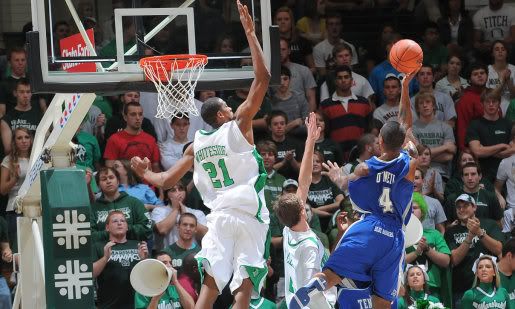
About Him: Hassan Whiteside basically came out of nowhere. He was a 19 year old that was coming off the bench for The Patterson School, a prep school in North Carolina, before committing to Marshall, a school in Conference USA, without a ton of fanfare from the recruiting services. But he set the world on fire in his one season at Marshall, leading the country in blocked shots, notching three triple doubles, and setting the Thundering Herd's all-time record for blocked shots. Not the single-season record, mind you. Whiteside is Marshall's all-time leader in blocks.
As a prospect, Whiteside is one of the more intriguing players in this draft. Whiteside is just a shade under seven feet with shoes one, and when combined with his 7'7" wingspan, he has a standing reach of 9'5", which is quite impressive. In addition to that length, Whiteside is a natural shotblocker coming over from the weak side. He has great timing and shows pretty good discipline when it comes biting on a pump fake.
He also projects well as a rebounder. He's active going to the glass, especially on the offensive end of the floor, and aggressively pursues the ball in the air. He's a good defensive rebounder, and will only get better as he adds strength. Where as most raw big man prospects struggle with natural scoring instincts, Whiteside is actually a good finisher in and around the basket. He has a very soft touch and is capable of knocking down perimeter jumpers, even hitting a couple three pointers this season. His length allows him fantastic extension finishing closer to the basket, and one numerous occasions during the season, Whiteside threw down a dunk he had no business finishing.
While Whiteside's strengths are as obvious as they can get, his weaknesses are as well. Whiteside has a long way to go in terms of his back-to-the-basket game. The majority of his points this season came as a result of catch-and-dunks, putbacks, and mid-range jumpers. That said, with some work, there's no reason that Whiteside can't become a post-up option in the NBA. We already know he has a soft touch, and he gets great extension on jumphooks and turnaround jumpers.
The bigger issue is Whiteside's strength. While he is pushing seven feet, Whiteside checked in at just 227 lb at the combine. He's thin, he has a frail frame that doesn't necessarily look like it can handle too much weight, and he has a long way to go in strengthening his lower body. Defensively, he really struggles at establishing position, getting backed down by big men at the mid-major level. He developed a bad habit of allowing a player to make a move and try to recover by blocking the shot, which was relatively successful at Marshall, but will not work in the NBA. Whiteside, right now, is a much better defender -- and shot blocker -- coming from the weak side than one-on-one. This lack of strength also means that he loses position too easily on the block offensively, which is why Whiteside had a tendency to float around the perimeter.
The biggest red flag are Whiteside's intangibles. He's not a typical freshman in college -- Whiteside just turned 21 years old, which limits his upside. He also comes in with a reputation of having a bad attitude and a poor work ethic. That is not a good thing for someone with the amount of development that Whiteside still has to do. Late in Marshall's season, Whiteside was benched for a multitude of reasons, which seemed to center around his eye on the NBA. Whatever the reason, that's not exactly a good sign for a prospect.
Comparison:
- Best Case Scenario: The obvious comparison is Marcus Camby. If Whiteside can fulfill his potential, he can be one of the best defensive centers in the NBA and possibly make a couple of all-star teams.
- Worst Case Scenario: Whiteside might be the most boom-or-bust prospect in this draft. Its just as likely that you never hear Whiteside's name again after Thursday night. I like the comparison of Patrick O'Bryant here.
Highlights:
Continue reading...
NBA Draft Prospects: Greivis Vasquez, Maryland |
Click here to find all of our 2010 NBA Draft prospect breakdowns.
Stats: 19.6 ppg, 6.3 apg, 4.6 rpg, 1.7 apg, 3.4 t/o's, 35.9% 3PT, 42.9% FG
Size:
- Listed: 6'5", 195 lb, 23 yrs old
- Combine: 6'6 1/2" (with shoes), 211 lb, 6'7" (wingspan)

About Him: There may not have been a more exciting player to watch in the country this past season than Greivis Vasquez. He stuffed the stat sheet, he played with loads of enthusiasm, and he made as many big shots as anyone this season. He was the ACC player of the year and for good reason.
Greivis Vasquez has an impressive all-around skill set. His scoring ability is evident by looking at his ppg averages over the course of his career. Averaging just a shade under 20 ppg as a senior, the place where Vasquez is the most dangerous is as a jump shooter. He's made impressive strides in this area during his career in College Park, knocking down a respectable 36% of his threes this past season, a number that is probably brought down by the degree of difficulty on some of the shots he takes.
Vasquez is an effective shooter off the catch and off the dribble, and that shooting ability is what sets up his penetration game. Vasquez is not a great scorer off the dribble -- he is an inconsistent mid-range shooter and does not have the length or the vertical explosiveness to be a finisher around the rim -- but he is an excellent passer and playmaker. While he still has a tendency to try and make the spectacular play as opposed to the smart, simple one, there's no two ways around the assist numbers he put up throughout his career. As a senior, his 3.4 t/o's are a bit unsettling, but when you consider how much Maryland relied on having the ball in Vasquez' hands and where his turnover numbers were when he came into Maryland, that stat gets a little less worrisome.
The two areas where Vasquez really excelled were in the pick-and-roll and in transition. He has tremendous court vision, and really understands how to get the ball to his teammates in a position that they can score.
The biggest knock on Vasquez as a potential NBA player is his athleticism. He entered the draft after his junior season, and his 26.5" max vert was the lowest at the combine (he didn't test this year). He's not explosive enough to finish in and around the rim. He doesn't have a great first step, and his lacking quickness made it difficult at times for him to penetrate against collegiate competition. While he did come up with some steals in his college career, his relatively frail frame, short wingspan (6'7" on a 6'6 1/2" player), and his poor lateral quickness make him a huge question mark on the defensive end.
This lack of athleticism means that Vasquez will completely have to makeover the way he plays in the NBA. Vasquez dominates the ball. He needs to ball in his hands to truly be effective, whether it is getting a shot for himself or a shot for his teammates. In the NBA, he is not going to be able to dominate in the same fashion. The biggest question mark -- other than his lack of athleticism -- is whether Vasquez can actually be a role player.
Comparison:
- Best Case Scenario: Vasquez is a difficult player to compare given his unique skill set. Marko Jaric is a name I've seen thrown out there a couple of times, and it is a comparison I like. A tall playmaker, Jaric did average 10 points and 6 assists one season.
- Worst Case Scenario: The worst case scenario for Vasquez is that he ends up in Europe, which isn't all that bad. He has more of a European game as it is, and playing in a lesser league, Vasquez can still make a quality living.
Highlights:
Continue reading...


 Posts
Posts

