
On Wednesday night, Baylor lost to Kansas 68-54, which dropped them a game off of the pace in the Big 12 standings.
In the writeup that I did for SI.com on the game, I said that "for all the talent that the Bears have on their roster, they are not going to do anything of note in the postseason until they learn how to consistently defend at an elite level."
That statement was kind of vague, so I wanted to touch on it a bit deeper.
Continue reading...
Showing posts with label Breaking Down. Show all posts
Showing posts with label Breaking Down. Show all posts
Thursday, February 9, 2012
Breaking Down: What was so bad about Baylor's defense? |

Thursday, December 15, 2011
Breaking Down: How good is Florida when they use Patric Young |
Past Breaking Downs:
- The efficient assassin
- What is the Michigan system?
- How Jared Cunningham defended John Jenkins
- The breakdowns in the Pitt defense
Florida needs to let the Big Dog eat.
Right?
Isn't that what we were all saying after Patric Young went for 25 points and 10 boards in a dominating performance against Arizona? That if the Gators are going to be successful, they have to pound the ball in to their big man? That the Gators will be the most successful when they 'let the big dog eat'?
Well, I decided to try and figure that out.

Patric Young is much improved in the post this season. You don't need a video breakdown from me to tell you that he actually has a post-move more advanced than a dunk in his repertoire this season. His hard numbers are up across the board (3.4 to 11.6 ppg, 3.8 to 7.9 rpg, 55.6 to 58.7 FG%) as are his efficiency numbers (11.3 to 20.5 usage rate, 110.8 to 118.4 offensive rating), but just because Young is better doesn't mean that he is a dominating low-post threat right now.
On the season, Young is scoring 1.02 PPP according to Synergy. That's not terrible. In fact, Synergy lists him in the 80th percentile and qualifies Young as "very good".
When you breakdown the numbers, however, it paints a bit of a different picture. Young's PPP numbers on put-backs (1.33), cuts (1.33) and shots around the basket that aren't post-ups (1.49) are all very high. But those numbers drop to 0.93 PPP in all post-up situations and 0.77 PPP and 0.73 PPP in left and right block post-ups, respectively. More eye-opening, however, is that Young is averaging just 0.96 PPP in post-up situations in which he has been single-covered, which drops him down to the 71% percentile for big men.
The kicker?
Only three times in Florida's nine games this season has Young seen a double-team. In other words, given the number of shooters and playmakers that Billy Donovan has hanging out on his perimeter, opponents are opting to allow Young to go one-on-one in the post instead of doubling him and risking that a shooter gets left open or given an easy driving lane to the rim. They are, for better or for worse, saying that they don't believe Young is going to be the guy to beat them.
To get an answer for whether or not Florida is better off pounding the ball into Young or using him as a pressure release to keep defenses honest, I went through the tape of Florida's three 'real' opponents this season -- Ohio State, Syracuse and Arizona. For the 96 minutes that Young was on the court for those three games, I charted every single Florida possession, finding a number for the PPP the Gators scored when Young got a touch in the post and when he didn't get a touch in the post.
Here is the chart (A couple of notes here: offensive rebounds that Young grabbed and went back up with or kicked out, leading directly into a shot, I counted as a post touch. Also, since Young didn't have a transition possession in these three games, I pulled those out at the bottom of the chart to try and figure out just how effective Florida was running their half-court sets when the ball doesn't get into Young's hands):
According to my data, in two of the three games, Florida was more effective (albeit in limited sample sizes) when they got the ball to Young on the block. Against Ohio State, the Gators got Young the ball on 28% of the possessions he was on the floor, but the big fella struggled early in the game. It was understandable; there aren't going to be many people capable of posting up Jared Sullinger. In fact, most of the damage that Young did came later in the game when he was being guarded by either Evan Ravenel or DeShaun Thomas. Young finished with 14 points and 12 boards on 5-10 shooting in that game.
The Arizona game is where Young really dominated. He got a post touch on 38.5% of the possessions that he was on the court and absolutely made the best of them, shooting 12-15 from the floor for 25 points while grabbing 10 boards and handing out a pair of assists for Will Yegeute dunks. More than anything, this game was an example of Young taking advantage of a smaller front line and his back court realizing the advantage.
The game where Young struggled came against Syracuse, but he was in trouble from the beginning. He picked up two fouls in the first six minutes of the game, killing any chance he had to get into a rhythm. That rhythm would have been very important against the Orange, because the combination of their big front line and their zone, a defense that is not exactly conducive to post-up isolations, essentially took Young out of the game.
But that doesn't mean that he was a non-factor.
Here, you can see Kenny Boynton attacking the Syracuse zone. He gets by the guards, but Fab Melo doesn't step-up to defend Boynton because he is worried about Young. Florida has the most success against the Syracuse zone when they were able to get the ball to that foul line area due to Young's presence:
Melo is worried about Young because of the lob. Young is a tremendous athlete and he has developed a knack for being able to get to the weak side of the rim and make himself available for the easiest assists that his guards are going to get. Here's an example of that from the Arizona game:
Florida runs a pick-and-roll heavy offense against man (and against zone; in the second half of the Syracuse game, they were running strictly man-to-man offense), and Young is very good in the pick-and-roll:
But the Gator's offense goes beyond just a simple pick-and-roll. In this clip, you'll see Young run a pick-and-roll with Erving Walker at the top of the screen. Arizona defends it well, and the ball gets swung to Bradley Beal. Erik Murphy sets a ball-screen for Beal, and as the freshman dribbles to the top of the key, Young seals his man hard. This is called a duck-in, and it may actually be what Young is the best at:
Even when his teammates don't give him the ball on a duck-in, the strength with which Young can hold a seal opens up driving lanes to the rim. In this set, you'll see Beal pop to the top off the key off of a downscreen from from Murphy. As Young holds his seal, Beal drives to the rim and gets a wide-open layup as Young holds off his defender:
While Young has the ability to be overpowering on the block, Florida has enough talented perimeter scorers that asking them to forsake their ability to pound the ball inside is not necessarily the smartest way for Florida to play. The issue is the decision-making of the back court players. Far too often, they settle for tough, ill-advised shots when they actually do have Young in perfect position. In the first clip, you'll see Walker get into the paint and miss a tough, 12-foot runner when he has Young all alone at the rim:
And in this clip, its Beal missing Young on a textbook seal and missing a challenged layup:
When Young does get the ball in position to score, he is capable of doing this:
And this:
As good as Young is, he's not yet Jared Sullinger. He doesn't have the kind of post game or ability to pass out of a double team that would allow him to be the star of this show. And, as I said, taking the ball out of the hands Florida's excellent back court is not the best option for Florida, not with the way that group can shoot.
But what Florida does need to improve on is getting Young the ball in spots that he can be effective. When he's got a seal on the block, dump the ball in. If his man comes to help a penetrator, put the ball up for him.
If Florida truly is going to compete for an SEC title, they need their back court to play well. And part of playing well is recognizing when they have a favorable matchup with Young on the block.
Continue reading...
Friday, December 9, 2011
Breaking Down: The Efficient Assassin, or how Marcus Denmon does his damage |
Past Breaking Downs:
- What is the Michigan system?
- How Jared Cunningham defended John Jenkins
- The breakdowns in the Pitt defense
NEW YORK - I am a believer in advanced statistics. But I'm not a 'stat geek'.
There is a difference.
I don't think that numbers can tell you the whole story. Yes, using the stats generated by Ken Pomeroy or Synergy Systems can be extremely enlightening, their value is diminished incredibly when they aren't taken in context with what actually happens on the court. For example, using Kenpom's efficiency numbers, Drew Wiley from Boise State and Tyrus McGee from Iowa State are the two most effective players in the country, but you are a truly dedicated hoop head if you know who those two kids are.
Another example? Missouri's Ricardo Ratliffe. He's the most efficient high-major post player in the country, sitting above the likes of Jared Sullinger, Thomas Robinson and Anthony Davis. But I don't think he would be one of the top 15 big men selected if we were to do a draft. What makes him so efficient is that he shoots a ridiculous 77.3% from the field (he's made 30 of his last 32 attempts), but if you watch Missouri play, the majority of Ratliffe's buckets are coming off of assists from his dynamic back court of Michael Dixon and Phil Pressey.
When the ball is given to any capable 6'9" big man in front of the rim, he's not going to miss many of those shots. 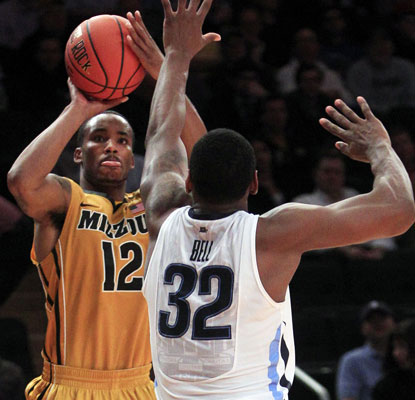
That brings us to Ratliffe's Missouri teammate, sharp-shooting two-guard Marcus Denmon, who is fourth in the Player of the Year race according to the guys at CBS and dubbed a first-team all-american by Luke Winn. Denmon's numbers alone are impressive -- he's averaging 21.3 ppg and 5.6 rpg while shooting 50% from three (seven attempts per game), 54.3% from the field overall and 89.3% from the line.
He's also the third-most efficient player in the country with an offensive rating of 147.3, according to Kenpom. That efficiency number becomes all the more impressive when you consider the fact that his performance against Villanova -- 28 points, 10-16 shooting from the field, 6-9 from three -- actually dropped him from being considered a "major contributor" to just a "significant contributor" to Missouri's offense. Think about that. (A major contributor has a usage rate between 24-28%, while a significant contributor is the range 20-24%.)
The most efficient major contributor with Denmon's drop is now Jarrod Jones of Ball State, whose offensive rating is 134.4.
All told, those numbers made me ask why. What is Denmon doing that makes him such a potent offensive weapon? Why is he a guy that both stat heads and more traditional hoop junkies think so highly of?
Denmon is, first and foremost, a catch-and-shoot player. According to Synergy, 50.6% of his shots -- 59 of 106 -- have been of the catch-and-shoot variety, with 79.7% (or 47) of those coming from beyond the arc. Denmon is scoring 1.468 PPP on catch-and-shoot jumpers, and that number rises to 1.548 PPP in a spot-up situation. (34.4% of his possessions-used come as a spot-up shooter. The difference between spotting and catching-and-shooting is that you can take a catch-and-shoot jumper on the move.)
Where Denmon is the most dangerous is in transition simply because he is so good at running from defense to offense. As soon as Missouri gains possession -- sometimes even earlier, if Denmon is able to anticipate who is going to get the rebound -- he's of and running. He understands how to stay wide and create space between himself and the transition defender.
Here's a perfect example. As soon as Phil Pressey grabs the rebound you can see Denmon, at the bottom right of this picture, taking off (click the picture to enlarge):
Pressey pushes the ball and recognizes that Villanova's defenders are all packed into the paint, so he kicks the ball to Denmon, who drills the three:
Mike Anderson may no longer be at Missouri, but that doesn't mean that the Tigers are afraid to get out and run in transition. In fact, they are running more and doing it better than they did last season: in 2010-2011, 17.7% of Missouri's possessions came in transition, when they scored 1.175 PPP. This season, 20.4% of their possessions have been in transition with an average of 1.18 PPP.
In fact, Missouri is so good on the run that they are able to fast break off of made baskets. In this example, you'll see Marcus Denmon challenge to Dominic Cheek three:
And then take off running. You'll notice he is the only Tiger not shown as the ball is inbounded:
He is once again able to spread the floor and find an opening, knocking down another three:
Against Villanova, Marcus Denmon hit 10 field goals. Nine of them came via assist from either Phil Pressey or Michael Dixon. Four of those were threes on the wing in transition, but the other five field goals came in the half court.
While Missouri is getting out in transition more often this season, they actually are averaging fewer possessions per game, 70.2 versus 72 a year ago. The reason for that is their execution in the half court; Frank Haith has a pair of point guards that understand how to pull the ball out and run their offensive sets. Last year, Missouri scored just 0.893 PPP in the half court. This season, that number is up to 1.072 PPP. A lot of what Missouri does in the half court involves ball-screens with their playmakers, but they do run some sets specifically designed to get Marcus Denmon a look at the rim.
In this first example, Missouri goes 1-4 high (both of the big men are on the elbows and the wings are foul-line extended):
And runs Denmon off of a double-screen across the two bigs, looking to isolate him on the opposite wing:
In this instance, Villanova defended it well, but Denmon was able to find some space when Pressey drives at his defender and kicks the ball out to him for an open look:
In this second example, Missouri uses the same set, but Matt Pressey is the guy that runs over the top of the double-screen: 
Denmon circles through underneath, using a double-screen at the top of the key:
He doesn't have a shot on the catch, using one dribble to free himself for a pull-up 17-footer:
The biggest reason that Denmon has been so efficient this season because he never turns the ball over. Well, never isn't exactly correct. In eight games, he has exactly four turnovers, good for a turnover rate of 4.1%. That's ridiculous.
But the other reason that Denmon is so efficient is that his point guards get him the ball in a position where all he has to do is shoot the ball. If there was a way to determine a point-per-dribble stat, he would probably have the highest rating for any scoring guard. That's also part of the reason his turnover rate is so low -- he doesn't need to create from the time he catches the ball until the time he shoots the ball.
There is no doubt that Denmon is one of the best in the country at what he does, but what he is is a finisher. The same way that Ratliffe is thriving because he is big and gets put into positions where all he has to do is score a layup of dunk the ball, Denmon is playing so well because his point guards are putting him in a position where all he has to do is shoot the ball.
And boy, when he gets in a rhythm, he may be the best shooter in the country.
But he helps his teammates get opportunities as well. You cannot leave Denmon to help on a driver. His man has to stay hugged up on him, otherwise Pressey or Dixon will find him, and odds are good Missouri is going to be getting three points on that possession instead of a possible two. In this example, you see Pressey come off of a ball-screen (which, admittedly, Mouphtaou Yarou defends terribly) and drive down the middle of the lane:
But Denmon's man -- and the guy guarding Kim English, who is shooting over 54.9% from three as well -- can't help, so when Yarou tries to block the shot, it creates an opening for Pressey -- who Ratliffe said has "eyes not only on the back of his head, but the side of his head too" on Tuesday night -- to throw a gorgeous pass for a dunk:
Continue reading...
Tuesday, November 29, 2011
Breaking Down: The John Beilein 'System' |
When you talk about Michigan, you always hear about the 'John Beilein system' and how its so difficult to defend and prepare for.
But what, exactly, is the Michigan attack all about? How is Beilein able to so consistently take a group of over-achievers and turn them into a nationally competitive basketball team? What is it about this 'system' that has been so good to Beilein at so many different stops?
In the latest edition of our Breaking Down series, we dive into the attack of the Wolverines.
Past Breaking Downs:
- How Jared Cunningham defended John Jenkins
- The breakdowns in the Pitt defense
The first thing that comes to mind when talking about John Beilein is the 1-3-1 zone that his employs. And while that zone is effective, its rarely used by the Wolverines. According to Synergy Sports database, Michigan has operated against a zone offense on fewer than 13% of their defensive possessions. While that number can be a bit misleading because of how often teams will use their man offenses against zone -- it helps create movement, as teams unaccustomed to playing against a zone have a tendency to get stagnant offensively -- the fact of the matter is that Beilein uses his zone defense as nothing more than a change of pace, the same way that any other coach will throw on a full-court press from time to time.
There are situations where the Wolverines will go almost exclusively zone. Against Memphis, 24 of Michigan's 63 defensive possessions were played in zone. Against UCLA, however, the Wolverines only played zone on four possessions. Another thing to note is that the 1-3-1 is not the only zone that Michigan is able to play; 20 of the 24 zone possessions that Beilein played against Memphis was in a 2-3.
But the 1-3-1 is effective, and its worth discussing because there will be times this year that Michigan will go almost exclusively to that defense depending on their matchup.
Beilein's zone isn't much different than a standard 1-3-1. He uses one of his bigger wings -- in this case, Tim Hardaway Jr. -- at the top, with two guards on the wings, the point guard under the basket and the center in the middle. Hardaway's job is to force the ball-handler, in this case Lazeric Jones, to pick a side. When Jones crosses half court, Hardaway and the strong side wing, Eso Akunne, will put a soft trap on the dribbler. Stu Douglass, who is on the baseline, hedges out on the baseline to be able to get to the man in the corner, while Zack Novak, the weak-side wing, drops on the opposite wing to protect a lob pass (click on the images to enlarge):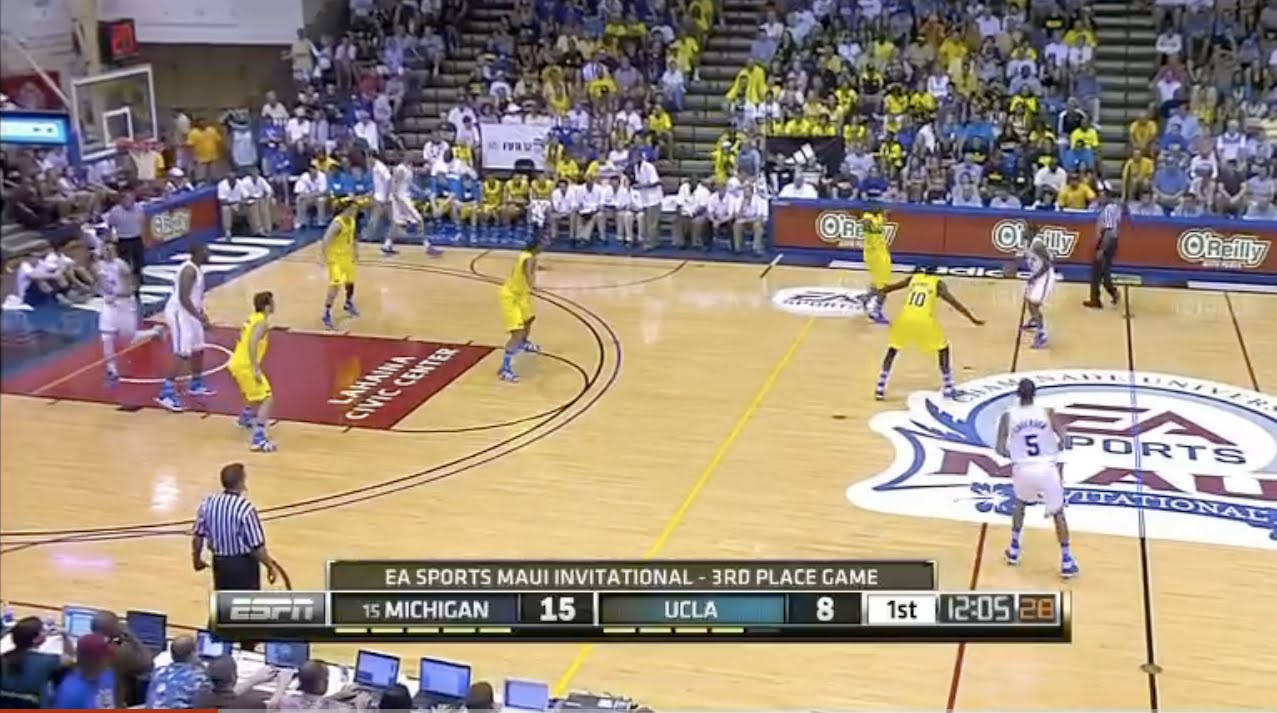
When the ball gets rotated to Jerime Anderson, Novak and Hardaway get another soft trap to prevent dribble penetration while Douglas rotates over to the other side of the lane and Akunne drops to protect the lob:
When the ball eventually makes its way to the corner, Akunne, the strong side wing, and Douglas, the baseline defender, trap the ball. Novak, the weakside wing, drops all the way to the rim while the center, Jon Horford, matches up with the opposing big man and Hardaway drops to the foul line to protect the high-post:
Here's the full video of the possession, which ends with what was very nearly a steal:
And here's another example of a possession in the 1-3-1 zone from the Memphis game:
On the offensive end of the floor is where Beilein's coaching style gets so interesting. Michigan has so many different plays and wrinkles off of those plays that they run, but their offense is fairly simple. It starts in a 2-1-2 set, with the two guards up high, a big man at the high-post and two more wing plays in the corners. From there, a play is called and the offense in initiated by one of the guards passing to the strong side wing. In this example, Trey Burke passes the ball to Novak while Douglass and Hardaway are on the weak side of the floor and Horford is at the high-post:
This is when it gets fun.
Out of this set, the Wolverines have a number of different options and reads that they use, but they all center around the idea of cutting hard, off-ball screens and rolls to the rim. In this particular example, Burke clears to the corner after passing the ball to Novak. Horford flashes out to rotate the ball while Douglass sets a screen for Novak at the high-post, and as Novak cuts across the lane using the screen, Horford swings the ball to Hardaway:
Horford than steps over and sets a ball-screen for Hardaway. Since Novak wasn't open on the cut, he and Douglass set a double back-screen for Horford as he rolls off of the Hardaway ball-screen:
The defense is so focused on defending Horford that they lose track of Novak, who is left wide-open on the three point line:
Here is the full play:
The beauty of this play design is that just five minutes of game-time earlier, Michigan ran a similar set that ended up in a wide-open layup for Horford. As Akunne passed the ball to Novak, both he and Douglas, who was the other guard at the top of the offense, cut through:
Novak, instead of swinging the ball, dribbled over to the other side of the floor. Hardaway, who was the opposite side wing, cut through as Douglass came up to receive the pass:
Horford set a ball-screen for Douglass while Novak set a down-screen for Hardaway, who curled through and popped to the top of the key:
As Horford rolled off of the ball-screen, his defender -- Josh Smith -- lost track of him in the confusion, and Hardaway found him for a layup:
Here is the full play:
The majority of Beilein's sets start with the guards at the top cutting through. Here's a perfect example from the Memphis game, where Novak sets a back screen for Hardaway before receiving a downscreen from Jordan Morgan:
And since Beilein is the king of the counter option, here is Douglass taking advantage of guards anticipating his cut through the lane and using a flare screen from Evan Smotrcyz:
John Beilein is the ultimate tactician when it comes to designing plays at the college level, and this is just a fraction of the playbook that he has given his Michigan team. When his offense is run correctly, it truly is a pleasure to watch.
Continue reading...
Tuesday, November 22, 2011
Breaking Down: Jared Cunningham vs. John Jenkins |
There is little question that John Jenkins is one of the best pure shooters in the country. As Luke Winn described him in a column today, "Jenkins is a gunner with a projectible NBA skill -- the ability to run off screens and drill threes with very little space between him and a defender." The standard cliche involving sharpshooters is that you are surprised when they miss, and there may not be a player in the country this season that proves that axiom more than Jenkins.
We saw Jenkins at his finest against NC State. He finished with 28 points on 10-16 shooting from the floor and 4-9 shooting from beyond the arc, including two jumpers where his toe was on the three point line. But against Oregon State, Jenkins was held in check. He had 14 points on 5-13 shooting and didn't even attempt a shot in the final 6:55 of the game.
"We don't just guard our man, we guard the other team," Oregon State head coach Craig Robinson said after the game. "We're focused on the guys that can hurt us and we try and make sure that everybody's aware of that. And we have Jared Cunningham, Ahmad Starks, Roberto Nelson and Challe Barton, who are four guards that I think I can put on anybody for some amount of time and hold them at bay."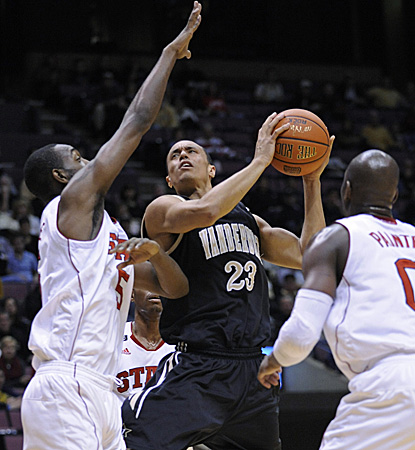
While that sounds nice to say, the simple fact is that for the 71 minutes that Jenkins was on the court at the IZOD Center, the only person that had any chance of slowing him down was Cunningham. Jenkins only scored eight points when Cunningham was on the court: he scored an uncontested layup on a leak out, he hit a three early in the second half when Cunningham lost focus and helped down on a driver and he hit a three with 6:55 left in the game when Barton was forced to switch onto Jenkins when Jenkins beat him down court. The other two threes that Jenkins hit were when Roberto Nelson was guarding him.
In other words, Cunningham didn't allow Jenkins to make one shot in a half court setting when he was guarding him man-to-man. He also collected four of his seven steals by defending Jenkins closely coming off of screens and forced another ball to be thrown away when Jenkins tried to curl tightly off of a down screen.
"He's real good using those screens," Cunningham said. "He's a great player. The team told me to focus in on him and just to stop him early and try to force other players to score."
What Cunningham did best was keep Jenkins from being able to curl off of down screens. He's a terrific athlete with excellent anticipation, meaning that he was able to not only trail Jenkins closely, but he wedged himself between Jenkins and the screener.
The Commodores love to run Jenkins off of double screens, and as you see here, Cunningham didn't give Jenkins any space around either of the screens, forcing Jenkins to catch the ball 35 feet from the basket, forcing a turnover. In the first picture, Jenkins is in the corner. In the second picture, he's running off of the second screen (click the images to enlarge):

In contrast, take a look at how much space Lorenzo Brown, a guard for NC State, gives Jenkins coming off of the double screen:

Jenkins isn't only a catch-and-shoot player. He's improved his ability not only to curl off of a screen and get to the rim, but to use his dribble to create an open look. In this clip from the NC State game, Jenkins hits the first of two back-to-back step-back jumpers:
But against Jared Cunningham, Jenkins wasn't able to use his dribble. In this clip, he ends up turning the ball over. It was the only turnover he had trying to beat Cunningham off the dribble, but it was also one of the only times he actually decided to try and beat Cunningham off the bounce:
These are just isolated examples of what happened in both games, but they are single possessions that represent precisely how each team as -- or, in the Wolfpack's case, wasn't -- able to defend Jenkins.
Continue reading...
Thursday, November 17, 2011
Breaking Down: Pitt's defensive breakdowns |
In the biggest upset of this young season, Long Beach State went into the Peterson Events Center and just beat down the Panthers. The final score was 86-76, but this wasn't like the 49ers hit a couple of free throws late in the game to extend the lead. LBSU went up eight minutes into the game and never relinquished the lead. They took their first double digit lead late in the first half and Pitt was never able to get closer than six the rest of the way.
We wrote an extended piece on the game here, but when you combine Pitt's performance on Wednesday night with their struggles against Rider over the weekend, it got me thinking: what is wrong with the Panthers? Why is Pitt, a team that many people believe has a chance to make the Final Four and will compete for the Big East title, struggling so much early in the season? Are these problems something that is fixable?
In a word: yes.
Pitt's biggest issue right now is defensive discipline. While the Panthers have a reputation for being a great defensive team, that is more the result of their roster makeup -- strong, physical bigs -- and their style of play -- slow-paced and aggressive on the offensive glass -- than anything else. In the Jamie Dixon era, Pitt has been a team that stays at home defensively, playing a helping man-to-man that emphasizes contesting jumpers without gambling on steals or forcing many turnovers. In other words, Pitt's goal on a possession is to take you out of your set, force you into a tough shot and to secure the rebound.
Pitt had two major issues against LBSU. The biggest problem was the Panther's transition defense. Long Beach consistently got run-outs and easy layups, scoring 25 transition. Defensive balance was a problem on a number of occasions. Here, LBSU is in a 1-2-2 zone. Freshman John Johnson shoots a three from the corner at the end of the shot clock. When the ball is in the air, Johnson watches the shot from the corner while the three Pitt bigs crash the offensive glass:
The rebound goes over the head of the Pitt bigs, and Casper Ware scoops up the ball on the run. With four Panthers on the baseline and trailing the play, LBSU has a 3-on-1 break, which ends with Ware finding Ennis for a layup:
Johnson either needs to rotate back out to the top after taking that three from the corner, or JJ Moore, who is on the opposite wing, cannot go to the glass:
Earlier in the first half, we had this debacle. Khem Birch tries to drive through the lane but turns the ball over. LBSU pushes the ball the other way, but Pitt actually gets four players back in transition. The problem is they don't locate the open man. Moore runs at Ware here, while Johnson has already set up at the top of the key to stop the ball:
Ware slings the ball to Michael Caffey on the wing. Gibbs has to run at the open Caffey, who finds Ennis wide open in the corner while three Pitt players stand around in the paint. Ennis had already buried a three in the game:
That's the result of a lack of discipline and communication by Pitt:
On this next play, you'll see an example of the breakdowns Pitt had in their half court defense early in the second half that forced them to go to a 2-3 zone. Gibbs trails Larry Anderson on a double screen, but doesn't follow him tight enough. Anderson curls off of the screen and gets himself open:
Nasir Robinson steps up to help, but he retreats to his man before Gibbs has recovered. Anderson drives towards the rim and both Robinson and Dante Taylor, who has lost track of Ennis, step up to try and take a charge:
Anderson is able to jump-stop and dump the ball down to Ennis for a dunk:
There is no question that Pitt had breakdowns defensively. They gave up 1.32 PPP, something that you rarely see even just an above-average defensive team like the Panthers do, especially playing in the Peterson Events Center. And while this post is looking at Pitt's defense, it very well could have been lauding LBSU's offensive game plan and execution. At some point, you just have to credit the 49ers for making shots and making plays:
That was filthy, but not as filthy as the smirk Ware gave after he made the shot.
Continue reading...
Subscribe to:
Comments (Atom)


 Posts
Posts

