
NEW YORK - Kansas is the favorite to win the Big 12 this season.
The Jayhawks have earned that right by winning seven straight Big 12 regular season titles and eight of the last nine. Baylor and Texas A&M both have good teams this season, but Big 12 supremacy won't be given away. It has to be earned. Texas A&M is dealing with their head coach's health issues and their star forward's knee injury. Baylor has is still trying to figure out who will run the point and how to win with Scott Drew coaching. While the Big 12 may be the most balanced conference in the country, there is no one in the league that can be considered a tier above the pack.
That's why the nod has to go to Kansas as the favorite.
And if any team is ever going to end the Jayhawk's reign atop the Big 12, this is the year to do it.
Kansas lost 75-65 to Kentucky at Madison Square Garden in the nightcap of the Champion's Classic on Tuesday. And while the final deficit was only ten points, in the second half it was quite clear -- Kansas was undeniably out-talented by Kentucky. By a wide margin. In the second half, when the Wildcats found their rhythm, Kansas got steamrolled. 
It was further evidence that Kentucky may just be the best team in the country.
But the news wasn't all bad for Kansas.
------------------------------------------------------------------------------
I don't think there is any question who the most talented team in the country is.
Its Kentucky. When they put it all together, this team is an absolute joy to watch and nightmare to play against. They have size up and down their lineup. They are loaded with athletes. They run the floor. They have shooters that spread the floor and finishers around the rim. They have a point guard that is able to get those guys the ball. Maybe the best measure of just how good this team is is Kyle Wiltjer. He's a top 20 freshman and he can't sniff the court this season.
There's was a stretch of last night's game where I closed my computer, I put my phone down and I just watched Kentucky play. I sat back and I admired what this team is capable of. They are that good.
The problem?
That Kentucky team only showed up for second half of last night's game. In the first half, Kentucky looked like a completely different team. They turned the ball over 12 times, six of them coming from their freshman point guard Marquis Teague, and shot just 38.5% from the floor. The problem was offensive execution -- far too often, the dribble-drive motion offense that John Calipari preaches broke down into his players trying to go one-on-one.
"We broke off every play," Calipari said. "I told them after the game that what I'm going to have to start doing is that is you break off a play, you're coming out. You think its ok that you're supposed to go right and you go left because you feel like it, you're coming out."
"Everybody walked into that game today and they were going to do their own thing, and they did it."
Its no secret that the key to winning at the collegiate level is recruiting, the ability to identify talented players and bring them into the program. But talent alone doesn't win games. That's why Butler was able to make it to the last two national title games. Its why Memphis finished fourth in Conference USA last season. Its why the 2010-11 Kentucky team was able to make the Final Four and not the much-more talented 2009-2010 Kentucky team.
"Everybody thinks talent wins," Calipari said. "No. Talented players that play together win."
"The message I gave them yesterday was 'we don't compete with each other'. We compete with the other team. We push each other and we challenge each other, but we complete each other. We all do what we do and we play off one another and we complete the team. We don't compete with each other."
That's not the only issue that this Kentucky team has. This is a young group. Of the eight players that played last night, four were freshmen and two were sophomores. The two seniors on the roster? They both came off the bench. Its not difficult to foresee composure being a problem from this group.
Two incidents stuck out last night. In the first half, Teague just absolutely melted down. Six turnovers is way too high for a point guard, and Teague had that number in the first half. He was over-penetrating, he was throwing bad passes and he was getting himself caught in the air without anywhere to go with the ball. With every mistake, Teague tried harder to make up for it. Coach Cal even moved Teague to the off-guard spot, allowing Doron Lamb to handle the ball, but that didn't make much of a difference. Teague's disastrous first half was a major reason Kentucky found themselves down. The Wildcats were lucky that performance came against Kansas and not North Carolina; they could have dug a hole too deep to get out of.
Teague isn't the first Calipari point guard to deal with these issues, however. Brandon Knight had the same problem at the start of last season. John Wall did as well, although he was able to mask his turnover problem by hitting game-winner after game-winner.
Then midway through the second half, Terrence Jones was knocked to the ground by Thomas Robinson, who regained his balance by straddling Jones. Instead of stepping to the side, Robinson walked over Jones, similar to the way Scottie Pippen walked over Patrick Ewing in the 1992 NBA Playoffs. Jones' reaction was to get up and try and get into Robinson's face. He wasn't alone, as the rest of his team rushed over and started some pushing and shoving.
While somewhat justified -- I probably would have done the same thing if I were him -- the incident shined a light on another potential issue for the Wildcats: composure. What's going to happen if Jones catches an inadvertent elbow from John Henson? What happens if Kidd-Gilchrist, who was the most vocal when the two teams came together last night, gets knocked into the scorer's table by Chane Behanan? How will the Wildcats react? Will it take them out of their game? Will a punch get thrown?
When Terrence Jones -- a kid who sulked his way out of the lottery at the end of last year, preens after every made shot and walked away from a car accident to avoid the punishment -- is the leader for a young team, having concerns about composure and handling adversity is certainly warranted.
"They think they're in Orlando," Calipari said, referring to where the AAU national tournament is held, "and they've got another game tomorrow morning and one that afternoon."
"Now they're talking to the other team, you can't do that here. You want to talk, but you want to talk to your team. They're young. They don't know better."
There is one common thread in all of the criticisms about Kentucky: youth. This team is young. They are freshmen and sophomores. They will learn. They'll understand that at this level of basketball, the game isn't all 1-on-1. They'll learn how to fit into an offense and how to play a role on defense. They'll learn what is a good shot and what is a bad shot. They'll learn how to walk away from a confrontation.
And with the amount of talent that this group has on their roster, if they learn it by the end of this year, watch out.
"I don't want to say that [this is my most talented team] because I've had some pretty good teams," Cal said, "but this team has a chance to be special."
------------------------------------------------------------------------------
"I think we played better than them in the first half."
That's the first thing that Tyshawn Taylor said to the group of reporters that managed to track him down outside of the Kansas locker room 45 minutes after the game had ended.
And you know what? He was right.
A lot of Kentucky's struggles were self-inflicted. Marquis Teague was playing out of control, Kentucky was breaking off their sets too early, Terrence Jones and Anthony Davis were taking some ill-advised shots. But some of the credit deserves to fall on the shoulders of the Jayhawks. They were the ones that made the steals when Teague threw a bad pass. They were the ones that played solid -- and well-prepared -- defense, helping to frustrate Kentucky's players into playing 1-on-1 basketball. And most importantly, they were the ones that capitalized on the Wildcat mistakes, jumping out to a 10-3 lead early and extending that lead to 21-14 at the under twelve timeout.
Kentucky made a push to get the game tied at the half, but Kansas could go into the locker room feeling pretty good about the 20 minutes that they had just played. The Jayhawks had held Kentucky to 38.5% shooting from the floor and forced 12 turnovers.
The second half was a different story.
"We had a lot of turnovers," Taylor said, "it was our mistakes, and they made us pay for it. One of the main things we wanted to focus on was taking care of the ball. There's different reasons that we didn't, but that's what cost us."
And while the loss hurt -- Taylor said after the game that he felt like his team had lost the championship -- its important that Kansas doesn't ignore the positives from this game. They hung with the most talented team in the country for 20 minutes and didn't quit after they dug themselves a 17-point second half hole. There are positives to take out of this game.
I know its weird to read, and even weirder to write, about moral victories when you're talking about Kansas, one of the top five programs in the history of the game, but its just one of those years for Kansas. The Jayhawks were crushed by early-entry after last season, with Josh Selby following the Morris Twins out the door and into the lockout. Kansas also lost starters Brady Morningstar and Tyrel Reed, valuable role players that could shoot and defend. Combine that with the swing-and-misses that Self has had on the recruiting trail over the last year or two and the fact that three of the Jayhawk recruits -- including Ben McLemore, the star of Self's 2011 class -- were ruled ineligible by the NCAA.
What does it all mean?
The Jayhawks have no bench. Their front court depth starts Kevin Young, a transfer from Loyola Marymount, who is actually playing behind Justin Wesley, a walk-on transfer from Lamar, where he averaged 1.2 ppg and 1.3 rpg. Connor Teahan, a former walk-on that finally earned a scholarship last year, played 23 minutes last night.
The guys that do play are all feeling their way through new and expanded roles. Taylor and Thomas Robinson are now the focal points of this offensive attack and expected to be in the running for all-league teams. Elijah Johnson, Jeff Withey and Trevor Releford are all seeing their first significant minutes since they entered the program. All three are former top 50 recruits.
"This was definitely a learning experience for a young team like us," Taylor said. "We got a lot of young guys, guys that just haven't been in this position before, pressure situations like this. I think we can definitely watch tape and learn from this."
"It sucks to lose like this, but its a learning experience. We just gotta build."
Kansas still has plenty of chances to learn before they start Big 12 play. They kick off the Maui Invitational next week against Georgetown. The host Long Beach State, Ohio State and Davidson in September before heading out to LA to take on USC. There will be plenty of opportunities for this team to learn and plenty of room for them to grow.
"We're only two games in. We just got to keep working hard and I think we're going to be where we want to be pretty soon."
Continue reading...
Wednesday, November 16, 2011
Kansas and Kentucky both can learn from last night |

Thursday, June 16, 2011
Kentucky admits that Coach Cal doesn't yet have 500 wins |
It appears as if this week's battle of wills between the NCAA and Kentucky is now over.
If you've forgotten, back on February 26th, Kentucky honored John Calipari on his 500th. But since 42 of those wins technically don't exist -- they were vacated due to the scandals involving Marcus Camby at UMass and Derrick Rose at Memphis -- the NCAA took exception to this celebration. The NCAA sent a five page letter to Kentucky saying, essentially, retract that statement or else.
On Thursday afternoon, the Wildcats relented, releasing this statement:
"After consulting with the NCAA, the University of Kentucky has been informed that the honoring of our head men's basketball coach for his 500th career victory on Feb. 26, 2011 was in error and that, henceforth, we will reflect our head men's basketball coach's career record in our media guides, Internet sites and other publications consistent with the NCAA's official records and statistics."
So that's it.
In their letter to Kentucky, the NCAA required Kentucky to receive their approval for the retraction, and since this statement has been released publicly, its safe to assume that they got it. In the end, both sides got what they wanted. Kentucky created a stir by exposing the absurdity of vacating wins while honoring Coach Cal for what was, in all actuality, the 500th win he has orchestrated as a collegiate head coach. The NCAA in turn forced UK to give in to their authority and admit that the NCAA's rules are, in fact, rules.
Problem solved.
Pointless argument ended.
Now we can all move on to the even more pointless practice of learning what college coach called which rising juniors.
The irony of the situation, however, cannot go unnoticed. The NCAA forced Kentucky to vacate their celebration of Coach Cal's 500th win because 42 of those wins were vacated. If that doesn't go to show you just how powerless the NCAA is when it comes to enforcing their rules, then nothing will.
Continue reading...
Monday, June 13, 2011
Vacating wins is pointless |
The NCAA does a lot of dumb stuff, but perhaps the most inane aspect of an idiotic, corrupt organization is the way that they opt to punish schools for breaking the rules.
I've said it before and I'll say it again -- vacating wins is a pointless penalty, a punishment that literally does nothing more than create work for NCAA employees, headaches for the athletics departments, and completely worthless blog posts like this one.
The reason that I am writing this now is that over the weekend, news broke that the NCAA was going after Kentucky for incorrectly celebrating John Calipari's 500th win. You see, back on February 26th, Kentucky beat Florida in Rupp Arena, which was the 500th time that Coach Cal has been on the winning end of a college basketball game. But that figure did not account for the 42 games -- four from the 1996 NCAA Tournament run that UMass made and 38 from his 2007-2008 season with Memphis -- that have been vacated during Coach Cal's career. This pissed off the NCAA because, as you might imagine, they really don't have anything else to worry about right now. 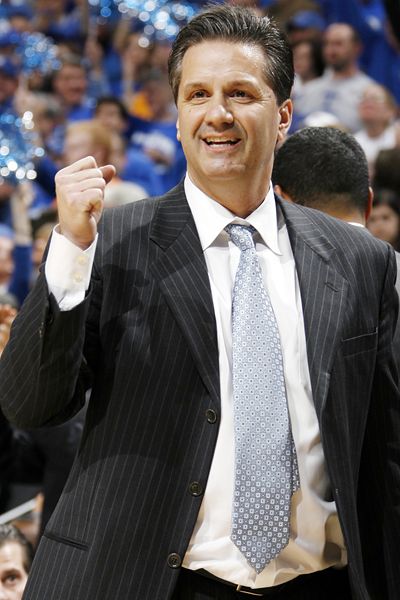
Jerry Tipton over at Kentucky.com goes into details about what, exactly, happened. Long story short, there appears to be a misunderstanding about whether or not Kentucky "accounted" for the 42 games that Cal has had vacated.
But the fact that this has even become an issue shows just how out of wack the NCAA's priorities are.
Forcing Memphis and UMass to take down their Final Four banners aren't going to erase the memories of those two fan bases. Neither Derrick Rose nor Marcus Camby, who were at the center of the scandals that caused those 42 games to be vacated, are going to think about the fact that their Final Four experiences didn't, technically, happen while they cashed a combined $13,999,450 in checks this past season. By officially stating in the record books that Coach Cal took neither the Minutemen nor the Tigers to the Final Four doesn't change the fact that he signed an eight year, $32 million contract with Kentucky because, in large part, he was able to take two non-BCS programs to the Final Four.
Coach Cal's attitude towards the vacated victories is telling. At the Final Four, when he was asked what it felt like to be at his first Final Four, Cal responded "we've been here three times. Those players played those games and did what they were supposed to." That's the attitude that the rest of the nation currently employs. I can go back and watch Memphis choke away a national title at the free throw line. I can watch highlights of the UMass loss to (ironically) Kentucky in the 1996 Final Four as well.
Those games happened, and nothing the NCAA can do will change that fact.
But is also creates an awkward situation. What, exactly, can they do to punish offending programs? Any kind of scholarship reduction only hurts potential student-athletes that had nothing to do with the violations committed. The same goes for postseason bans and television bans -- see the 2009-2010 USC basketball team. They can't cause the firing of a coach because the coach is not an employee of the NCAA, they are the employee of an academic institution with NCAA membership. Levying fines would probably be an effective deterrent -- Bruce Pearl probably won't be lying again after getting hit with a million dollar fine -- but, again, the NCAA may not have the power to fine a power -- Pearl's money went back to Tennessee.
What is clear, however, is that vacating wins is pointless. Taking down banners doesn't erase the memories or the internet caches. And in this case, as Jeff Eisenberg points out, the NCAA is doing nothing but feeding the fodder that they have it out for John Calipari and Kentucky. I'm far from a John Calipari apologist, and its obvious that the NCAA's reaction is the result of needling from Kentucky, but in this case they are right.
Vacating wins is dumb.
John Calipari has been the head coach when his team won 509 times.
He should have the right to celebrate it without having to toe the NCAA's line.
Continue reading...
Tuesday, May 31, 2011
John Calipari, Jim Tressel, the media, and some rambling |
In case you missed it over the Memorial Day weekend, Brett McMurphy -- one of CBSSports.com's new hires on the college beat -- wrote an excellent piece on John Calipari and what the embattled Kentucky head coach does off the court.
Its a terrific read and really paints Calipari in a light you don't often see. Coach Cal is what you might call a hot-button issue. There doesn't really seem to be many people on the fence. Either you believe that he is a cheat that has illegally recruited his way to two (vacated) Final Fours and a string of top-ranked recruiting classes at Kentucky, where he is making $4 million-a-year, or you believe that he is clean, framed and blamed by the media because they are jealous of his success.
You either hate him or love him, and its not difficult to figure out who in the media can be penciled in on the 'hate' side -- ahem, Pete Thamel and Pat Forde.
Cal added fuel to the fire on Memorial Day, when he took a shot at his haters in the media, tweeting:
The irony of Coach Cal's tweet is that it came on the same day that Jim Tressel, the Ohio State football coach, resigned as SI was getting set to publish an expose on the Buckeye program under Tressel. It is ironic because many fans and media-types alike look at Tressel and Cal as one in the same -- an excellent head coach, a man that contributes to society outside of sport, and a master of plausible deniability, of keeping his name just far enough away from the dirt to avoid being implicated.
Jim Tressel is going to be vilified over the coming days and weeks. The same would happen to Coach Cal if some ambitious investigative reporter were to ever turn up some incriminating evidence.
My question: do they deserve it?
Neither Tressel or Calipari have committed a crime. They aren't kidnapping children or shooting up abortion clinics. They may be hated by those that aren't fans of the Buckeyes or the Wildcats, but does anyone without a rooting interest in sport truly care about either of them enough to 'hate'? At best, these two head coaches are willfully ignorant about what is going on in and around their program. At worst, they turned a blind eye (and facilitated?) student-athletes getting paid for playing a sport that generates eight and nine figure dollar amounts and helped some kids fudge their grades in order to better their lives.
In our world of seemingly random rules imposed by the same institutions now punishing themselves, Cal and Tressel are pariahs because they are/were successful. In the regular world, they are just two people that are trying to get ahead in their profession.
And while the methods that Cal and Tressel use to 'get ahead in their profession' are detestable for the diehards of the sport -- which is what makes these two men 'hated' -- credit needs to be given when credit is due. And Calipari is due credit for the work that he does off the basketball court.
Taking to twitter to incite Big Blue Nation for a lack of media attention for your good deeds is, indeed, a douchey move. But when you use your standing as the head coach of Kentucky's basketball team to, among other things, raise $1.5 million for the earthquake in Haiti, that douchiness gets a pass.
Continue reading...
Wednesday, May 4, 2011
So was Kentucky's pro day a success? |
Kentucky's 'combine' or 'pro-day' or whatever you want to refer to is as was a success.
And it wasn't.
Huh?
According to Mike DeCourcy of the Sporting News, at least one NBA scout felt that the two-day session that Wildcat head coach John Calipari had scheduled for his players currently eligible for the NBA Draft was a worthwhile experience. The scout, George Felton from the San Antonio Spurs, said that more than two-thirds of the league's teams were likely to attend at least one day of the combine.
"I thought it was a tremendous concept that Coach Cal came up with," Felton said. "To have an opportunity to get another look at these young men, and also to have an opportunity to interview them — I would love to see more universities do this."
Jonathon Givony of Draft Express received much different feedback, however. According to him, the combine was a disappointment for a lot of the NBA folks. While they got a chance to see Brandon Knight, Terrence Jones, DeAndre Liggins, and Josh Harrellson work out, it was nothing more than a workout. The players ran through a series of drills without any competitive, 1-on-1 or 2-on-2 action. Givony had one tweet that quoted a GM as saying they watched "lay-up lines".
If the NBA folks were, in fact, disappointed in the kind of action that took place, that can be adjusted in the future. But what is clear is that Calipari is once again setting the trend.
That said, don't be surprised if this doesn't catch on.
Having a pro-day in which NBA scouts flock to a campus to evaluate a prospect only makes sense if that prospect is "testing the waters" of the NBA Draft. It avoids anything -- flights paid for, workouts paid for, housing in Vegas or Chicago or New York covered, etc. -- that could conceivably render the athlete ineligible or be considered an illegal benefit.
But testing the waters will be gone next season. With the new rule that the NCAA instituted, college players will be forced to decide on their NBA Draft status a week after the Final Four ends, and that decision will be final. For the players that do put their names in the draft, NBA teams will be able to pay for travel expenses to get the players they want to see matchup come in and workout.
That eliminates the need for on-campus group workouts.
But it doesn't change the fact that Calipari is the best marketer in all of college basketball.
Continue reading...
Monday, May 2, 2011
The 'Kentucky Combine' is another example of John Calipari being ahead of the curve |
Once again, John Calipari is proving that he is one step ahead of the curve when it comes to running a players-first program.
This afternoon at 3:00 pm marks the start of the two-day Kentucky combine. At least 23 NBA teams will have representatives at the Joe Craft Center as the five members of the Kentucky basketball team currently eligible for the NBA Draft -- Josh Harrellson, Enes Kanter, Brandon Knight, Terrence Jones, and DeAndre Liggins -- will have an opportunity to interview with and work out for scouts.
The Kentucky coaching staff worked closely with the NCAA to determine what needed to be done to keep Knight, Jones, and Liggins eligible should they opt to return to Kentucky, meaning that no UK coaches will be involved as the workouts will be entirely run by NBA personnel.
Its genius.
Its no secret that the best recruits in the country view college basketball as nothing more than a one-year hiatus before they make their way to the NBA. And at a time when the rest of the coaches are moving up the early entry deadline to benefit themselves at the cost of their players, Calipari is doing everything in his power to make sure that his kids get the opportunity to make the most informed decision in regards to their future.
That's why Calipari is able to land just about any recruit that he wants. These kids know that he is going to push them to enter the NBA Draft if it is right for them. They know that he is going to prepare them for a career after their time, however, short, is done on a college campus.
Most importantly, however, Coach Cal knows that by running his program this way -- by establishing a track record of supporting his players and turning them into professionals as quickly as possible -- he is going to be able to have the ear of every top recruit in the country.
The criticism of running a program with this methodology is that Calipari will almost always have a team full of supremely talented freshmen. Winning with freshmen, critics will tell you, is not possible at this level of basketball. I wonder if those critics realize that in his two years at Kentucky -- in which six freshmen and eight players overall have declared early for the NBA draft -- Calipari has led his team to the Elite 8 and the Final Four.
Butler is the only other team that has been to the last two Elite 8's, having played in the last two national title games.*
*(The irony of this fact is that Butler is the polar opposite of Kentucky when it comes to recruiting. Brad Stevens lands the players that fly under the radar and builds a team through experience.)
Oh, and for what its worth, Trevor Lacey, a top 40 recruit from Alabama that is still uncommitted for the class of 2011, is currently on the Kentucky campus on a visit.
Coincidence?
Doubt it.
Continue reading...
Friday, April 22, 2011
Coach Cal talks about his coaching methodology |
Kentucky head coach John Calipari has garnered quite a bit of criticism for the way that he builds a team.
In essence, Coach Cal has embraced the art of the one-and-done. Cal and his staff (his staff never gets enough credit for the work that they put in on the recruiting trail, in my opinion) are able to routinely recruit the best players in the country because they know that once the season ends, he has their best interests in mind. Its no secret that Cal basically told John Wall and DeMarcus Cousins last year that they had no choice but to enter the NBA Draft, essentially forcing their hand on the decision.
As you might imagine, this process doesn't exactly go over well with the folks that are enamored with the 'good ole days' of college hoops, where players stayed for three or four years, earning their degree before they took off for the NBA.
Cal responded to his critics today on his website CoachCal.com:Being a Players-first program means:
I couldn't agree more with what Coach Cal is saying.
1. During the recruiting process, we don’t make outlandish promises about playing time, starting positions, minutes, shots, points or anything to these young men that we can’t keep. At Kentucky, you have to work for everything and compete every day at the highest level.
2. The second part is that once the season begins, we are teaching players to be the teammate they want to play with. Our whole focus is on team play. I want individuals to play well but I’m getting them to understand nothing of significance will be accomplished by themselves.
3. Lastly when the season is over, when our TEAM is done playing, my job is to help them make the best decisions, with the best information I can give them, for them and their families. I’m not trying to convince them to come back if that’s not in their best interest. Likewise, I’m never trying to shove anybody out the door.
During the season, college basketball is about the team. Its about a group of kids coming together, playing as a unit, and winning while performing at their highest level in whatever role they are assigned on the team. But once the season ends, it becomes about the individual. Entering the NBA Draft should be solely about what is best for that particular player and their family given the circumstances that they are living in.
Cal understands that.
And the best players in the country realize it. That is why every blue-chip high school player in the country wants to be a Kentucky Wildcat right now. Because they know that the Kentucky coaching staff will fully support and push for what is in that player's best interests.
Since Kentucky seemingly has their pick of high school prospects, it makes it all the easier for Coach Cal to support a player like DeAndre Liggins declaring for the draft to gauge his interest. He can withstand the loss of three of his most important players because he knows that he will be bringing another crop of lottery picks the next season.
Coach Cal recruits by selling a fast track to NBA riches.
You may not like it, but it works. He's been to an Elite 8 and a Final Four using the method, and he has his best recruiting class to date coming in next season.
How many schools can make those claims?
Continue reading...
Tuesday, November 9, 2010
Coach Cal gives out fashion advice |
On Friday night, Kentucky played Dillard University in a scrimmage at Rupp Arena. Dillard is coached by a former Wildcat named Dale Brown who, it appears, has style that this blogger will never be able to compete with:
Calipari commented on the suit after the game, and this is where it gets interesting.
To read the rest of this post, check out Beyond the Arc.
Continue reading...
Saturday, September 25, 2010
Eric Bledsoe investigation is over |
Eric Bledsoe's ordeal, if you can call it that, is over.
But that doesn't mean it has to make sense.
Friday evening, a Birmingham, AL, law firm published a report from a three month investigation into Eric Bledsoe's grades during his time in high school. The outcome? The law firm found that the teacher's reasoning for changing Bledsoe's Algebra III grade was "not credible" (read the entire report here), but the firm couldn't find enough evidence of wrong doing. The Birmingham school board decided that the findings were not sufficient, and thus Bledsoe's grade will remain an A and his eligibility will remain intact.
In other words, the law firm believed the teacher was lying, but no one could prove it. Kentucky's Elite 8 in 2010 will live on. Kentucky fans celebrate!!!
For the rest of the college basketball world, it looks like the Wildcats -- and John Calipari -- once again got off on a technicality. And while that may be true, the issue isn't the technicality. As anyone that has seen an episode of Law And Order knows, its not about what you know, its about what you can prove. Did Bledsoe get his grades changed? Yes. Is there reason to suspect that the change was less than kosher? Yes.
But grades get changed all the time in high school. I once talked a teacher out of giving me a C in a class by agreeing to write a paper late in the year. Who is to say that Bledsoe didn't do something similar?
The bottom line is this: Eric Bledsoe was originally cleared by the NCAA. He played in the games last season. And, personally, I would rather have Bledsoe's questionable grades hold up than see Kentucky punished by having a season vacated, which has to be the dumbest punishment in the history of sports.
Now that this saga is over with, we are one step closer to being able to talk about actual basketball. REJOICE!
Continue reading...
Friday, September 24, 2010
The latest on Enes Kanter |
Through out the entire process with Enes Kanter, John Calipari has been adamant that he believes Kanter is an amateur.
Yesterday, when talking to reporters, Calipari made it clear that he believed that Kanter's team from Turkey simply wanted him back, which is what that team's GM made the comments he did to Pete Thamel.
"Obviously, one side wants him back," Calipari said. "There's four million reasons they want him back."
The "four million reasons" Calipari is referring to is the transfer fee that the Turkish team would receive if Kanter played in Europe. This isn't a new theory, either, as the motives behind Fenerbahce Ulker's push to get Kanter ineligible have been fairly transparent.
If Kanter does end up getting cleared by the NCAA, it isn't going to be based on the word of Coach Cal, who, I'm sure, many would tell you is not trustworthy, versus the word of a Turkish GM that clearly has an agenda. The decision is going to depend on the records. Fenerbahce gave the NCAA their records for paying Kanter, proof, so they say, that Kanter received a salary while playing in Turkey. But according to Calipari, the family kept "meticulous" notes in order to preserve Kanter's eligibility.
Perhaps the most interesting part of Calipari's press conference is that he did not even get the information correct. As Draft Express pointed out this morning, precedent says that Fenerbahce would likely receive about a $300,000 transfer fee for Kanter. In addition, Calipari said that players cannot sign a contract in Europe until they are 18, which is not true either.
Regardless of what decision ends up getting made, I think the NCAA's track record of a slow speed when making decisions like this guarantees that Kanter, who has been cleared to take classes and practice with the team, will miss some game time.
Continue reading...
Tuesday, September 14, 2010
Report: Eric Bledsoe had grades changed in high school |
Back in May, Pete Thamel of the New York Times penned an article claiming that Eric Bledsoe received improper benefits during his high school days, and also made accusations of academic impropriety.
While Thamel's article seemed to do nothing more than spawn an investigation, a report today from the Birmingham News seems, on the surface, to be quite damning.
You can read the article from Jon Solomon in full here (and I strongly suggest you do), but there are two key components to take note of.
- Bledsoe's transcript says that he received a 90 in Algebra 3 during two night school sessions. But a grade report from those two sessions indicates that Bledsoe actually received a low C and a low B in those classes.
- The other issue is that Bledsoe seemingly took these classes out of order. He took Alegbra 3 during the first semester of his senior year, while taking Algebra 2 in the second semester. He got an A in both classes. As the article indicates, Bledsoe would have fallen short of the NCAA's criteria for eligibility if he had received anything less than an A in either class. Bledsoe had never received a grade higher than a C in math before enrolling at Parker High for his senior year.
- Another issue to take note of is that Bledsoe received just one grade higher than a C in his core classes before enrolling at Parker, and that was a B he received as a make-up grade during a summer school session. After enrolling at Parker, seven of the ten grades he received in core classes (the ones that matter to the NCAA) were an A or a B.
But with all the other information out there -- including grades that seem to have actually been changed -- this report is going to draw a lot of interest from the NCAA.
As we learned from the Derrick Rose fiasco, the NCAA has the right to, if they wish, retroactively make a player ineligible. The NCAA has a staff of 55 people to examine some 90,000 potentially ineligible transcripts. Their view is that it is on the school to do a more thorough investigation into an athlete's eligibility.
If Bledsoe did lie on his transcripts, if the NCAA decides that Bledsoe earned a C in Algebra 3 instead of an A, then they could very well rule him ineligible. (Although this case does resemble the one involving Kansas' Darrell Arthur.)That would mean that Kentucky would, in all likelihood, have to vacate every one of the wins that Bledsoe played, which just so happens to be every game Kentucky won last season with the exception of a 104-61 drubbing of Hartford.
We will definitely be following this story as it develops.
Continue reading...
Wednesday, September 8, 2010
Reactions to Enes Kanter from around the web |
As we all know by now, last night Pete Thamel of the New York Times published a report claiming that Enes Kanter had, in fact, received somewhere in the low-six figures during his times with Turkish Club team Fenerbahce Ulker. Below, we give you snippets of what the best in the business think about the report. For our take, go here. And, as always, if you have a link you want us to share, hit us up on twitter or send an email to contactbiah AT gmail DOT com.
Adrian Wojnarski, Yahoo!: "Some top INTL bball officials at USA practice validated on (Pete Thamel's) Kanter probe: "We've all known that kid's already a pro," one said"
John Clay, The Lexington Herald: "The Times does report that Karakas was unhappy about Kanter's departure and stands to benefit if Kanter is declared ineligible, as his club would get a transfer fee if Kanter played for another European team next season. But Karakas told Pete Thamel of the New York Times that the issue is more a matter of telling the truth. If the NCAA confirms Karakas' claims — the manager said he provided the NCAA paperwork — it could mean that Kanter would be ruled as a professional and not eligible to play college basketball in the United States. Last year, the NCAA suspended West Virginia’s Deniz Kilicli when it was learned that the Turkish team he played on included a professional player who was receiving money. Kilicli was not ruled to have taken money himself."
Gary Parrish, CBSSports: " Let's be honest: Calipari isn't concerned with winning November and December games at this point in his career (except for the ones against Rick Pitino, of course). He's been undefeated deep into the year, been ranked No. 1, earned No. 1 seeds, and won more games in a season than everybody else. The only remaining goal is to win a national championship, and having Kanter involved makes that goal more attainable even if he isn't involved from the start. If Calipari could only have Kanter for March, he'd take him. If Calipari could only have Kanter for next season, he'd take him. So the lone truly devastating punishment would be the NCAA ruling Kanter ineligible forever and always, and if that happens, well, what's been lost? Answer: Nothing."
Jeff Goodman, FOXSports: " Kanter's situation has been bandied about for months among college basketball coaches. At one time, he was committed to Washington, but the well-traveled (he attended numerous schools since arriving in this country) 18-year-old son of a professor de-committed from the Huskies and wound up signing with Kentucky. There were, according to sources, plenty of other schools in the mix who were contacted by Ergul, who considers himself an advisor for Turkish players such as Dogus Balbay (Texas) and Denis Kilicli (West Virginia) that have come to the United States to play college basketball. Most of the schools took a pass, but Calipari decided Kanter was worth the risk. Now, he'll have to wait and see whether it pays off."
Andy Katz, ESPN.com: "Sandy Bell, Kentucky's associate athletic director in charge of compliance, and a representative of the NCAA's amateurism department may need to go to Istanbul and meet with [Nedim] Karakas if Kanter is to gain eligibility for this season, the compliance officer told Katz. According to the compliance officer, the burden of proof is on Kentucky to prove Kanter received only actual and necessary expenses after Kanter signed with the Wildcats over Washington last year. Those expenses can be food, travel expenses for practices and competition as well as housing. Where this can get dicey is that Kanter was only 14 at the time he started with the club team, and housing for his family may have to have been included. The NCAA could determine that his family getting rent paid for by a club team could be viewed as him using his skill to gain an advantage for his family."
Luke Winn, SI: "If there's anything good about this for Kentucky, it's that Kanter's alleged benefits were made public before he played for the Wildcats. Had he suited up in official games, and later been outed as a professional, the UK wins would've been voided by the NCAA. Given coach John Calipari's history with vacated Final Four trips -- first at UMass, in 1995-96, and then at Memphis in 2007-08 -- he couldn't afford another scandal. UK can't be subjected to any NCAA punishment for merely trying to get Kanter eligible, because all of his alleged business dealings occurred prior to his arrival in the U.S."
Truzenzuzek, A Sea of Blue: "The purpose of the Thamel article was clearly to create a public relations problem for Kanter, the NCAA and Kentucky. Evidently, Fenerbahce hopes that by doing so, the NCAA will find enough "complexity" in the matter to declare Kanter a professional. It may or may not work, but keep in mind that the NCAA is an inherently conservative organization, and this rule change was a real departure for them. They may decide that it is wisdom to err on the conservative side of amateurism (a view that I suspect few NCAA coaches or presidents would oppose, particularly when the subject is a Kentucky player), and that hope is clearly revealed in Karakas' disingenuous comments."
Matt Norlander, College Hoops Journal: "Amazing how frequently controversial stories and reports come out of the Kentucky camp. Since [John] Calipari arrived 16 months ago, there’s been about one allegation or sign of smoke per month. This is just the latest, and while it’s more on Kanter than Kentucky, if any evidence surfaces that Kentucky knew of Kanter receiving money, then the dobermans will be unleashed on Calipari and everyone in that athletic department. The recruit is now toxic, though. No matter what comes of this decision, if Kanter ever plays for Kentucky it will only enhance the negative spotlight on the program. Is Kanter’s ability worth that? Most would say, absolutely: yes."
Matt Jones, Kentucky Sports Radio: "4. Was there a Desire to be a Professional?: I have talked to a number of folks around this case and they all tell me that the key issue for the NCAA will be whether the player had a desire to be a pro. That will be determined in part by money taken, but also by secondary issues. For Kanter, some of those work in his favor. His father is a doctor and a professor and the family was not in need of money. Thus, the idea that he would jeopardize his potential future as an Amateur for a piddling amount of money would seem unlikely. Plus, Kanter left the team while he was 16 and he didnt seek to sign other deals with clubs…which one might assume likely if he wanted to be a professional. These secondary facts, in addition to the money, could play a role in the decision, especially if the total amount paid is somewhat murky."
Rush The Court: "This much we know. The burden will rest with Kentucky to prove that Kanter is indeed eligible, and that any payments he took from Fenerbahce Ulker were actual and necessary to only cover his (reasonable) expenses and did not rise to the level of a salary. The organization notably did not provide Thamel documentation of the “salary” that was paid to Kanter, so if they’re truly blowing smoke on this in an effort to destroy Kanter’s amateur status, presumably the NCAA would know this. KSR breaks down the key questions to focus on in this matter, and but at a certain point (presumably after UK makes its best arguments) it will be the NCAA that has to make the difficult decision as to how much is too much when it comes to whether payments made to Kanter were merely expenses or a full-timer’s salary."
Jonathon Givony, DraftExpress: "Enes Kanter's team would have to be paid a buyout of about 300,000 (according to FIBA precedent) if he signed in Europe now. I really don't think the 300k matters to Fenerbahce either way. This would be more about pride, & screwing Max Ergul, Kanter's rogue agent. Kanter can go play in the D-League if he wants, as there's no FIBA letter of clearance needed there. Then he can join a NBA team w/no buyout."
Adam Zagoria, ZagsBlog: "Despite the latest news about Enes Kanter, NBA experts expect that the 6-foot-11, 272-pound Turkish big man will still be a lottery pick in the 2011 NBA Draft. "He's a first-round pick," said one Eastern Conference NBA scout. "He's a lottery pick. It could affect him a couple of spots, but then again maybe not. There's 30 teams. He’s highly skilled and he’s right at the top of the one of the very best guys in this class."
Eric Crawford, Louisville Courier-Journal: "Q: Why is The New York Times out to get UK? I mean, going all the way to Turkey, come on! A: This was a bit of bad luck for UK. I'm sure efforts were being made to get to these Turkish club officials, but being there in person made it more effective, and the FIBA World Basketball Championships being held in Istanbul, an event The Times would likely have covered anyway, made it more feasible (I originally said convenient, but there's nothing convenient about reporting from Istanbul) for them to report this. I don't want to speak for The Times, which can go anywhere for any story -- and to its credit, often does -- but I'd be surprised if they'd have sent a reporter to Turkey just to report on the eligibility of a UK freshman, without this international basketball competition going on."
Percy Allen, Seattle Times: Looks like the Washington Huskies dodged a potential headache when former recruit Enes Kanter (far left) reneged on a verbal commitment and chose Kentucky. During his recruitment there was speculation about Kanter's NCAA eligibility because the 18-year-old Turkish star played on a professional team in Europe. Kanter denied taking a salary, however, the general manager of Fenerbahce Ulker, Nedim Karakas, said Kanter received more than $100,000 in cash and benefits over three years."
Continue reading...
Report from NY Times says Kentucky recruit Enes Kanter was paid in Turkey |
There are a number of players around the country that are still waiting to hear about their eligibility from the NCAA, but none is more important that Enes Kanter.
Kanter is a 6'11" behemoth from Turkey that is considered by some to be the best big man prospect in the world. The problem? The fine folks at Fenerbahce Ulker realized this years ago and had been grooming Kanter to be a future star, or a potential cashcow, for their organization since he was 14 years old.
The question that the NCAA has been trying to answer is whether or not Kanter was actually a professional while playing in Turkey. According to a report from Pete Thamel of the New York Times, who is covering the World Basketball Classic in Turkey right now, he was:
The best recruit in Kentucky’s top-ranked recruiting class, the Turkish center Enes Kanter, received more than $100,000 in cash and benefits over three years from the professional team he played for here, according to the team’s general manager.
No matter how you slice it, if this turns out to be true, then Kanter will never play for Kentucky. Ever.
...
Karakas said that Fenerbahce provided housing to Kanter and his family for more than three years, provided them with food and pocket money and paid Kanter a salary of more than $6,500 a month during his final season.
The question is whether or not this is true.
In Thamel's report (which is quite impressive and damning, and I strongly suggest you read it), the general manager of Fenerbahce Ulker, Nedim Karakas, gave bank and housing records to the NCAA that prove that Kanter had been paid to play during his time with Fenerbahce.
But Karakas refused to show the documents to Thamel.
As Mike DeCourcy so thoroughly laid out earlier this afternoon, European clubs have a strong incentive to keep their star players from heading to the NCAA.The European clubs have obvious motivation to dissuade their best young players from coming here to play. For starters, if somebody’s playing in the NCAA Tournament, he can’t be playing in the Euroleague. Also, if a young player is under contract to a European club and is ready to try the NBA, the club almost certainly will receive a substantial buyout in return. A 19-year old who wants to leave Kentucky for the draft merely signs a paper declaring that intent. He is free to leave.
It also doesn't help matters here that Fenerbahce felt violated by Kanter's decision, which was influenced by European agent/advisor Max Ergul. They discovered Kanter. They groomed him into the prospect that he is today. And he headed stateside on them, taking him with him what some expect to be a buyout of $300,000.
In other words, the same people that are trying to get Enes Kanter ineligible for competition in the NCAA are the people that would benefit the most if he decided to return to Europe. (For what its worth, if Kanter is declared ineligible -- which seems a likely outcome based on the information from tonight -- he can head to the D-League for a year, which would not result in a buyout when he ended up in the NBA.)
That is quite the conflict of interest.
The other question that was asked tonight was whether or not the burden of proof was on Kentucky or the NCAA. According to an ESPN.com report, it is on Kentucky:The burden of proof is on Kentucky to prove Kanter received only actual and necessary expenses after Kanter signed with the Wildcats over Washington last year. Those expenses can be food, travel expenses for practices and competition as well as housing. Where this can get dicey is that Kanter was only 14 at the time he started with the club team, and housing for his family may have to have been included. The NCAA could determine that his family getting rent paid for by a club team could be viewed as him using his skill to gain an advantage for his family.
Right now, there does not appear to be a outcome that will be good for Kentucky. If Kanter is declared ineligible, Kentucky loses their most important player. Ignoring the value of a dominant big man at this level, Kentucky's only other post options are the seldom-used Josh Harrellson and Eloy Vargas, a JuCo transfer and couldn't get off the bench for Florida, a team that also lacked size, in 2008-2009. Without Kanter, Kentucky may be the third best team in the SEC.
But if he is allowed to play, it may as well be open season on John Calipari and Kentucky. This has been the third major scandal involving a Kentucky player or recruit (Eric Bledsoe and Anthony Davis). I bet Kentucky fans didn't think it could get any worse.
I'll pose you with one question before signing off on this subject: What is the difference between the money that Kanter got and the money that every high school player attending an expensive prep school gets? Kanter got around $100,000 over the span of about three years, which comes to a little over $30,000 a year. Isn't that the same amount of money that an american player would get -- via tuition -- if he attended, say, Findlay Prep (which is run by a UNLV booster) or Montrose Christian or any other basketball institution? I'm not saying I think that Kanter should be deemed eligible, but I would argue that there are a number of american players that don't even get their eligibility questioned by the NCAA that may as well be "pros" before they can even get their driver's license.
Its something to think about.
Here is Kentucky's statement on the matter: "Kentucky is working diligently with the NCAA on this matter and we fully support Enes Kanter and his family through this ongoing NCAA review. We will have no further comment."
And, since we all like youtube videos, a highlight reel of Enes Kanter:
Continue reading...
Tuesday, September 7, 2010
Chane Behanan, the Kentucky native, picks Louisville |
Louisville's big weekend is already paying off. This morning, Chane Behanan, who is rated 25th in our consensus rankings, pulled the trigger on the 'Ville.
"Louisville is where I will be going," Behanan said according to Jody Demling at the Louisville Courier-Journal. "I felt so comfortable with the players and the coaches and my family really liked the environment. It was the best place for me."
This is a big get for Rick Pitino. Behanan is the highest-rated Kentucky native in the class of 2011, and Behanan admitted that John Calipari was recruiting him pretty heavily this summer. He made an unofficial visit to the Kentucky campus a few weeks ago, and according to Behanan, Coach Cal offered him a scholarship.
 Chane Behanan chose Louisville today at a press conference.
(photo credit: Louisville C-J)
Which means that Pitino, technically, beat Calipari out for a recruit. We can argue semantics -- Louisville may have been recruiting Behanan harder, Behanan may simply have grown up a Cardinals fan, etc. -- but the bottom line is that both Calipari and Pitino had given scholarship offers to Behanan, and he chose Pitino. As we are all well aware, that doesn't happen often these days for anyone, let alone Pitino, who already lost Marquis Teague to his in-state rival.
It may be even more significant when you consider that Behanan is a Kentucky native. Kentucky may be the home of Big Blue Nation, but politically, the Commonwealth is red. Red states aren't generally too supportive of abortion. Maybe I'm digging too deep here, but if an in-state recruit, and his family, is able to look past what was revealed during Karen Sypher's trial, shouldn't that lessen any concerns that the family of a Quincy Miller or a Deuce Bello or a Josiah Turner have?
Because those players may be more important.
That's not meant as a shot at Behanan, either. As a basketball player, Behanan will be a fine addition for Louisville. He's a big, strong forward (6'7", 230 lb) with deceptive quickness and leaping ability that has a pretty well-developed face-up game. He also plays the game hard, which is always a plus. He will, in all-likelihood, contribute significant minutes immediately.
But Behanan isn't a program changer. Miller, however, is, especially if he comes with Bello as a package deal, as many expect. And if Turner follows suit, joining Will Blackshear who is already committed, the Cardinals will have a recruiting class that is nearly as good as Kentucky's in 2011.
(Pause for a second right here. Let's pretend that Louisville does land all three of those recruits. Can you imagine the matchup between the Cats and the Cards in 2011? Four of the top ten, and nine of the top 50 recruits on one court. It would be like the McDonald's all-american game, except better because they will actually play.)
Now, that is a big 'if' (according to Adam Zagoria, Bello and Miller could very well end up visiting Baylor), specifically with Turner, but landing Behanan is a very nice step in the right direction.
Anyway, here is a video of an interview with Behanan after his press conference today (more here):
For those that like mixtapes, take a look at Behanan from the summer:
Continue reading...
Sunday, August 29, 2010
Kyle Wiltjer commits to Kentucky |
Just two shorts weeks ago, Anthony Davis -- the consensus No. 6 recruit in the country -- committed to John Calipari and the Kentucky Wildcats. This set off a flurry of discussion and speculation regarding where UK's 2011 recruiting class, which at the time included Davis, No. 2 Mike Gilchrist, and No. 3 Marquis Teague.
At the time, we said that it was premature to compare the 2011 Kentucky class because we did not believe the class to be complete yet.
It only took 12 days for this theory to prove itself true.
Last night was the BOOST Mobile Elite 24 high school all-star game, and during the game, 6'9" power forward Kyle Wiltjer from Oregon committed to Kentucky. Perhaps the most amazing part of the decision made by Wiltjer, who is the 22nd rated prospect in our rankings, is that he committed to the Wildcats despite having not even visited Kentucky.
 Kentucky now has four of the top 22 recruits in the country.
(photo credit: Louisville Courier-Journal)
That is pretty impressive.
Right now, Kentucky is using 11 of their 13 scholarships. Josh Harrellson is a senior, and Jarrod Polson is a walk-on that was given a scholarship for this season, which means that Coach Cal can feasibly give all four 2011 freshmen scholarships. Many believe that Enes Kanter, and possibly Brandon Knight and/or Terrence Jones, will be one-and-done prospects. If that's the case, then its quite possible that Calipari will be able to bring in an even stronger class.
Will Quincy Miller and Deuce Bello decide to head to Lexington? What about DeAndre Daniels, who recently withdrew from his commitment to Texas? (Daniels is headed to prep school, but there are still rumors floating around that he could end up at Kentucky this season.) Tony Wroten? Chane Behanan?
I think its safe to assume Kentucky will be the preseason No. 1 in 2011-2012.
Continue reading...
Friday, August 6, 2010
The Sun-Times publishes another article going after Anthony Davis |
UPDATE: Kentucky has put out a press release reaffirming their stance that the Chicago Sun-Times articles are completely incorrect. (Read the full press release here.)
Two things to note before we put this issue to rest for the weekend (hopefully):
- Kentucky doesn't necessarily refute the report. They denied that anyone in the athletic department offered Davis money, but the article doesn't necessarily claim that it was an athletic department member. A booster? A runner? All the article says is someone who wants Davis to go to UK.
- Michael O'Brien, the writer of these articles, does have some credibility on the Chicago prep scene. If you believe what Dan Wolken has to say, O'Brien had a big part of the story involving Derrick Rose and his SAT score, but sat on it because he couldn't verify it. So there's that.
On Wednesday, the Chicago Sun-Times published a story that started a feeding frenzy.
In an article that claimed Anthony Davis had committed to Kentucky, Michael O'Brien -- who covers Chicago high school sports -- made a reference to a rumor that Davis was being paid $200,000 for his commitment to Kentucky. UK fans flipped out, Kentucky sent a letter to the Sun-Times threatening legal action, and the article was pulled with no mention of a retraction while a completely different article was posted. This puzzled some, but it seems to make a little more sense now.
The Sun-Times and Michael O'Brien are not backing off of their accusations. In an article published today, O'Brien did what he should have done in the first place -- make the accusation of Davis selling his commitment the centerpiece of his article. O'Brien is still making the claim that Kentucky and Davis negotiated a deal for $200,000 for Davis' commitment to UK, but now he is saying that he has sources at three different schools claiming that Davis Sr. asked for $125,000-$150,000.
After the first article, the question that everyone talked about was the journalism ethics of the Sun-Times and O'Brien. How could they publish such an inflammatory rumor? How could they put that claim in the ninth paragraph? Why is this getting published with so little being substantiated?
Now?
Now that question might shift.
Now will people be asking whether or not this is true?
Admittedly, after the first article was posted and the way that this story has come to be, some of the credibility of this outlet has taken a hit. But think about this -- the Sun-Times has taken quite a bit of heat already, Kentucky has already threatened legal action, and they still decided to go ahead and strengthen their claim that Kentucky paid Davis. Either they are confident in this story and in O'Brien's sources, or they are scrambling to cover their own asses. They still haven't addressed why the original has a piece pulled from it, or why it was then taken down all together.
Wednesday's mention easily could have been forgotten, written off as one of the thousands of rumors that float around these big time recruits that should never have been published. Today's article pretty much guarantees that Davis' collegiate career will always have a black cloud hanging above it.
Kentucky fans have been paranoid about the media coming after John Calipari, and maybe rightfully so, but if this article is true, then the media got him. Scandals in college athletics don't get much bigger than this. If Coach Cal bought a recruit, then that does away with his mystique as the world's best recruiter.
When Alex Rodriguez admitted using steroids, every stat that he put up throughout his career immediately became a question mark. How could we know exactly what homeruns were legitimate and what were tainted? The same thing with Calipari here. If he bought Davis, does that mean he bought Terrence Jones, or Enes Kanter, or Derrick Rose, or any of the other one-and-done recruits that have spent time under his wing?
I don't have the answer for that, but I can guarantee that question will be asked.
The Sun-Times has credibility issues right now. But this is still the Chicago Sun-Times. If they are moving forward with the story like this, after Wednesday's events, then they have to believe it.
Do you?
Continue reading...
Friday, July 2, 2010
TMZ Report says the NCAA is investigating four Kentucky Wildcats |
For the second time this summer, the Kentucky basketball program is making headlines for potential violations.
Back in May, it was Pete Thamel of the New York Times outing Eric Bledsoe for a spike in his grades during his senior year in high school, although nothing has come of it as of yet. There wasn't enough dirt to dig up.
TMZ may have done him one better, however.
The gossip website that has recently delved into the sports world (and college hoops; they were the ones that broke the story on Tiny Gallon getting $3,000 from a financial adviser) currently has an article up on their website claiming that the NCAA is investigating at least four Wildcats players -- two current, two who just got drafted -- and their possible involvement with agents.
In the case of one former Wildcat, we're told the NCAA wants to know about his relationship with his current agent. We're told the investigator asked about multiple meetings the agent allegedly had with the player ... dating back to the player's senior year in high school. The insinuation is the agent had an arrangement with the player before he went to Kentucky.Could this be another black eye for a John Calipari-coached program? If all that happened was that a player had decided on who his agent would be before he went to college, is that really all that big of a deal? I wonder if this has anything to do with John Wall's relationship with Dwon and Brian Clifton?
Who knows. Until names are named and until the NCA actually speaks on the matter, I am going to be taking every report like this with a grain of salt.
While it is probably deserved, I think it is safe to say the Coach Cal witch hunt is officially on.
And here is the rest of it. Continue reading...
Monday, June 28, 2010
Enough about Coach Cal's draft comments already |
I have largely ignored the comments by John Calipari regarding Thursday's NBA Draft, but it has gotten to the point that I need to make a comment.
If you don't know what I'm referring too, Coach Cal told ESPN's Heather Cox that Thursday night, when five Kentucky players were selected in the first round of the NBA Draft, was the "biggest night in the history of the Kentucky program."
This comment sent the blogosphere into a minor tizzy, blasting Cal for having the audacity to believe that an Elite 8 team sending five players to the NBA (via early entry, none-the-less) was more important than any of their seven national titles.
I agree.
Its ludicrous to think that sending five players to the NBA is more important than winning a national title. Kentucky fans haven't been going crazy over the last two recruiting classes because they want to see former Kentucky players in the NBA. Its because they believe that this is the best way for them to land No. 8.
But anyone that blasted Cal over the last couple of days missed the point: he wasn't talking to you. He wasn't talking to me, or Eamonn Brennan, or Rush the Court, or Jerry Tipton, or Matt Jones, or anyone else that weighed in on Cal's comments.
He was talking to Mike Gilchrist and Marquis Teague. He was talking to Michael Chandler, and Tony Wroten Jr., and Andre Drummond, and every other high profile recruit that is considering going to school at Kentucky. And if you missed it, what he was saying was "come to Kentucky, and I'll get you a guaranteed contract."
And if you think about it from that perspective, maybe Cal was right. Maybe last night was actually the biggest night in their program's history. If Cal can get Daniel Orton, who averaged 3.4 ppg and 3.3 rpg into the first round of the NBA Draft, doesn't that make his program incredibly appealing? Hey, you don't even have to play all that much here and I can get you paid.
Cal already has landed two of the top five players in the class of 2011. If he continues to add to that class, and he catches a break with some of this year's crop of freshman playing more than one season, isn't it feasible that an eighth national title is on the way? And if he can continue to recruit like this, is No. 9 that much further on the horizon?
Let's assume that Cal actually does lead Kentucky to two or three national titles in the coming years, and that he does it with crops of one-and-done freshman.
Would his comment be looked at as negatively then?
Continue reading...
Thursday, June 17, 2010
Coach Cal talks about his portrayal in the media |
Before all this chatter about realignment flooded the college hoops news feeds, the talk from this summer centered around a potential controversy involving Eric Bledsoe's high school transcript. If you remember, Bledsoe made a notable jump in GPA between his junior and senior years, and a New York Times article penned by Pete Thamel exposed this back in May.
Kentucky Sports Radio, the preeminent Kentucky sports blog run by Matt Jones, has been Calipari's first line of defense, especially when dealing with the media. Two days after the Thamel story broke, Jones went off on Pat Forde -- with his collateral damage being Mike Freeman and Thamel -- questioning the ethics of the three sportswriters. It isn't the first time that Jones has thrown someone under the bus in his defense of the Kentucky program. Anyway, if you can get past the blind homerism, Jones actually does make some good points.
Yesterday, Jones had to opportunity to chat with John Calipari at a basketball camp the coach was running and addressed the issues with the media. When asked if there is a double standard, and if he believes the media is out to get him, Cal responded:I hope not. I don't believe that and I don't know why they would be. But what does happen is that you start to see agendas and I don't know if its always been that way or what. But here is what I will tell you about coaching at Kentucky: its like being in politics, our core fans in this state will love what we are doing. And if you sit in the seat I am, its great because they love you. The other side however is trying to unseat you by any means, be it innuendo or rumor. They say things like 'where there is smoke there is fire.' And the guy is standing on the side with a billow, pumping smoke in there. But I guess that's the way it is and you have to live with it if you are coaching at Kentucky. Your kids are going to get scrutiny that makes you say, 'what is that about, that's nothing?' That's why I say, you cant be a 35 year old coach and take this job and go through what I have been going through. I have been fired once, I have had about every nasty thing written about any human being has been written about me. I can't even tell you what hasn't been written about me. But after a while you just deal. I am about our kids, our program, our state and that is really all I worry about. Everything else is just wasting time.
There's a lot of interesting content in there, and he does have a point. Calipari has never been caught red-handed committing any kind of violation. Sure, he's had two Final Four vacated and he operates right on the line of legality, but no one -- including Thamel, who spent months investigating Kentucky, Bledsoe, and Calipari -- has been able to pin anything on him. That is why we as writers use the phrase "where there is smoke, there is fire", but then isn't that just adding to the smoke? When a writer speculates about Calipari's guilt, all it does is create a more toxic atmosphere surrounding the coach. That's how rumor spreads.
Having said that, Calipari has to be able to understand why he is under this amount of scrutiny. Like it or not, the fact of the matter is that he has had two Final Fours erased from the record books, the only coach ever to have that happen. Right before news of the second vacation broke, Cal made headlines by leaving Memphis for Kentucky, a school with arguably the most dedicated and loyal fan base in the country.
Any coach at Kentucky is going to be under immense pressure, from the fans and the media alike (its why Billy Gillispie only lasted two years), but when you are a coach that's earned the nickname 'Teflon John', its safe to say that the media is going to be on red alert.
And when you are John Calipari coaching at Kentucky and you land back-to-back-to-back stellar recruiting classes, which includes big-time talents that many considered to be heading elsewhere (DeMarcus Cousins, John Wall, Terrence Jones, Enes Kanter, Marquis Teague), you are just going to have to accept the fact that your name -- and any scandal with your name associated -- is going to sell papers and rack up page views.
Simple as that.
Its not necessarily that the media is trying to unseat Coach Cal, or even that they dislike him. It just so happens that in the current situation, the job is to investigate him and speculate about him.
Continue reading...
Thursday, June 3, 2010
John Calipari donates $1 million to charity |
John Calipari is no stranger to being in the news and is no stranger to having mud slung at his name.
But that is what happens when you run a program the way Calipari runs a program. He lives on the edge, routinely recruiting kids with questionable backgrounds, some of whom seem completely unaware of the mores of our society. We are all aware of the results -- two vacated Final Fours and the current scandal involving Eric Bledsoe.
Finding people that hate -- or media that hates on -- Calipari is not a difficult thing to do.
And while we can argue all day about John Calipari the basketball coach, John Calipari the man isn't all bad. From the Memphis Commercial-Appeal:John Calipari still has a few fans left in Memphis, at least at the Streets Ministries organization.
No matter how you slice it, $1 million is a lot of money. There are a lot of folks out there that hate Calipari -- and I'm sure there are quite a few of them in Memphis -- and I have no problem with that. But you must also be able to commend him on this. $1 million is likely more money than I will make before I'm 40, and he is giving it away to a charity he believes in. Granted, Kentucky is paying him quite nicely (8 years, $35 million), but this is still a gesture that deserves a tip of the cap. How many of you would buy the homeless guy on your corner a McDonalds breakfast?
The former University of Memphis basketball coach has donated $1 million -- payable over five years -- to the group that works to help underprivileged children in Memphis.
This isn't the first time he has donated either:"When I've talked to Cal in the past, he said he's probably given money back to every city he's lived in," Streets founder Ken Bennett said Tuesday.
That last statement makes you wonder.
...
Calipari couldn't be reached for comment, but issued a statement: "(My wife) Ellen and I are constantly looking for alliances that serve our mission of helping underprivileged children in both Kentucky and Memphis. We're thrilled to be able to help Streets Ministries and Ken Bennett in any way we can."
Think about the Eric Bledsoe situation like this. Here's a kid that grew up incredibly poor (this message board says that his family lived out of their car). So poor that his mother couldn't afford to pay $400 a month in rent, which is why his head coach gave him money. Coach Cal takes a chance on this kid that most expected to end up a junior college, and allows him to show off his ability to the point that he is considered a potential lottery pick.
Bledsoe fits the definition of an underprivileged kid to a T. He was cleared by the NCAA -- whether or not he got his grades in line legally isn't the point -- and Cal turned him into a young man that is potentially facing a hefty payday.
What if Cal took the risk on Bledsoe because he knew it would help a young man in a bad, bad situation?
I'm not saying I believe it, but its a possibility, right?
Anyway, my point is that you can hate Coach Cal for the way he does his job, and I'm not going to stop you. But if he's donating $1 million to charity, maybe he actually isn't that terrible of a person.
Continue reading...


 Posts

