
Last season, St. Mary's had the inside track to becoming the first team not named Gonzaga to win an outright WCC title since 2000.
They were sitting two games up on the Zags with three to play in the league, meaning that even with a loss to Gonzaga in the second-to-last game of the regular season, the Gaels controlled their own destiny. But the Gaels frittered that opportunity away. After losing to one of the worst teams in college basketball in San Diego, St. Mary's lost to Utah State in their BracketBusters game. Throw in their third loss of the season to Gonzaga in the WCC Tournament title game, and it was enough to send the Gaels to the NIT.
Continue reading...
Showing posts with label Gonzaga. Show all posts
Showing posts with label Gonzaga. Show all posts
Friday, February 10, 2012
The key for St. Mary's: don't let the Gonzaga loss spark another collapse |

Monday, December 12, 2011
The Memphis loss says more than Creighton, Gonzaga or Harvard |
There were five teams ranked in last week's Coaches Poll that came from outside the Power Six conferences: Xavier, Creighton, Memphis, Gonzaga and Harvard. Four of those five -- with the exception of Xavier, depending on how you view the aftermath of their brawl with Cincinnati -- lost this past week.
Harvard's loss, which came on Thursday, is explainable and was expected. There aren't going to be many teams going into Storrs and beating UConn this season. And while the Crimson lost by 14 points, they did so valiantly, answering every UConn surge with a couple of big baskets of their own. As you might expect, Harvard fell out of the rankings this week; that's simply what happens when you lose a game, particularly if your program hails from the Ivy League. But that doesn't mean that there has been a shift in the majority opinion of this team: they are tough and disciplined and have enough talent to win a game or two in the tournament, but they will struggle if they get matched up with a team that has more size and athleticism.
The remaining three teams have some explaining to do: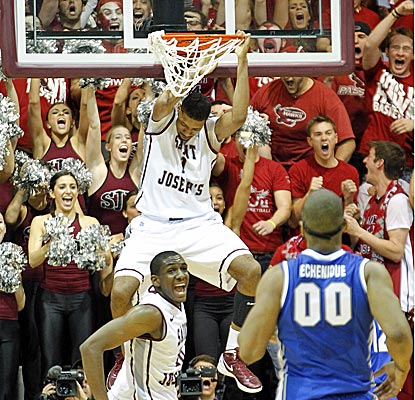
Creighton: I'm not overly concerned about the Bluejay's 80-71 loss at St. Joseph's on Saturday afternoon. To be frank, this team was overrated at 17th in the country. They don't play enough defense, and it came back to bite them against St. Joe's. Up 35-30 at the half, St. Joe's hit 15-26 from the field in the second half as Tay Jones scored 20 of his 29 points to lead the Hawks to a nine point win.
That wasn't the only issue, either. Doug McDermott played great as usual, finishing with 26 points and 10 boards. But take away the 10-16 that McDermott shot, and the rest of Creighton's lineup was 17-45 from the floor. Creighton also got beat up on the glass, giving up 13 offensive rebounds getting just five. St. Joe's has struggled over the last couple of years, but a talented recruiting class that Phil Martelli brought in last season -- Langston Galloway, CJ Aiken, Ronald Roberts, Daryus Quarles -- is starting to pay dividends. This Hawk team is one of the most improved in the Atlantic 10 this season and a tough team to beat at home. Combine that with an off-night for Creighton, and, well, losses like this happen all the time.
Gonzaga: The Zags ran into a buzzsaw known as Draymond Green. Michigan State's versatile power forward had one of the best games of his career on Saturday night, going off for 34 points as the Spartans knocked off Gonzaga 74-67. Green was the only player on Michigan State to finish the game in double-figures. Michigan State is probably better than they are being given credit for -- they've now won eight in a row since losing to Duke -- but they didn't exactly play like it on Saturday.
That should be concerning for Gonzaga. Why? Because they have a versatile power forward of their own that got eaten alive by Green. Elias Harris finished with just six points and five boards on 2-11 shooting from the floor in 32 minutes. Harris is supposed to be the best player on the Gonzaga team, but he couldn't slow down Green enough for the Bulldgos to win at home on a night when everyone else on Michigan State was strugging? Yes, Robert Sacre and David Stockton played well. Yes, Gonzaga did an admirable job keeping Tom Izzo's club from getting to the offensive glass. That's all impressive.
But until Harris can consistently be a strength for Mark Few's team, the Zags are always going to have question marks. 
Memphis: The Tigers, without a doubt, have the most to worry about from this group. While Murray State is a far cry from being a bad team, Memphis should never lose to the Racers at home. Not with that team and not on their home court. Its clear that Josh Pastner is in over his head trying to coach these guys.
They've already begun to take away from Joe Jackson's ball-handling responsibilities. One of the most talented point guards in the country, Jackson is now spending just as much time as an off-guard, allowing Chris Crawford to be the one. Wesley Witherspoon has reverted back into his old self. Tarik Black fouls too much. No one on the team knows how to box out and, despite having as much size and athleticism as anyone they are going to play this season, no one on the roster -- save for maybe Will Barton -- has any desire to go and get an offensive rebound.
Frankly, outside of Barton, it doesn't seem like anyone on the Tigers has any desire period. Josh Pastner is a terrific recruiter, but if he cannot get the kids he brings in to play for him, it will cost him his job eventually.
Continue reading...
Wednesday, October 5, 2011
2011-2012 Top 50 Countdown: No. 23 Gonzaga Bulldogs |
Over the coming weeks, we will be counting down our Top 50 teams in the country. Teams 26-50 will be posted in groups of five, while we will count backwards from No. 25 to the No. 1 team in the country. You can find a complete schedule of our 2011-2012 Season Preview coverage here. To browse through the rest of the Top 50, click here.
Last Season: 25-10, 11-3 (t-1st WCC), lost to BYU in the round of 32
Head Coach: Mark Few
Key Losses: Steven Gray, Demetri Goodson, Manny Arop
Newcomers: Gary Bell Jr, Kevin Pangos, Kyle Dranginis, Ryan Spangler, Chris Sarbaugh, Guy Landry
Projected Lineup:
- G: David Stockton, So.
- G: Marquise Carter, Sr.
- F: Guy Landry Edi, Jr.
- F: Elias Harris, Jr.
- C: Robert Sacre, Sr.
- Bench: Sam Dower, So.; Gary Bell, Fr.; Kevin Pangos, Fr.; Kelly Olynyk, Jr.; Mathis Monninghoff, Jr.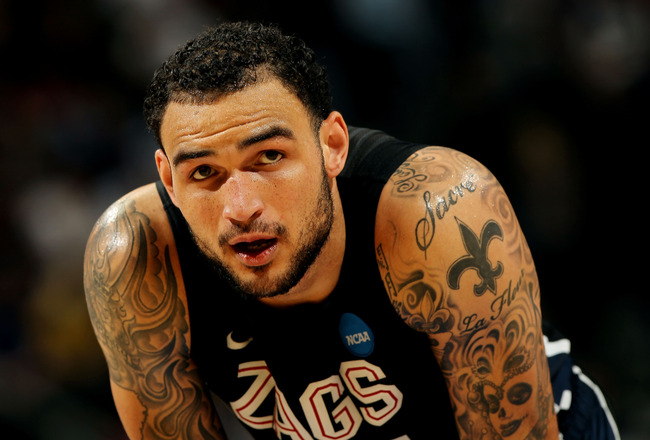
Outlook: Gonzaga is coming off of a 2010-2011 season that was strange, to say the least. After struggling through the early part of the season -- they lost five of their first nine games in non-conference play and started out league play just 3-3 -- the Zags flipped the switch when Marquise Carter was moved into the starting lineup and David Stockton and Sam Dower became the primary options off the bench. The Zags won 10 games in a row in WCC play, enough to give them both a share of the conference regular season title and the WCC Tournament title, sending Mark Few's club back to the NCAA Tournament.
There will be some new faces on this team, however. Gone is Steven Gray, Gonzaga's leading scorer from last season. Also gone is defensive-stoppers Manny Arop and Demetri Goodson, who transferred to Indiana State and Baylor, respectively, the latter for football. And while this year's back court is going to have a new feel to it, the Zags still appear to be the favorite in the WCC.
The strength of this year's Gonzaga team is going to be in the front court, but a lot of just how good that front court ends up being is going to depend on Elias Harris. Specifically, which Elias Harris are we going to get this year? As a freshman, Harris had lottery pick written all over him. Here was a 6'8", 220 lb kid that could go by his man on the perimeter, he could score over a smaller defender in the post, he was able to finish above the rim with a authority, and he was a deadly three-point shooter. But as a sophomore, Harris's number dipped across the board. For my money, there were three reasons for that: A) Robert Sacre's continued development; B) the lack of a pure point guard and a natural playmaker with Matt Bouldin graduating; and C) an off-season shoulder injury and an early-season achilles injury that limited his explosiveness and left him out of shape.
One of the knocks on Harris during his time at Gonzaga has been his inability to create his own shot. He was a finisher around the rim and a catch-and-shoot guy on the perimeter as a freshman, and that didn't change when he was a sophomore. But after an offseason in which he was healthy and able to develop his game, there's no reason why Harris shouldn't be a more well-rounded offensive player. If he is, than he will create a dangerously talented and experienced inside-outside combo with Robert Sacre, who has quietly developed into one of the best big men on the west coast. Sacre is a legitimate seven-footer with a solid back-to-the-basket game, the ability to draw fouls and convert free throws, and the size to take up space in the paint and make his presence felt on the glass and as a shot-blocker.
Joining those two up front will be Sam Dower and Kelly Olynyk. Dower is an interesting prospect. A redshirt sophomore, he didn't see many minutes until midway through the season, when Gonzaga's struggles forced Few to give him a chance. He responded with production, making a name for himself as a junkyard dog around the rim, using his length and positional smarts on the glass. Olynyk is a 6'11" face-up four with a solid perimeter stroke when he has time. Like Dower, he's a pest on the offensive glass. That front court rotation will be able to matchup with any front court in the country.
The back court is where the real question marks arise. For my money, the only guaranteed starter is Marquise Carter, the combo-guard who sparked the late-season surge. He's a 6'2" senior that had a couple of big scoring games as a junior. He's not just a scorer, however, as he can create for his teammates as well. Few will be counting on him to become more consistent this season, as he will likely begin the year as the primary offensive weapon. 
From there, the picture gets a bit blurry. I think that David Stockton can and will start for this team next year, although there are folks that will disagree with me. But Stockton isn't as big and doesn't have the athleticism of some of the other back court options. He's also not as dynamic of a playmaker; Stockton plays more of a leader/facilitator role. That's fine when you are dealing with a team with individual talent and scorers, which I believe Gonzaga as -- assuming Harris finds the ability to create his own shot. Don't be surprised to see Kevin Pangos, a canadian point guard and fairly highly regarded recruit, to push for some minutes at the point as well, although I believe he is still a year or two away from having a major impact.
The other perimeter spot is also up in the air, and it appears that two newcomers will be battling for the position. The freshman phenom is Gary Bell Jr, a Kent, WA, native known for his ability to score. His game centers around his perimeter stroke, but he also appears able to put the ball on the floor and get to the rim. Guy Landry Edi is a JuCo transfer from Midland (TX) that Gonzaga fans are hoping will be the x-factor. He's an athletic, 6'5" wing and Ivory Coast native that should be able to replace the defensive presence that Arop provided. Also keep an eye on Mathis Monninghoff, a sharp-shooting swingman that got eight starts last year.
There is talent on this roster, but there are going to be two keys to the season for the Zags. The first is whether or not Harris can live up to his potential as a superstar and first round NBA Draft Pick. The other is whether Gonzaga can solidify a back court rotation, and just how good the newcomers end up being. The Zags should be considered the preseason favorite in the WCC, and if things break right, there are the pieces here to make a run to -- and past -- the second weekend of the NCAA Tournament.
Continue reading...
Wednesday, July 13, 2011
Looking Back: Re-ranking the 2003 recruiting classes |
Last summer, we ran a series called Looking Back where we went through past recruiting classes to see how the players from those classes developed.
Why?
Well, for starters, it was a fun and interesting thing to do. You're not interested in the fact that Josh McRoberts and Gerald Green were once considered the best high school basketball players in the country? Its also an interesting way to keep fans from getting too excited when a top 25 recruit pledges to their school. Projecting the long-term ability of 17 year old hoopers is an inexact science, and never is that more evident than when you look back at past recruiting rankings.
This summer, we are going to go back through the Team Rankings. In other words, we want to see if the team that the pundits said had the best recruiting class really did have the best recruiting class. The science here will be a bit inexact. For starters, its tough to find consistent rankings. Rivals has them dating back to 2003, Scout to 2005, and ESPN to 2007. Its also tough to determine exactly what players had what effect on a given season. Did UConn's 2007 recruiting class -- which featured Donnell Beverly and, well, Donnell Beverly -- really have much influence on the 2011 national title?
For our purposes, we will be looking at the success that each member of each program's recruiting class had individually in college as well as the success that the team at while those players were member of the program. Like I said, it will be inexact, but inexact science makes for better arguments. Tell us your thoughts in the comment section.
Re-ranking the the 2003 recruiting classes:
1. UConn (Scout: 9, Rivals: 14): Josh Boone, Charlie Villanueva, Marcus Williams, Ryan Thompson
The Huskies were the clear winner of the 2003 recruiting class. Boone, Villanueva, and Williams all played key roles for the 2004 UConn team that won the Big East and NCAA Tournament titles. They became stars on the 2005 team that won a share of the Big East regular season title. Villanueva left school after his sophomore year, becoming the seventh pick in the NBA Draft, while Boone and Williams returned for their junior seasons. UConn again won a share of the Big East regular season title, but lost to George Mason in the Elite 8 of the NCAA Tournament in one of the biggest upsets in college basketball history. Williams and Boone left school after their junior years and ended up getting picked in the first round of the draft.
2. Gonzaga (Scout: N/R, Rivals: N/R): Adam Morrison, Derek Raivio
We all know about Adam Morrison. The kid that no one wanted managed to contribute to one of the most talented teams that Mark Few has fielded in Spokane as a freshman before becoming the 'Zag's go-to player as a sophomore and the co-national player of the year with JJ Redick as a junior. Morrison would eventually become the third pick in the NBA Draft. Derek Raivio didn't have quite as immediate individual success, but he played a key role on three teams before leading the transition -- and winning the 2007 WCC player of the year award in the process -- from the Adam Morrison era to the Matt Bouldin era. Gonzaga was 40-2 in WCC play in the three years Raivio and Morrison were both in the program, and Raivio was a member of four straight outright champions, winning both the WCC regular season and tournament titles every season. The only year Gonzaga made it out of the first weekend in the NCAA Tournament was in 2006, when they blew a 17 point lead to UCLA.
3. Wake Forest (Scout: 22, Rivals: 16): Chris Paul, Kyle Visser, Jeremy Ingram, Todd Hendley
Chris Paul. Enough said. Paul -- who ranked third behind Shannon Brown and Drew Lavender for point guard -- was as good in college as he has been since he entered the NBA. In his two seasons, Paul led Wake Forest to back-to-back NCAA Tournaments, the Sweet 16 as a freshman, and a second place finish in the ACC regular season as a sophomore. He also managed to win national freshman of the year honors and was a consensus first-team all-american as a sophomore before becoming the fourth pick in the 2005 draft. The only other impact player from this class was Kyle Visser, who played a role for three years before becoming a third-team all-acc selection as a senior after averaging 17.0 ppg and 7.4 rpg.
4. Oklahoma State (Scout: N/R, Rivals: N/R): John Lucas III*, Marcus Dove, David Monds, Tremaine Fuqua
(*The inclusion of John Lucas III deserves an asterisk. He was originally in the class of 2001, but he transferred to Oklahoma State from Baylor after the death of Patrick Dennehy and the resulting scandal.)
In their first season, this group had the best season in recent Cowboy history. They won the Big 12 regular season and tournament titles and advanced to the Final Four before losing to Georgia Tech. John Lucas III became a star on a team that already included Tony Allen and the Graham twins, while Fuqua and Monds were role players. In 2005, Lucas led the Cowboys to another Big 12 Tournament title and OSU's second straight two seed before bowing out in the Sweet 16. Lucas graduated in 2005, and for the next three seasons, Dove (who red-shirted in 2004) and Monds were role players and starters on three straight NIT teams.
5. Pitt (Scout: 21, Rivals: 9): Aaron Gray, Chris Taft, Dante Milligan, Antonio Graves
Jamie Dixon's first recruiting class at Pitt spawned two eventual second-round picks. Chris Taft was the player with the most immediate impact. He was a starter from day one, averaging double-figures as a freshman on a Panther team that won the Big East regular season title and made it to the Sweet 16 of the NCAA Tournament. Taft left school after his sophomore season, getting scooped up in the second round of the 2005 Draft. Taft's departure opened up space for Gray, who became a double-double machine his last two years, anchoring a Panther squad that finished second in the Big East and made the Sweet 16 in 2007. Gray was picked in the second round in 2007. Graves was a typical Pitt guard -- contributed for four years, a starter his last two.
6. Florida (Scout: 16, Rivals: 12): Chris Richard, Lee Humphrey, Mohamed Abukar
Florida's 2003 is easily the most interesting to discuss and probably the most controversial in these rankings. None of the three players ever really advanced beyond being a role-player. Abukar transferred as a sophomore to SDSU (where he was all-MWC), but Richard and Humphrey stayed where they became members of three straight SEC Tournament title winners, the 2007 SEC regular season champ, and, most importantly, the 2006 and 2007 national champions. Humphrey started and shot a bunch of threes during the two title runs, while Richard played impressively enough in his limited minutes off the bench to spelling Joakim Noah and Al Horford that he became a second round pick.
7. Syracuse (Scout: 6, Rivals: 7): Louie McCroskey, Terrence Roberts, Demetris Nichols, Darryl Watkins
The year before these four arrived on campus, the Orange rode the coattails of freshman Carmelo Anthony to the 2003 NCAA title. But none of these four freshmen were as lucky, as all four were at the back-end of a short Jim Boeheim rotation, one freshmen rarely crack. The 2004 NCAA Tournament was the only year that this group made it past the first round of the NCAA Tournament. As sophomores, all four were still coming off the bench but all four had seen their roles increase. The Orange won the 2005 Big East Tournament, but lost to Vermont in the first round of the NCAA Tournament. As juniors, Demetris Nichols, Terrence Roberts, and Darryl Watkins all became starters, but if it wasn't for the heroics of Gerry McNamara in leading the Orange to a second-straight Big East tournament title, Syracuse (who went 7-9 in the Big East) would have missed the NCAA Tournament. McCroskey transferred to Marist as a senior while Nichols became an 18.9 ppg and an all-Big East first team selection, but the Orange went to the NIT despite finishing 10-6 in Big East play.
8. Maryland (Scout: 3, Rivals: 3): Ekene Ibekwe, DJ Strawberry, Mike Jones, Will Bowers, Hassan Fofana
As freshmen, Ekene Ibekwe, DJ Strawberry, and Mike Jones all played key roles for a Maryland that ran through the ACC Tournament and to the second round of the NCAA Tournament despite finishing just 7-9 in ACC play. The Terps went to back-to-back NIT's the next two seasons before returning to the NCAA Tournament in 2007, where they beat Davidson but lost to Butler in the second round. Ibekwe, Strawberry, and Jones all developed together. As sophomores and juniors, their roles expanded before becoming starters, and in Strawberry's case a star, as seniors.
9. Wisconsin (Scout: N/R, Rivals: N/R): Brian Butch, Kammron Taylor, Zach Morley
The Badgers just barely get the nod over the Spartans. Kammron Taylor was the only typical recruit in this class for Bo Ryan. A seldom-used back-up to Devin Harris as a freshman, Taylor became the No. 2 option for the Badgers behind Alando Tucker as a junior and senior. Morley was a JuCo transfer that played valuable front court minutes in his two seasons, including the 2005 Elite 8 run. Butch was the most interesting recruit. A top ten player coming out of high school, he redshirted a season in 2004, something you don't see very often in hoops. Butch played a role as a redshirt freshman, slowly developing into the third option as a junior and the focal point as a senior, when he led the Badgers to Big Ten regular season and tournament titles.
10. Michigan State (Scout: 5, Rivals: 13): Brandon Cotton, Shannon Brown, Drew Naymick
Brandon Cotton, a McDonald's all-american, last all of three games with the Spartans before transferring to Detroit. Drew Naymick never became more than a limited role-player in his five seasons in East Lansing. Shannon Brown, as you know, ended up going in the first round of the 2006 NBA Draft after becoming a second-team all-Big Ten pick. Brown played a supporting role for the 2005 Michigan State team that made the Final Four.
11. LSU (Scout: 2, Rivals: 4): Brandon Bass, Tack Minor, Darnell Lazare, Regis Koundjia, Robert Neltner
12. Oregon (Scout: N/R, Rivals: N/R): Aaron Brooks, Mitch Platt, Ray Schafer
13. Florida State (Scout: 1, Rivals: 1): Von Wafer, Alexander Johnson, Diego Romero, Antonio Griffin
14. Arkansas (Scout: 10, Rivals: 5): Ronnie Brewer, Olu Famutimi, Anthony Gray, Vincent Hunter, Darian Townes
15. Louisiana Tech (Scout: N/R, Rivals: N/R): Paul Millsap, Donnell Allick, Solomon Brown, Fred Marshall, JueMichael Young
The most disappointing classes:
- Kansas (Scout: 4, Rivals: 8): The Jayhawks brought in a six man recruiting class, but only two of the six players finished their career in a Kansas uniform. David Padgett transferred to Louisville, where he became a fixture for a very good Cardinals team. JR Giddens left Lawrence under some duress, transferring to New Mexico where he eventually became a first round pick of the Celtics. Omar Wilkes transferred to Cal to play with his brother. Nick Bahe finished his career with Creighton. Only Rodrick Stewart and Jeremy Case, neither of whom were stars, graduated a Jayhawk.
- Oklahoma (Scout: 14, Rivals: 2): The only player from Oklahoma's vaunted six-man recruiting class in 2003 that played their entire career in Norman was Longar Longar, and that was after he spent a year at a prep school. Drew Lavender started as a freshman but transferred to Xavier after his sophomore season. Brandon Faust transferred to Southeast Missouri, Lawrence McKenzie transferred back to Minnesota, and Jimmy Tobias went to a JuCo after one season and finished his career with Georgia Southern. Jaison Williams spent two years in a limited-role off the bench after transferring in from a JuCo.
- Mississippi State (Scout: 13, Rivals: 20): The Bulldogs 2003 recruiting class is one example of why I don't want to see the NBA allow players to go straight to the NBA again. Neither Jackie Butler nor Travis Outlaw ever made it to Starkville, which set MSU's class off on the wrong foot. Gary Ervin never really found a home with the Bulldogs, transferring after his sophomore year to Arkansas. Bill Begley finished his career at Nicholls State. There were some successful recruits in this class, however. Dietric Slater became a solid role player as a junior and senior. Iowa State transfer Shane Power averaged double figures in his two seasons in Starkville, although he was technically part of the 2002 class. And then there is Lawrence Roberts, who, like John Lucas III at Oklahoma State, transferred out of Baylor due to the scandal.
Continue reading...
Wednesday, May 4, 2011
Demetri Goodson the latest to leave Gonzaga |
Demetri "Meech" Goodson has ended his basketball career, as the now-former Gonzaga point guard has decided to transfer -- possibly to Texas A&M -- to play football. The Bulldogs put out a press release on it Tuesday, but we're giving credit for the scoop to The Slipper Still Fits.
"I have decided to pursue football next year," said Goodson. "I would like to thank my coaches and staff for the opportunity to play here. I also want to thank the city of Spokane and all of the Zags fans who have supported me over the years. It's been an awesome experience."
The writing was on the wall for Goodson.
A lightening quick point guard, Goodson was never really able to live up to his athletic prowess in his time at Gonzaga. He started 35 games last season, but he averaged just 5.2 ppg and 2.6 apg while seeing his playing time severely diminished late in the year thanks to David Stockton's emergence.
Goodson is the brother of Carolina Panther running back Mike Goodson and was a good enough player in high school to be recruited by some Pac-10 schools. That said, Meech hasn't played football since high school back in the state of Texas. He will have two years of eligibility remaining in football and can play immediately since the Zags don't have a football program.
While Gonzaga will now be losing a lot on their perimeter -- Manny Arop has also left the program while Steven Gray is graduating -- the Zags should be alright on their perimeter. Not only will Stockton be returning for his sophomore season, but they all two very talented freshmen -- PG Kevin Pangos and SG Gary Bell -- as well as JuCo transfer Guy Landry. Goodson's departure also opens up a scholarship for Bryce Jones, a talented wing that transferred out of USC. Jones is considering UNLV, SDSU, and Gonzaga, but had pushed back two visits to Spokane because the Zags did not have an available scholarship.
One thing to note -- Goodson is the sixth player to transfer out of the Gonzaga program in recent years. GJ Vilarino, Grant Gibbs, Andy Poling, Bol Kong, and Arop have all left with eligibility remaining.
Continue reading...
Friday, March 18, 2011
Marquise Carter makes the Zags a more dangerous team |
Gonzaga disappointed a lot of folks this season, as they struggled through much of the regular season.
The problem wasn't a lack of talent. The 1-2-3 punch of Steven Gray, Elias Harris, and Robert Sacre is about as good as you'll find in the country. The issue, however, was that the Zags didn't have anyone to replace Matt Bouldin's play making. With not facilitator or creator on the floor, the offense stagnated and Gray and Harris ended up forcing tough shots.
Enter Marquise Carter.
The JuCo transfer really came on down the stretch of the season. Over the last nine games, Carter averaged 12.7 ppg and 3.9 apg, acting as the dynamic complement to David Stockton's floor leadership.
And on Thursday, Carter erupted.
Against a St. John's team that was supposed to be physical defensively and tough in the full court, Carter led a surgical evisceration of the Johnnies, winning 86-69. He had a career-high 24 points to go along with six assists and six rebounds in what was one of Gonzaga's best offensive performance of the season.
The Zags scored 1.32 PPP. They shot 53.8% from the floor and 9-15 from three. The most impressive stat of the night, however, had little to do with Carter, as Gonzaga grabbed 86.1% of the available defensive rebounds and 44.4% of the available offensive rebounds. In total, the Zags outrebound St. John's 43-20.
Steven Gray added 16 points, six boards, and five assists while Elias Harris chipped in 15 points and eight boards.
"They're definitely a Final Four-capable team, national championship-potential team," St. John's head coach Steve Lavin said after the game.
While I don't know if I would go that far just yet, this is definitely a Gonzaga team that can beat BYU in the next game and play their way into the Sweet 16. Maybe beyond. Wouldn't be ironic if the first time that Mark Few has made it past the Sweet 16 was the year his team was supposed to be a disappointment?
Forgive me, I'm getting way ahead of myself.
The Zags must first deal with the Jimmer before they can think about the Elite 8.
But the reason that we can even toy with that thought is the play of Marquise Carter. Expecting him to put up numbers like he did tonight is too much, but simply having that kind of threat in their back court makes Gonzaga a much more dangerous team.
Continue reading...
Friday, March 11, 2011
Dancing with the Stars: Gonzaga Bulldogs |
Conference: West Coast Conference
Record: 24-9, 11-3
Rankings: 32 (KenPom), 37 (Sagarin), 54 (RPI)
Potential Seed: 9/10, I've seen them listed as a No. 13-seed, a No. 10-seed is much more realistic.
Best Players: Steven Gray (13.8 ppg, 3.9 apg), Robert Sacre (12.5 ppg, 6.2 rpg), Elias Harris (12.1 ppg, 5.9 rpg)

Big Wins, Bad Losses: The early part of their season, both non-conference and WCC play is where the Zags suffered their worst losses. The worst of the bunch was a 22-point defeat at the hands of Washington State after losing to Illinois 61-73 two days before. In WCC play, they had back-to-back losses against Santa Clara and San Francisco. The Zags don't have too many great wins, but they do hold victories over Marquette, Baylor, and Xavier, plus two against St. Mary's.
Tendencies: The Zags have had some identity issues all year. Their point guard play has been shaky at times. Steven Gray isn't a true point guard, and Demtri Goodson is not reliable at all. Luckily, David Stockton and Marquise Carter have been productive in the increased minutes they have gotten down the stretch. Also, the Zags front court is too reliant on Elias Harris and Robert Sacre, both of whom are not exactly playing up to pre-season expectations. That being said, this team relies heavily on it's defense this season, and they were able to control the tempo of the games late in the season because of their defensive pressure.
How They Got There: When you look back at their schedule, it doesn't really look that bad. They lost five of seven during non-conference play, but those losses were to teams like San Diego State, Kansas State and Notre Dame. The were able to go on a nine-game win streak that carried into WCC-play, before dropping three straight, two against sub-par teams San Francisco and Santa Clara. But following a mid-season, non-conference loss to Memphis, the Zags rallied off another nine-game win streak, and head into March Madness with momentum.
Outlook: This isn't your older brother's Gonzaga squad, but they certainly won't be shocking the world if they make it two or three games deep in March. Their coach is a guy who has seen it all, and they have a few players with NCAA tournament experience. Provided they get a descent first round match-up, most likely against a No. 7-seed, it very possible to see this team pick up a tournament win. More than one win could be a stretch, however.
Continue reading...
Sunday, March 6, 2011
VIDEO: San Francisco has their Chris Webber moment |
Gonzaga held on to beat San Francisco in the WCC semifinals on Sunday night, setting up a dream matchup against St. Mary's Monday in Las Vegas.
Both the Zags and the Gaels are sitting squarely on the NCAA Tournament's bubble. And depending on who you ask, Gonzaga is in better shape than St. Mary's, St. Mary's is in better shape than Gonzaga, or this game is, for all intents and purposes, a play-in game.
So yeah, high drama at its finest.
But if it wasn't for Marko Petrovic ... err, Rex Walters? ... that outcome could have been very different. USF hit a three to cut the Gonzaga lead, that was double digits at one point, down to 68-65 with 10 seconds left. The Dons stole to ensuing inbounds pass, and while Rashad Green was on the floor with possession of the loose ball, Petrovic can clearly be seen calling a timeout on the bench (he is number 10):
(h/t to @bubbaprog for the video)
The problem?
San Francisco didn't have any timeouts left. They were called for a technical foul and after Marquise Carter hit one of two from the free throw line before the Zags got the ball back. Instead of having a chance to force overtime, USF was down two possessions and had to force another turnover.
To his credit, San Francisco head coach Rex Walters took the blame for the timeout.
"You can call me a liar because I'm going to say that I called the timeout," Walters said after the game. "I'm not going to put it on one of my players. I have to do better job at making sure it’s really clear to our guys that we don't have any. I thought Rashad (Green) made a heck of a play to get the ball."
That's what you want a coach to do.
Or maybe but let his team know that they don't have any timeouts left.
Continue reading...
Friday, January 28, 2011
B.I.A.H Not-Top-Ten Rankings |
Every week, writers, publications, media outlets and bloggers issue their Top-25 rankings for the week. A majority of the time, everybody has virtually same opinion of all the teams.
If you want to find this week's top-25 rankings, you've come to the wrong place. Here you will find our rankings for the 10 worst team performances in the NCAA. This list isn't just home to the winless mid-major bottom-feeders. No, here you will find the biggest underachievers, slumpers and teams in a funk, the worst weekly performers, and the teams that just plain suck. Now there will be teams on this list that are better than teams not on this list. But come on people, we are trying to be creative, just work with us.
The B.I.A.H Not-Top-10 Rankings
1. Syracuse Orange
Record: 18-3 (5-3)
Suffering back-to-back losses in the Big East is not all that bad, especially when both losses are to top-10 teams. But a team follows up those two losses with a 22-point drubbing AT HOME to a team like Seton hall, then they deserve to get slammed. What happened to that raucous Carrier Dome atmosphere that was present for the Villanova game? Fans started leaving the Seton Hall game with nine minutes to go in the second half. 
This team was supposed to be a real threat to win it all this year. But I guess we shouldn't forget that this is also the team that went to Pittsburgh and promptly got down 19-0 before the first TV timeout. With games against Marquette and UConn on the horizon, the Orange need to get out of this funk quickly or else they could slip-n-slide right into the middle of the Big East pack.
2. Michigan State Spartans
Record; 12-8 (4-4)
What on Earth is going on in East Lansing? First, Chris Allen was removed from the program before the season started, then Korie Lucious got a DUI. After that, it was reported that two players raped a MSU student in her dorm room. On top of that, Tom Izzo was suspended one game for a minor recruiting violation. All of that took place before Big-Ten play started, and when it did, the wheels were already off the bus. 
Tom Izzo benched Durrell Summers due to lack on enthusiasm. They've lost four of their last six, including losses to Penn State and Michigan. last week, Korie Lucious was suspended for the rest of the season. We are all aware that you can't doubt Tom Izzo's squad come March Madness time. But what if they don't even make it to the tournament?
3. Gonzaga Bulldogs
Record: 13-8 (3-3)
For the second time this season, the 'Zags have lost three games in-a-row. For what must be the first time in at least a decade, the 'Zags have lost three league games in a row. Last night they lost to St. Mary's on a buzzer-beater, but that followed up back-to-back losses at Santa Clara (75-81) and at San Francisco (91-96 OT). Elias Harris was supposed to have a breakout season worthy of a guaranteed lottery pick, but so far he's been hampered by injuries and is averaging just 12.5-ppg and 5.6-rpg. It looks like Gonzaga's NCAA tournament streak may be in jeopardy because they have almost no shot of getting an at-large bid, and well, at 3-3 in league play, it doesn't look like they will get the automatic bid either.
4. West Virginia Mountaineers
Record: 13-6 (4-3)
Ten days ago they were the hottest team in the country. Ten days later, they have nine scholarship athletes, and suspended their best scorer for the second time this season. They've lost to Marshall (down 47-23 at the half) and to Louisville. During their lone win in that time frame, their back-up forward Danny Jennings got up off the bench and walked out of the game, something I don't think I've ever seen or heard about before in my life. A couple days later Casey Mitchell was suspended indefinitely for breaking team rules. 
Bob Huggins is constantly dealing with player personnel issues with this squad. Regardless of how good they might play during some games, this team has some serious problems.
5. Towson Tigers
Record: 4-16 (0-10)
For a team that's played ten conference games already, they have the worst record in the country. They've lost ten in-a-row, and that streak feature losses by 31 and 26. Their most recent loss, the 26-point blowout at George Mason came under much scrutiny. Towson University was unable to make their Wednesday night game at George Mason, who's campus is just two hours away. Poor planning of snow travel caused the game to be pushed back to Thursday afternoon at 4:00PM, and the university received a public reprimand from the conference for their lack of preparation. The team was dealt a 26-point loss to boot.
6. Central Florida Knights
Record: 14-5 (1-5)
UCF's 14-game winning-streak at the beginning of the season wasn't just a product of an easy non-con schedule. They beat a couple good teams in that stretch and were primed for a breakout year in the Conference-USA. That's why it's so hard for me to understand how this team has lost five games in-a-row. Yes, they've had to play the top teams in the league, but they led us to believe they were capable of winning those games. In their last game, a 15-point loss at Memphis, the Knights got down by as many as 25-points and never led in the ballgame. Their next four games are against UAB, at UTEP, at ECU, and against Memphis. It's very possible UCF is 1-9 in C-USA play by Valentines Day.
7. Arizona State Sun Devils
Record: 9-11 (1-7)
I don't think people realize Arizona State is as bad as they are. Well, maybe they aren't BAD per se, but they sure do lose a lot. They've lost four in-a-row and six of their last seven. None of their recent losses have been too catastrophic, but they can't score (ranked 287th in the country) and can't rebound (299th), and like I said, have lost seven games in the Pac-10, and that's pretty bad. In fact, I'm having trouble figuring out what their "best win" is. Herb Sendek's seat is getting hot, and I don't think a lot of people realize that yet.
8. Iowa Hawkeyes
Record: 8-12 (1-7)
Want to get an idea of how bad this team is? They lost to Wake Forest. BOOM. But seriously, this team hasn't won since before Christmas, and has lost their last five games by an average of 19.6-ppg. It's entirely possible that this team doesn't win another conference game this season. Oh wait, nevermind, they still have to play Michigan State twice.
9. North Texas Mean Green
Record: 16-5 (5-3)
Maybe it's my fault for being so high on the Mean Green bandwagon. I was sure this team could roll through the Sun Belt Conference with maybe only one or two losses. As of now they are 5-3, and their last two losses have come against teams with a combined total of ten wins. With the Denver Pioneers off to a quick start at 6-0, and a match-up with them tomorrow, the Mean Green can ill-afford to play at the level of mediocrity that they are now.
10. East Carolina Student Section
Listen, I'm all for getting under the skin of the opposing team. I have no problem with profanity-laced insults and borderline-hurtful signs and chants towards players. I was a soccer hooligan for four years in college and believe that it is the responsibility of the student section to get inside the opposing players heads and take them out of their game, even if that means getting personal. But regardless of how rowdy and insulting you get, you must respect your elders. Coaches and parents are the type of people you do not insult or disrespect. But apparently the ECU student section didn't get memo during their team's home game against Southern Mississippi. 
The Golden Eagles head coach, Larry Eustachy battled alcoholism for a long portion of his early career and was eventually fired from Iowa State when photos were leaked of him partying it up with college students back in 2003. The Pirate fans were mocking Eustachy the entire game, which his team won 84-77. The coach hasn't had a drink in almost seven years and the students were still getting on him. Listen kids, would you say that to a professor? How about one of your friend's parents? Go after a player who got a DUI or someone who failed English Lit. but show some respect for the elders.
Continue reading...
St. Mary's got their first win at the Kennel under Randy Bennett |
St. Mary's has officially taken the throne from Gonzaga as the King of the WCC.
Well, actually, that's not exactly true. Gonzaga is still the reigning champ and until someone wins the the conference regular season, but after the Gaels beat the Zags 73-71 on Thursday night, the power structure of the WCC has been rearranged.
Matthew Dellavedova has 15 points and five assists while Rob Jones added 15 and 13 boards, but Mickey McConnell was the star of this show. He finished with 27 points and six assists on the night, but no play was bigger than this one:
"We were going to try to run an on-ball and get Sacre to switch off," said McConnell. "We knew we had to get one shot so we had to get the last shot."
"We couldn't have guarded it any better," Gonzaga coach Mark Few said, "but he still had the moxie to get it up there. I don’t know how many of those he could make out of 10, but to his credit he stepped up and hit it."
The loss was the third straight in conference play for Gonzaga. As of right now, this is a team that doesn't look like they are worthy of the NCAA Tournament discussion. They do have some wins -- Marquette, Baylor, Oklahoma State, Xavier -- but would you consider any of those 'marquee' wins? I wouldn't.
The Zags do get Memphis at home and at least one more shot at St. Mary's, but if they have any hope of being able to earn an at-large bid, Gonzaga must win those two games.
As for St. Mary's, the Gaels are once again rolling along, Samhan or no Samhan. Mickey McConnell is one of the most underrated playmaking point guards in the country. Throw him in a back court with Dellevadova to play alongside San Diego transfer Rob Jones, who is turning into the ultimate glue guy.
Perhaps the most impressive part of this victory for the Gaels?
It was head coach Randy Bennett's first win at the Kennel.
That, alone, should give you a good feel of what the WCC is like this season.
Continue reading...
Monday, December 20, 2010
12/20 - College Hoops Week in Review: Upsets Galore |
Game of the Week: Texas 78, UNC 76
We'll get to Josh Selby and the exciting finish to the Kansas-USC game in a bit. And as terrific as that game was, the Longhorn's win over UNC had an even better finish. Texas used an 18-8 surge in the first half to open up a 28-18 lead over the Heels, punishing them inside despite the fact that Tristan Thompson was out with two fouls. But the Heels didn't fold, attacking the Longhorns off the bounce and using a 15-4 run over the final 7:30 of the half to take a 33-32 lead at the break.
In the second half, both teams came out on fire, but UNC, led by a career-high 18 points from Dexter Strickland, finally found their transition game. On three different occasions, Strickland was able go coast to coast for a layup -- two of which came off of made baskets -- and UNC was able to hold a two possession lead for much of the second half, pushing it to seven three times.
But, as UNC's offense is wont to do, the Heels offense got bogged down for a string of three or four possessions late in the second half, and three straight Texas baskets gave the Horns a 70-69 lead with less than three minutes left. The teams would trade baskets before Thompson -- who was an animal inside over the last four minutes of the game -- got his second dunk in heavy traffic with 45 seconds left for a 74-73 lead. After two free throws from J'Covan Brown, UNC had the ball with 24 second left and down three points. Roy Williams called a time out, drew up a play for Harrison Barnes, and the freshman came off of a screen and drilled a three with 11.7 seconds left to tie the game. It set up this:
With the loss, UNC drops to 7-4 on the season, although the team that took the floor Saturday afternoon looked much improved over the UNC we have seen earlier this season. The win for Texas was important for two reasons. First of all, the Longhorns are entering the most difficult part of their schedule. Their next two games are at Michigan State and at home against UConn before they start Big XII play. But, more importantly, it was a breakout game for freshman point guard Cory Joseph. Joseph had 21 points, and in contrast to the potential game-winner he threw over the back board against Pitt in MSG a month ago, the freshman buried UNC with a tough, turnaround against very good defense. When Joseph, Jordan Hamilton, Tristan Thompson, and J'Covan Brown are all clicking, Texas has a team with a lot of offensive weapons.
This needs mentioning: St. Bonaventure 112, Ohio 107 4OT
Ohio fought back from 10 down with 9:42 left in regulation to force the first overtime on a three from DJ Cooper with 22 seconds left. In the first overtime, the lead changed hands four times before Cooper once again tied the game on a driving layup with 17 seconds on the clock before the Bonnies missed two free throws. The second overtime saw Ohio grab a three point lead, but Michael Davenport once again tied the game with a three pointer. Only four points were scored in the third overtime before St. Bonaventure opened up a five point lead in the fourth OT, making 7-8 free throws (after going 6-18 from the charity stripe in the first three overtimes) to hold on to the win.
The box score read something like a game of NBA 2K11. Cooper had 43 points, 13 assists, 8 steals, and 8 rebounds while shooting 17-41 from the floor. Andrew Nicholson of St. Bonaventure had 44 points, 12 boards, and 5 assists. Five other players reached double figures. Ohio took 101 shots, 40 from three. St. Bonaventure shot 56.7% from the floor. Five players fouled out. Six played more than 50 minutes. Four of them were on St. Bonaventure, with Nicholson logging all 60 minutes of game time. But, perhaps the most incredible stat, the Bonnies only got six points from their bench in 60 minutes of basketball.
Player of the Week: Josh Selby, Kansas
I'm not giving this to him just because he had an impressive performance against USC. Sure, he had 21 points and hit two clutch threes -- including the game-winner with 24 seconds left on the clock -- as the Jayhawks knocked off a scrappy USC team. But if we were rating a player based on their performance alone, Selby probably did not live up to his potential on this night. He was hot from three, there is no question, but Selby's not going to be going 5-8 from three every night. In fact, for a kid known for his slashing ability, Selby did strikingly little inside the arc. Fifteen of this 21 points came on threes, and he hit all three free throws when he was fouled shooting a three. He scored three points and took only three shots doing something other than spotting up while turning the ball over four times. Granted, that was a result of Selby being a good teammate and playing within the Kansas offense, but my point is that the Selby that is playing in the NCAA Tournament will be a different player than the one we saw on Saturday.
No, I'm giving Selby the player of the week in large part because its so damn hard not to feel great for this kid after the performance he had. Kansas was undefeated, but they weren't undefeated in impressive fashion, struggling to beat mediocre teams like Arizona and Memphis. The Jayhawk faithful, after seeing guys like Brandon Knight and Kyrie Irving play great basketball, had sky-high, almost unfair, expectations for the freshman. And, after sitting out nine games, Selby was debuting in a noon tip on a Saturday two hours before the college football bowl games were to start. There were a lot of eyes on this kid.
And not everyone was rooting for him to win. According to the NCAA, Selby is a cheater. He accepted $6,000 worth of illegal benefits and had a personnel relationship with Carmelo Anthony's business manager that the NCAA determined bordered too closely on professional.
Me? I wanted to see this happen. I wanted Selby to succeed. Here's a kid who grew up without the luxuries that many of us grow up with. He spent some time homeless as a kid when his single-mother lost her job. He lived in an area of Baltimore where violence was common. He saw his best-friend get pistol-whipped and had a cousin murdered when he was 15. I fail to see the sense in rooting against a kid that accepted what every recruit accepts and received advisement from a family friend that was illegal because of the job that friend holds.
I may in the minority here, but I want to see Selby succeed. And Hollywood couldn't have scripted a better debut.
The All-they-were-good-too team
Co-Teams of the Week: Florida Gators, UCLA Bruins, Gonzaga Bulldogs
We'll get into it more in a bit, but this week was the week of the upset as seven ranked teams were knocked off by unranked opponents. Florida, UCLA, and Gonzaga were three of the unranked teams to do the knocking off, and while it is still too early in the season to say that anyone needs to "desperately" win a game, it is safe to say that the Gators, the Bruins, and the Zags all really, really, really needed their wins.
The Week of the Upset: As I mentioned before, seven ranked teams lost to unranked opponents last week. Considering the limited number of games that took place this week, the percentage of ranked teams that lost to their unranked opponents was incredibly high:
Matchups of the Week:
Continue reading...
Thursday, December 9, 2010
What is going on with Gonzaga? |
Before the season started, Gonzaga was a trendy pick to (finally) make a run to the Final Four.
They had a loaded front court, headlined by potential lottery pick Elias Harris, and a back court with Steven Gray, Demetri Goodson, and a couple of touted role players.
But eight games into the season, Gonzaga hasn't looked anything like a Final Four team. Hell, they have barely looked like a tournament team.
Last night, the Zags were completely embarrassed by Washington State 81-59. Not Washington, mind you. Washington State. The same Cougar team that finished last in a dismal Pac-10 last season. Gonzaga went scoreless for the first eight minutes of the game. They turned the ball over 25 times. Their 39.6% shooting percentage is only respectable because guys like Sam Dower and Mathis Monninghoff scored some late buckets when the game had already been decided.
Add it all up, and Gonzaga is now 4-4 on the season. They've lost to San Diego State at home. Kansas State blew them out in Kansas City. Illinois rained threes on the Zags in a 12 point win in the Battle in Seattle. And now this mess against Washington State.
Gonzaga's only relevant win came against Marquette, who isn't exactly looking like a world beater at this point in the season.
The Zags better be careful. They still have some impressive non-conference games left on their slate -- Baylor, Xavier, Oklahoma State, Notre Dame, Memphis -- so there are still plenty of chances for them to turn things around. But will they be able to? Is this team actually good enough to win any of those games?
There are three issues for Gonzaga right now. The first is the most obvious. Harris, their star forward, is not healthy. He's had a bum shoulder since the preseason and the achilles injury he suffered late in the loss to San Diego State is obviously hampering his explosiveness. He doesn't look like the same athlete as last season.
The second issue is on the defensive end of the floor. Gonzaga can't stop anyone. They allow too much penetration, they don't play any transition defense, and they allow far too many open looks on the perimeter. The past two games, Illinois and Washington State have combined to go 23-44 from three. Even Kansas State, a team not known for their shooting prowess, knocked down 12 threes against the Zags.
The biggest issue, however, is point guard play. Demetri Goodson is a terrific athlete, but he is not a creator. He's not the kind of player that can get into the lane and kick out to open shooters. He struggles when he is forced to be a facilitator for this offense.
Gonzaga really misses Matt Bouldin. Steven Gray is a terrific talent, but he's a scorer and a slasher, not a point guard. Marquise Carter hasn't really developed the way a lot of Gonzaga fans had hoped. The end result is that David Stockton, John's son, is playing a lot of minutes at the point. He's a smart and gutty player, but he's just not athletic enough for Gonzaga's high major opponents. They attack with traps defensively and with isolations offensively.
Harris will get healthy this season. Gonzaga has never been a great defensive team, but that issue is fixable.
But without a guy like Bouldin to run this team on the offensive end, Gonzaga is not an elite basketball team.
Continue reading...
Monday, November 22, 2010
Pair of power forwards returns |
In a day that is full of meaningful basketball, the most intriguing game of the day is the 9:30 pm tip between No. 3 Kansas State and No. 12 Gonzaga.
And thanks to Jeff Goodman's neverending string of sources, we now know that the matchup just got that much better.
Curtis Kelly was the leading scorer in the Wildcat's front court as a junior, averaging 11.5 ppg and 6.2 rpg. But he was suspended for the first three games of the season, likely the result of a perceived lack of dedication to the team. Kelly will be back in uniform tonight, and his presence will be welcomed with open arms by K-State. One of the biggest issues the Wildcat's have faced here early in the season is a lack of scoring in their front court.
Kelly isn't the only power forward returning to the line up tonight.
The rest of this post can be found at Beyond the Arc.
Continue reading...
Wednesday, November 17, 2010
Elias Harris injured; "I heard something pop" ... UPDATE: He'll be fine |
UPDATE: Good thing we just did a post on this...
According the Jeff Goodman of FOXSports.com, Elias Harris did NOT tear his achilles. He'll miss about a week. Now, the question is whether or not he will be available for the CBE Classic. Gonzaga gets Kansas State on Monday, and could face Duke or Marquette on Tuesday depending Monday's results.
--------
Losing to San Diego State is a loss Gonzaga can overcome.
The Aztecs are criminally underrated (well, maybe not anymore) and got a career game out of one of their best players. The Zags still have plenty of opportunities to pick up enough quality wins to earn an at-large big.
A loss they cannot overcome would be Elias Harris.
Harris injured his shoulder a few weeks ago, so when he wasn't on the floor at the end of the game, that was the reason that some suspected. It turns out that he suffered a potentially serious foot injury:
Gonzaga standout sophomore forward Elias Harris left with an injury late in the game. "I think it's my Achilles' (tendon)," said Harris, who will have an MRI today. "I heard something pop. I couldn't get up in the air and I couldn't run any more."If that's the case, then Harris will miss the rest of the season. He's getting an MRI today. It would be a huge blow to the Zags, as he was the favorite to win the WCC Player of the Year award in the preseason.
You can't replace a talent like Harris -- he's going to be a lottery pick whenever he turns pro -- but Gonzaga does have some pieces to make up for the loss. Kelly Olynyk and Sam Dower have been good early in the season, and Steven Gray is playing the best basketball of his career right now.
This team is still good enough to win the WCC.
But with the injury Harris, their Final Four aspirations may be headed out the window.
Continue reading...
Wednesday, October 27, 2010
No. 13 Gonzaga Bulldogs |
To browse through the rest of our Top 50 Countdown, click here.
Last Season: 27-7, 12-2 (1st WCC), lost to Syracuse in the 2nd round of the NCAA Tournament
Head Coach: Mark Few
Key Losses: Matt Bouldin, Bol Kong
Newcomers: Marquise Carter, Keegan Hyland, Mathis Keitha, Mathis Monninghoff,
Projected Lineup:
- G: Demetri Goodson, Jr.
- G: Steven Gray, Sr.
- F: Manny Arop, So.
- F: Elias Harris, So.
- C: Robert Sacre, Jr.
- Bench: Kelly Olynyk, So.; Sam Dower, Fr.; Marquise Carter, Jr.

Outlook: Gonzaga is not only one of the best programs outside of the BCS conferences, they are one of the best basketball programs in the country. Period. How many programs could handle what the Zags have lost the past two seasons -- Josh Heytvelt, Jeremy Pargo, Austin Daye, Micah Downs, Matt Bouldin -- and still put a team on the floor that is good enough to be considered top 15 nationally? It may be obvious to Gonzaga fans, but its a point that shouldn't be lost on a national scale.
The biggest reason that Gonzaga is expected to be this good is 6'8" sophomore forward Elias Harris. Harris is, for lack of a better term, a beast. He's strong and athletic enough to play the four while also being mobile and skilled enough to play the three. He can score on the block, he can finish above the rim, he can knock down a three, and he can put the ball on the floor and get by his defender. The player I like to compare him to is Josh Howard when Howard was at Wake Forest. I wouldn't be surprised in the least if he turned into an 18 and 9 guy this season before becoming a lottery pick next June. The one question I have about Harris is whether he can develop into a go-to scorer, a guy that can create his own shot. He got a lot of points off of offensive rebounds and easy buckets created by his teammates last year.
Joining Harris inside will be Robert Sacre. Sacre is a bit of a conundrum, and has to be frustrating for Gonzaga fans to watch. He's a legitimate seven footer with a soft touch inside and some nice post moves, but he never really asserted himself last season. He's a good shot blocker, but he needs to get tougher in the paint -- as both a post scorer and a rebounder. Kelly Olynyk will likely be the first big off the bench. Olynyk is a lanky, 6'11" power forward that showed some promise as a freshman last season. He played well with the Canadian national team over the summer, and I am expecting a good year out of him. Sam Dower will likely round out the front court rotation. A redshirt freshman, Dower is an athletic big man with impressive tools that spent his redshirt season learning how to use them. At worst, he should be able to provide some defense and rebounding this year.
Gonzaga's front court will be their strength this season, which is atypical for a program usually known for their back court stars. But that doesn't mean the perimeter is devoid of talent. Steven Gray is probably the best of the group. One of the most underappreciated players out west the last few seasons, Gray is an athletic two-guard that is at his best when he is attacking the basket. He's a capable shooter, but he needs to push his percentage (33% last season) closer to what it was when he was a freshman (46%). Demetri Goodson may end up being the x-factor for this team. He's a talented kid with great tools to be a point guard -- he's super-quick and can beat his man off the dribble -- but he is still learning how to use those tools to be a leader on the floor. He'll need to be more of a creator this season in Bouldin's absence.

Manny Arop seems like the guy that will slide into that third perimeter spot in the starting lineup. An excellent athlete, Arop is known for his ability to defend and will likely draw the assignment of guarding an opponents' best perimeter scorer. He hit 47% of his threes last year, and while he probably isn't that good of a shooter (he only took 17), if he can consistently knock down open looks, it will give the Zags a second shooter on the perimeter. JuCo transfer Marquise Carter seems like he will be the first back court option off the bench. Carter was a big time recruit and will remind some people of Bouldin. He's a bigger point guard and can create and score the ball, and should be able to play on or off the ball offensively. Other guys -- Keegan Hyland, Mathis Monninghoff, Mathis Keita -- may see some minutes on the perimeter as well.
This looks to be a different Zags team than we are used to. They should be much better defensively, as they have a number of athletes that can pressure the ball on the perimeter and the size to block some shots inside. Offensively, their strength will be on the interior instead of on the perimeter, which is the norm for this program.
The way I see it, there are two issues that could haunt this team. The first is perimeter shooting. Gray is supposed to be a sharpshooter, but he has hit under 34% of his threes the past two seasons combined. Goodson is no a good perimeter shooter, while Arop is unproven. If this team can't hit threes, will there be enough space inside for the bigs to operate? I also worry about the Zags finding a star. Can Elias Harris be that guy? Can he carry the team when things get bogged down offensively? Who does Mark Few give the ball to when his team needs a basket?
If those two questions are answered, Gonzaga has the make-up of a team that make a Final Four.
Continue reading...
Friday, September 3, 2010
Kelly Olynyk's coming out party |
Canada is not known nationally as a basketball powerhouse. While US colleges are beginning to mine some of the younger talent of our neighbors to the north -- Cory Joseph, Tristan Thompson, and Myck Kabongo are all headed to Texas, while guys like Andy Rautins and Kris Joseph made their names on national stage last year -- that success didn't translate at the World Basketball Championships.
Canada was eliminated, after losing all five games in Group play.
There were some positive signs to take out of the trip, however, particularly if you are a Gonzaga fan.
The Zags are losing an all-american guard in Matt Bouldin this season. Despite that loss, many believe that Gonzaga will, once again, but a top 25 team nationally and the class of the WCC. The biggest reason for that is Few's front line.
By now, everyone in college basketball should know the name Elias Harris. He's an super-athletic 6'8" power forward from Germany with post moves and a perimeter game. A rising sophomore, Harris seems destined to be Gonzaga's next NBA Draft early entry. He is already drawing comparisons to guys like Josh Howard, and I don't think anyone will be surprised to see him go in the first round when he finally does turn pro.
And then there is Robert Sacre, who played on the Canadian national team at the WBC. A seven foot behemoth, Sacre was a double digit scorer and a legitimate post threat last season. While he started for Gonzaga, he hasn't been the most impressive Zag this offseason.
That award would go to Kelly Olynyk, the 6'11" rising sophomore who had a bit of a coming out party this past week. After barely playing in Canada's first two WBC contests, Olynyk became a key piece over the last three, averaging 11 ppg and 3.7 rpg in just over 20 minutes per game. He went for 13 against France and had 14 against Spain in the final game.
Now, I don't really care all that much about the WBC. What we should all take out of this, however, is that Olynyk, who plays behind Sacre at Gonzaga, got significantly more minutes and was significantly more effective that Sacre on this Canadian team. If Olynyk can transfer that success back to the Pacific Northwest, Gonzaga will have arguably the best front line on the West Coast, and one of the better front courts in the country.
With Demetri Goodson, Steven Gray, and Mangisto Arop also returning, Gonzaga looks like they are going to just keep on winning.
Continue reading...
Tuesday, August 31, 2010
BYU to leave the MWC, head to the WCC in basketball |
It's official.
Gonzaga will need to make room. They are no longer alone at the head of the WCC table.
After two weeks of speculation, BYU finally pulled the trigger, as they will officially become a football independent, sending the rest of their sports teams to the West Coast Conference in the 2011-2012 school year.
The question now becomes what happens to the MWC and the WAC. The MWC has lost Utah and BYU, meaning they lost their stranglehold on the Salt Lake City markets, but they will add Boise State, Nevada, and Fresno State. It seems likely that the conference will survive as the WAC reinvented, although the pipe dream of an automatic qualifier into the BCS is dead.
For the WAC, the situation is much more dire. Will they be able to keep the remaining six teams -- Utah State, Louisiana Tech, San Jose State, Hawaii, Idaho, New Mexico State -- as members? Will the MWC poach Utah State? Can they bring in a couple of schools from Conference USA? BYU's decision could be the spark that sets off a chain reaction that will drastically alter the landscape of college basketball's second tier conferences.
As far as basketball is concerned, the 'Zags are well into their second decade of basketball dominance in the WCC. And while the addition of BYU will likely change that, this should still be a major boost to the WCC and, in turn, the Gonzaga program. From our post earlier today:For starters, BYU is always going to play Utah State, who is a perennial NCAA Tournament threat (two at-large bids and four tournament overall in the last six seasons), so by joining a different conference, they aren't going to be losing a quality resume game. And by joining the WCC, BYU would make the league a perennial two-bid conference, with the potential -- with St. Mary's and the recent successes of teams like Portland, San Diego, and even upstart Loyola Marymount -- for even more.
This is huge for the WCC.
BYU is much bigger -- 33,000 students, while no one in the WCC has even 10,000 -- and could complicate things with the religious aspect -- BYU is a mormon school, while seven of the eight WCC schools are Catholic while Pepperdine is affiliated with the Church of Christs -- but the WCC is still the Cougars best option.
And don't forget about the league's ESPN deal, which allows Gonzaga to get quite a bit more national exposure than BYU gets in the MWC even if it is coming around midnight on the east coast.
Even with St. Mary's emergence and the potential shown by Loyola Marymount and Portland in the last couple of seasons, the WCC has essentially been a one team league. Adding BYU gives them two teams that will almost assuredly be in the NCAA Tournament on a yearly basis. And if St. Mary's can continue their ascendance to becoming an elite mid-major program, the WCC will have a 1-2-3 atop their league that will rival that of the A-10, Conference USA, the MWC, and the MVC, other leagues that are generally considered the first step down from the Big Six.
This should help the conference as a whole, as well. Not only are they adding the Salt Lake City market -- the WCC now can claim residence in Salt Lake City, Spokane (and by default Seattle), Portland, LA, and the Bay Area -- they are doing it at a time when their ESPN deal needs renegotiating. More exposure and better competition makes the conference better. In turn, does that mean that the league's lesser programs can start recruiting at a higher level? Can Santa Clara now get into the conversation when it comes to some of the best players in California?
Think about it. What would the difference be between C-USA and the Sun Belt if Memphis, and to a lesser degree UAB and UTEP, weren't in the league? What would the A-10 be if Xavier, Temple, Dayton, and St. Joe's left? Would the remnants be all that much better than the CAA?
The WCC just became a top ten conference nationally. How's it feel?
Continue reading...
Friday, May 21, 2010
Omar Samhan beer night |
Those of us that follow college hoops religiously have known the name Omar Samhan for a while.
During this year's NCAA Tournament, Samhan became a household name, and it wasn't just because of the 30 and 10 he dropped in the first two rounds of the big dance.
It was more than just the numbers. Samhan is a chubby, 6'11" dude that slightly resembles Shrek. He also is one of the most outgoing players to ever set foot on a college campus, giving writers around the country quote after quote after quote. Hell, he even interviewed his own teammates for his blog during the Gaels tourney run.
Samhan may be the most hated man in Spokane, but in Moraga, CA, he may be the most loved.
Which brings me to my point -- Omar Samhan drink specials.
That's right.
He got his own drink special.
The owner of McCovey's Restaurant in Walnut Creek, CA, is a St. Mary's alum, and last night he retired Omar Samhan's jersey, as well as Patty Mills'. In honor of the Samhan, McCovey's offered a unique drink special -- if you buy a drink, you got another beer or rail drink for just $.50, Samhan's number.
Now, I don't know what beer prices are like in Walnut Creek, CA, but if this were to occur in a place like DC, or NYC, or LA, where $6 beer night specials are a common occurrence, McCovey's would have been over run with fans of booze, and not necessarily fans of the Gaels.
My biggest question: did Samhan have to pay for his own drinks?
Continue reading...
Wednesday, March 17, 2010
2010 NCAA Tournament Bracket Breakdown: Sleepers you have seen |
How do you define a sleeper?
A sleeper, at least when talking about college hoops, is a team that is capable of making it further than they are expected to based on their seed. But there's a catch: to be a "sleeper", you have to like them to win at least two games, and to make it least one game (preferably two) beyond where they are expected if chalk holds. Five seeds can't be Sweet 16 sleepers. Two seeds can't be Final Four sleepers. If you only think they can win one game, they aren't a sleeper; they are an upset pick.
Sleepers come in all shapes and sizes. Sleepers can come from the low- and mid-major conferences. Sleepers can come from the power conferences. Sleepers can have all-americans and lottery picks. Sleepers can lack a single all-conference player. Sleepers can be picked based on talent, style of play, and/or matchups. Most importantly, correctly predicting the "sleepers" is how you win your pool. And isn't that why all of you are reading this?
Today, we will be schooling you on the sleepers. Who should you trust? Who shouldn't you trust?
Here are the sleepers that you have seen play:
Georgia Tech Yellow Jackets: #10 seed, Midwest Region
If there is one thing that we have learned about Georgia Tech this season its that they aren't to be trusted. Paul Hewitt's club is overflowing with talent, especially on their super-sized front line, but the potentially-lame-duck head coach has had a heckuva time trying to figure out how to get this team in sync. Normally, I would not recommend putting much -- if any -- faith in Tech, but I really like their matchups the first weekend. Georgia Tech's DeAndre Bell is a tough kid, making it all way back from spinal stenosis, the same injury that derailed TJ Ford's career. He is a very good defender on the perimeter, and both Oklahoma State and Ohio State rely heavily on a star player -- James Anderson and Evan Turner. It also doesn't take a basketball genius to realize that neither of the OSU's have much size or depth inside. Georgia Tech does with Gani Lawal, Derrick Favors, and Zach Peacock. If the Yellow Jackets can put it all together, they can win a game or two in this tournament.
Siena Saints: #13 seed, South Region
Everyone is going to be picking Siena in the first round against Purdue. The Boilermakers were going to be a popular pick for an early exit ever since Robbie Hummel blew his acl. But after scoring just a measly 11 points against Minnesota in the first half of their Big Ten semifinal, Purdue dropped down to a four seed. I get the feeling that the disappointment of this season is going to be weighing pretty heavily on Purdue. If Siena can jump on the Boilermakers early, I think they might fold. Regardless of who the Saints would get in the second round -- Texas A&M or Utah State -- I think it is going to be more about what Siena can do than what their opponent can. The Saints are talented enough that they don't need to rely on a good matchup to knock off higher seeded team. Remember, when discussing the possibility of calling this season a disappointment for the Saints, all of their big matchups came on the road. This is a team that has been waiting for March ever since they lost a dogfight to Louisville in last year's second round, and you could tell by some listless play late in the year. Siena is balanced (only team with four scorers at 13 ppg or higher), they are experienced, they have size, and they have a phenomenal point guard in Ronald Moore.
Gonzaga Bulldogs: #8th seed, West Region
I think the Zags are going to have some trouble with Florida State in the first round. They always get flustered against teams with as much length and athleticism as the Seminoles have. If they do happen to get past FSU, I really like the way the Zags match up with Syracuse, especially with Onuaku out. They have size inside, and their two best post players are far from what you would call a stiff. Both are offensive weapons on the block or at the high post. Steven Gray, and to a lesser extent guys off the bench like Manny Arop and Bol Kong, are shot makers on the perimeter. But the player that makes the difference against this zone is Matt Bouldin. He's the guy that can penetrate and get into the paint; he's the guy that can beat the zone with his passing; he's the Zag's star. I also like the Sweet 16 matchups Gonzaga would face. The Bulldogs have a team that can make an Elite 8 run. But how often have you heard that about Gonzaga?
Marquette Golden Eagles: #6 seed, East Region
I keep saying it. Over and over again. Marquette is not a team you want to face in the NCAA Tournament. They're tough, they're battle-tested, and they know how to get you playing their style. The Golden Eagles like when their games become a slower, grind-it-out paced affait. It works perfectly for them on the offensive end, as most teams are going to eventually break down defensively, especially when dealing with as many mismatches as the Golden Eagles cause. Their matchup with Washington should be entertaining, but I think Marquette picks up the win. After tonight's NIT performance, I have officially lost all faith in Pac-10 teams. New Mexico's personnel matches up well with Marquette's, in that they both like to try and exploit mismatches on the perimeter with the four and five man. That said, I simply think Marquette has better players and shooters. When Marquette is hitting their threes, watch out. If the Golden Eagles and West Virginia meet in the Sweet 16, it is going to be a battle. WVU beat Marquette in Morgantown on a buzzer beater from Da'Sean Butler. Both are very physical teams that don't mind getting physical and playing a scrappy style of basketball. If Marquette can keep the much bigger 'Eers off the glass, they can win it.
Continue reading...
Subscribe to:
Posts (Atom)


 Posts
Posts


