
When you talk about Michigan, you always hear about the 'John Beilein system' and how its so difficult to defend and prepare for.
But what, exactly, is the Michigan attack all about? How is Beilein able to so consistently take a group of over-achievers and turn them into a nationally competitive basketball team? What is it about this 'system' that has been so good to Beilein at so many different stops?
In the latest edition of our Breaking Down series, we dive into the attack of the Wolverines.
Past Breaking Downs:
- How Jared Cunningham defended John Jenkins
- The breakdowns in the Pitt defense
The first thing that comes to mind when talking about John Beilein is the 1-3-1 zone that his employs. And while that zone is effective, its rarely used by the Wolverines. According to Synergy Sports database, Michigan has operated against a zone offense on fewer than 13% of their defensive possessions. While that number can be a bit misleading because of how often teams will use their man offenses against zone -- it helps create movement, as teams unaccustomed to playing against a zone have a tendency to get stagnant offensively -- the fact of the matter is that Beilein uses his zone defense as nothing more than a change of pace, the same way that any other coach will throw on a full-court press from time to time.
There are situations where the Wolverines will go almost exclusively zone. Against Memphis, 24 of Michigan's 63 defensive possessions were played in zone. Against UCLA, however, the Wolverines only played zone on four possessions. Another thing to note is that the 1-3-1 is not the only zone that Michigan is able to play; 20 of the 24 zone possessions that Beilein played against Memphis was in a 2-3.
But the 1-3-1 is effective, and its worth discussing because there will be times this year that Michigan will go almost exclusively to that defense depending on their matchup.
Beilein's zone isn't much different than a standard 1-3-1. He uses one of his bigger wings -- in this case, Tim Hardaway Jr. -- at the top, with two guards on the wings, the point guard under the basket and the center in the middle. Hardaway's job is to force the ball-handler, in this case Lazeric Jones, to pick a side. When Jones crosses half court, Hardaway and the strong side wing, Eso Akunne, will put a soft trap on the dribbler. Stu Douglass, who is on the baseline, hedges out on the baseline to be able to get to the man in the corner, while Zack Novak, the weak-side wing, drops on the opposite wing to protect a lob pass (click on the images to enlarge):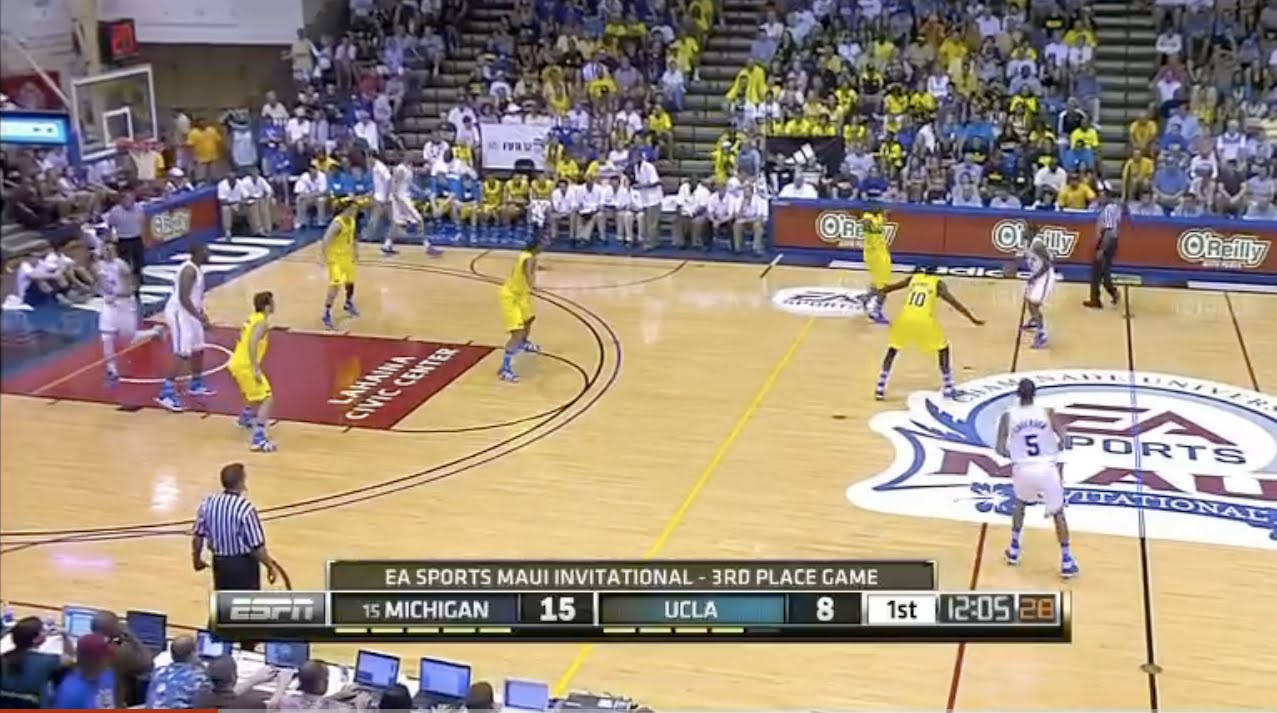
When the ball gets rotated to Jerime Anderson, Novak and Hardaway get another soft trap to prevent dribble penetration while Douglas rotates over to the other side of the lane and Akunne drops to protect the lob:
When the ball eventually makes its way to the corner, Akunne, the strong side wing, and Douglas, the baseline defender, trap the ball. Novak, the weakside wing, drops all the way to the rim while the center, Jon Horford, matches up with the opposing big man and Hardaway drops to the foul line to protect the high-post:
Here's the full video of the possession, which ends with what was very nearly a steal:
And here's another example of a possession in the 1-3-1 zone from the Memphis game:
On the offensive end of the floor is where Beilein's coaching style gets so interesting. Michigan has so many different plays and wrinkles off of those plays that they run, but their offense is fairly simple. It starts in a 2-1-2 set, with the two guards up high, a big man at the high-post and two more wing plays in the corners. From there, a play is called and the offense in initiated by one of the guards passing to the strong side wing. In this example, Trey Burke passes the ball to Novak while Douglass and Hardaway are on the weak side of the floor and Horford is at the high-post:
This is when it gets fun.
Out of this set, the Wolverines have a number of different options and reads that they use, but they all center around the idea of cutting hard, off-ball screens and rolls to the rim. In this particular example, Burke clears to the corner after passing the ball to Novak. Horford flashes out to rotate the ball while Douglass sets a screen for Novak at the high-post, and as Novak cuts across the lane using the screen, Horford swings the ball to Hardaway:
Horford than steps over and sets a ball-screen for Hardaway. Since Novak wasn't open on the cut, he and Douglass set a double back-screen for Horford as he rolls off of the Hardaway ball-screen:
The defense is so focused on defending Horford that they lose track of Novak, who is left wide-open on the three point line:
Here is the full play:
The beauty of this play design is that just five minutes of game-time earlier, Michigan ran a similar set that ended up in a wide-open layup for Horford. As Akunne passed the ball to Novak, both he and Douglas, who was the other guard at the top of the offense, cut through:
Novak, instead of swinging the ball, dribbled over to the other side of the floor. Hardaway, who was the opposite side wing, cut through as Douglass came up to receive the pass:
Horford set a ball-screen for Douglass while Novak set a down-screen for Hardaway, who curled through and popped to the top of the key:
As Horford rolled off of the ball-screen, his defender -- Josh Smith -- lost track of him in the confusion, and Hardaway found him for a layup:
Here is the full play:
The majority of Beilein's sets start with the guards at the top cutting through. Here's a perfect example from the Memphis game, where Novak sets a back screen for Hardaway before receiving a downscreen from Jordan Morgan:
And since Beilein is the king of the counter option, here is Douglass taking advantage of guards anticipating his cut through the lane and using a flare screen from Evan Smotrcyz:
John Beilein is the ultimate tactician when it comes to designing plays at the college level, and this is just a fraction of the playbook that he has given his Michigan team. When his offense is run correctly, it truly is a pleasure to watch.
Continue reading...
Tuesday, November 29, 2011
Breaking Down: The John Beilein 'System' |

Monday, October 12, 2009
John Beilein coaches track |
To be a college basketball player, you have to be in excellent shape. Between the constant running on the offensive end to the toll that playing tough defenses takes on your legs, it isn't hard to understand why coaches hate when their players show up to the start of practice in something other than peak physical condition.
But have you ever wondered what these guys do to get into such great shape?
AnnArbor.com gives us a little insight, at least into what John Beilein has his Michigan team doing:
The players run two miles in shorter intervals. They run sets of two 400-meter runs, two 200-meter runs and two 100-meter runs twice. That’s it. In between are breaks of varying lengths, although Beilein has structured it similar to breaks players would receive in basketball games.And those are just the pre-season workouts.
Some breaks are 30 seconds, equivalent to a short timeout. Others are longer, equivalent to a TV timeout. And others are 10 to 15 seconds, just long enough that a player would be at the free throw line or going in for a substitution.
Pretty intense, no?
And remember, this is for a team that doesn't play at the pace of, say, a Washington or a North Carolina. Imagine what those kids have to do to get into shape.
Continue reading...
Saturday, December 6, 2008
John Beilein: Where's the Love? |
 Question: Who are the top five coaches in college basketball? Depending on who you ask, I'm sure you are going to get a lot of Roy Williams and Coach K's; Jim Calhouns and Jim Boeheims; Tom Izzos and Bo Ryans; probably some Rick Barnes's, Billy Donovans, Ben Howlands and Coach Cal's as well.
How many people would put John Beilein on that list? Not many.
Well, maybe its about time people started mentioning him. Beilein's Michigan Wolverines knocked off their second top 10 team of the season on Saturday when they beat Duke 81-73. They also beat UCLA in the semi-finals of the pre-season NIT. I don't think any team in the country can boast two wins that impressive. Maybe North Carolina, with wins over Michigan State and Notre Dame.
Yes, this is the same Michigan team that lost 22 games last year and hasn't been to the NCAA Tournament since '98 (the Ed Martin scandal and fallout had a lot to do with that) after making three Final Fours in five years from '89 to '93.
And no, its not the first time Beilein has turned a program around. He coached at LeMoyne from '83-'92, where he took a failing program and made them perennial contenders.  He then moved on to Canisius, where he reached the postseason in his last three years (and an NCAA tourney berth in 1996). His next stop was Richmond, where he made two NIT's (reaching the quarters one year) and one NCAA tourney (where the Spiders knocked off South Carolina in the first round). His last stop before Michigan was at West Virginia. There, he made back-to-back NCAA tournaments (reaching the Elite 8 and the Sweet 16) and the next year won 27 games and made the NIT despite losing 80% of their scoring (ironically, his first three D1 stops lasted five years, so in 2012, Penn State and St. John's should drop him a line).
So why is Beilein consistently over-looked? For one, a few Sweet 16 and Elite 8 trips are great, but he has no Final Fours, let alone a national title. But to his credit, his MO is to take over a struggling program, revive it, and then head somewhere else (I don't know if that was his plan exactly, as every job change was a move to a bigger program, and leaving West Virginia coincided with his son's graduation). Building a national champ isn't easy, especially when you are starting with a 10-22 team.
Another reason is that he earned the label "system coach". He has always and will always run his back door motion offense and his 1-3-1 zone defense. It is kind of unfair that he gets this rap when the fact of the matter is, damn near every coach is a system coach. Coach Cal runs his dribble drive motion. Roy Williams wants fast breaks and secondary breaks. John Thompson III has his princeton offense. If they get a couple extremely talented guys that don't really fit their system, they'll tweak it a little bit to help the player fit. But Beilein can do the same thing. Manny Harris (did you know his real name is Corperryale?) and DeShawn Sims aren't exactly Mike Gansey and Kevin Pittsnoggle. They are similar, but both Harris and Sims are much more adept at getting to the rim than Gansey and Pittsnoggle, while the latter two were better spot up shooters. So this year, Beilein is allowing Harris and Sims more leash when it comes to creating within the offense. Against Duke, both Sims and Harris attacked the rim from the wing off of the first pass, something that never happened when Beilein was at WVU.
The thing with Beilein is that he is so good at finding the right guy to fit into what he wants to do. He doesn't need the top 25 recruits. He doesn't was the freakishly athletic guy with no offensive skills or the uber-talented but self-centered gunner. No matter the position, all Beilein wants is someone that can handle the ball a little bit, is a smart player/good passer/good decision maker, can shoot the lights out, and is willing to buy into what Beilein believes. The only other guy I can think of with as much success as Beilein that recruits strictly for his system (ignoring top prospects) is Bo Ryan at Wisconsin.
When it comes down to it, there are really three qualities a school will look for in a coach. The first is his coaching ability - his knowledge of the x's-and-o's, his ability to game plan, the way he handles a group of kids. The second is his ability to handle the media and portray the university in a good light (why do you think Bob Knight got the axe at Indiana). The third is how he recruits - is he going to be able to get the guys he needs to win. I think Beilein has proven himself in all three.
When ranking coaches, it all depends on what you are grading them on. I don't think there is a better recruiter right now than John Calipari and his Memphis staff. Coach K might be the best with the media - you may hate him, but he always says and does the right thing, and seems like a genuinely good guy that truly cares about his players. And to even be considered for a head job at any of these schools, you have to know basketball inside and out.
But when it comes to running your system and getting the most out of the guys on your roster, is there anyone better than Beilein?
Continue reading...


 Posts
Posts

